
 AS 9100
 SPACE 2009
 AS 9120


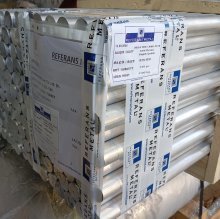


6061
EN 2694 / AlMg1SiCu / 6061 / T62
| Chemical Properties | % Value |
| Silicon (Si) | 0,40 - 0,80 |
| Chromium (Cr) | 0,04 - 0,35 |
| Manganese (Mn) | 0,00 - 0,15 |
| Magnesium (Mg) | 0,80 - 1,20 |
| Copper (Cu) | 0,15 - 0,40 |
| Titanium (Ti) | 0,00 - 0,15 |
| Iron (Fe) | 0,00 - 0,70 |
| Zinc (Zn) | 0,00 - 0,25 |
| Aluminium (Al) | Balance |
| Physical Properties | Value |
| Density | 2,70 g/cm³ |
| Melting Point | 582 °C |
| Thermal Expansion | 23.6 µm/m.°C |
| Modulus of Elasticity | 69 GPa |
| Thermal Conductivity | 167 W/m.K |
| Electrical Resistivity | 43% IACS |
| Mechanical Properties | Value |
| Yield Strength | 270 MPa |
| Ultimate Strength | 320 MPa |
| Shear Strength | 190 MPa |
| Elongation A50 mm | 9% |
| Hardness | 88 HB |
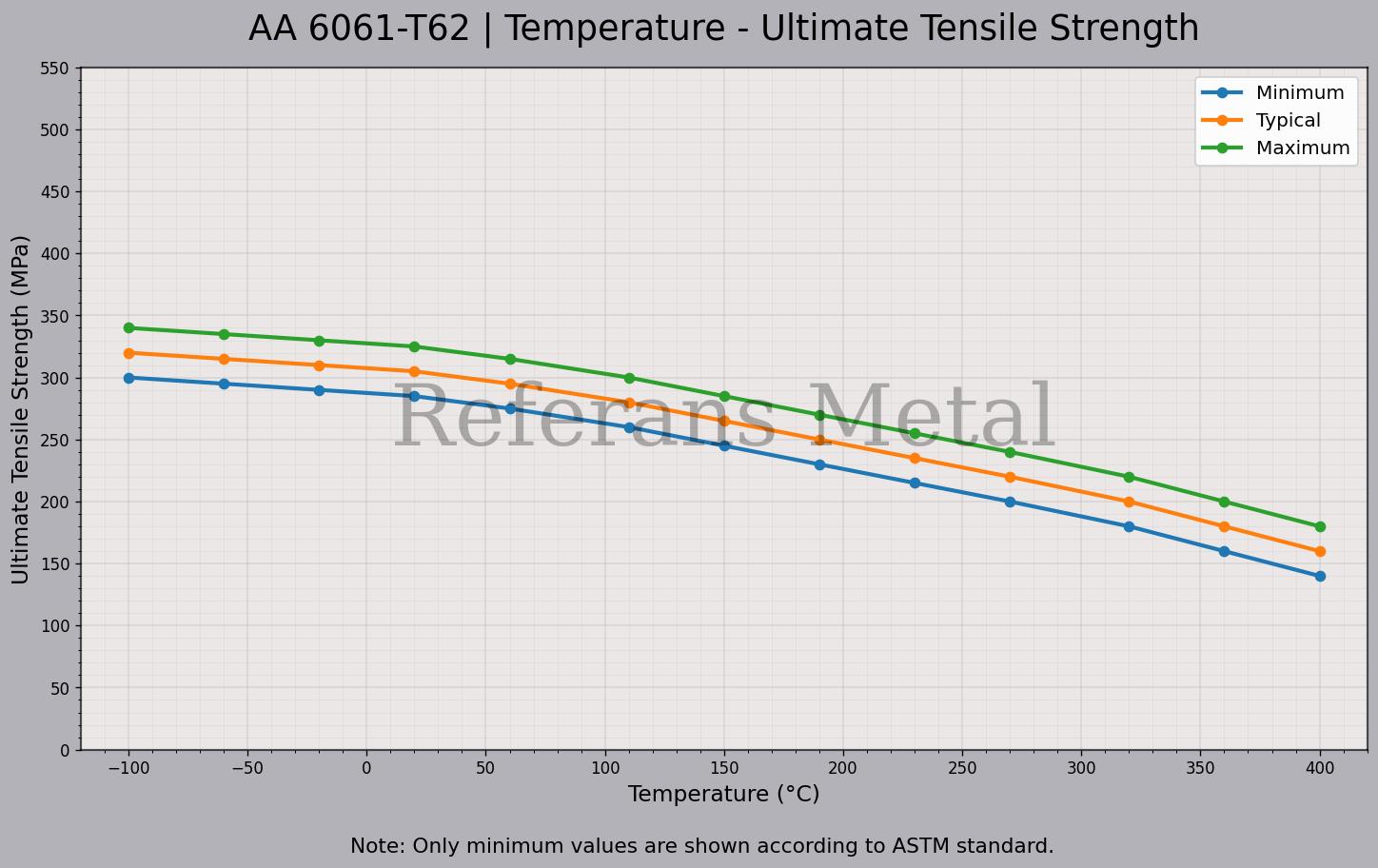
| 6061 T62 Temperature – Ultimate Tensile Strength Graph |
 |
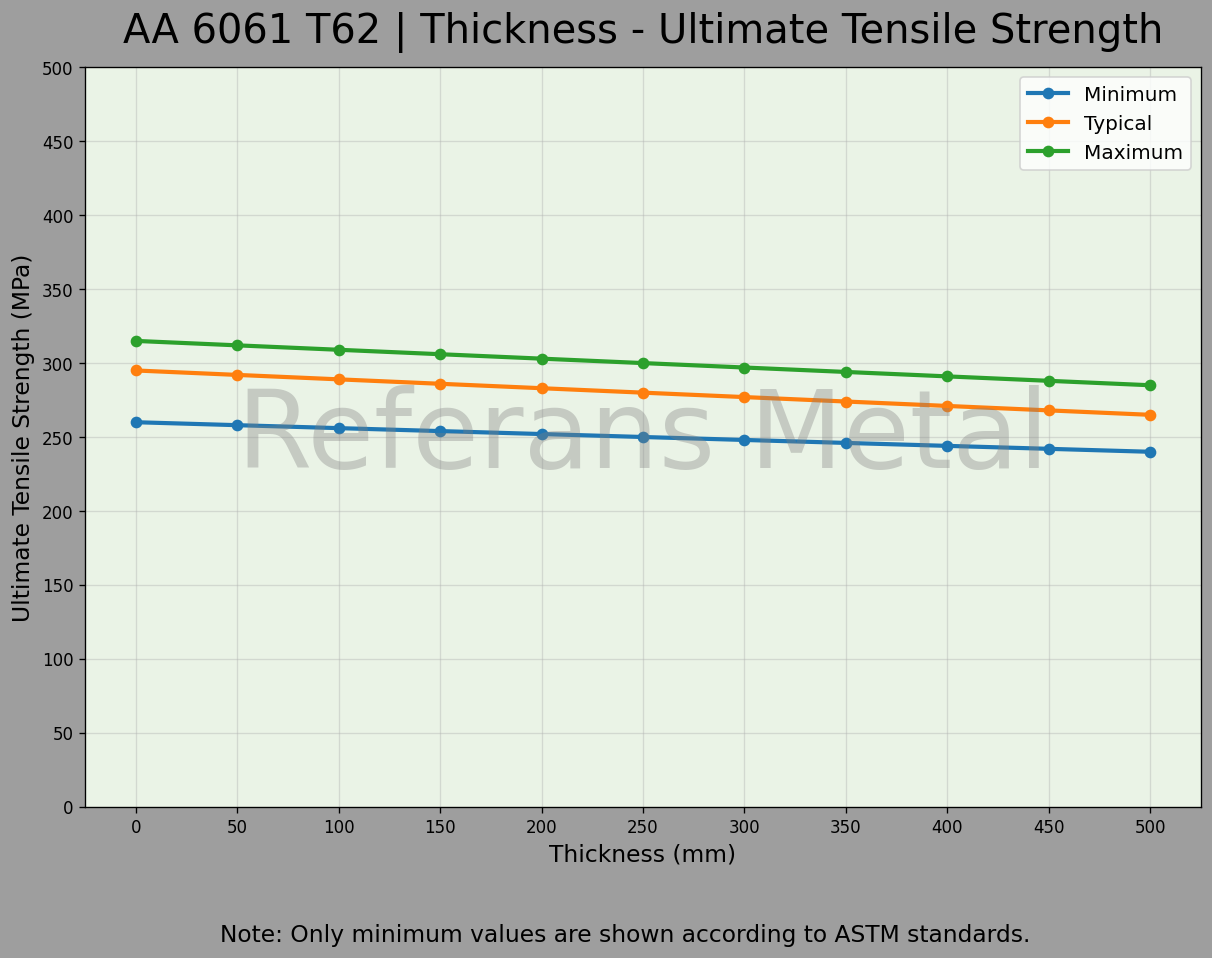
| 6061 T62 Thickness – Ultimate Tensile Strength Graph |
 |
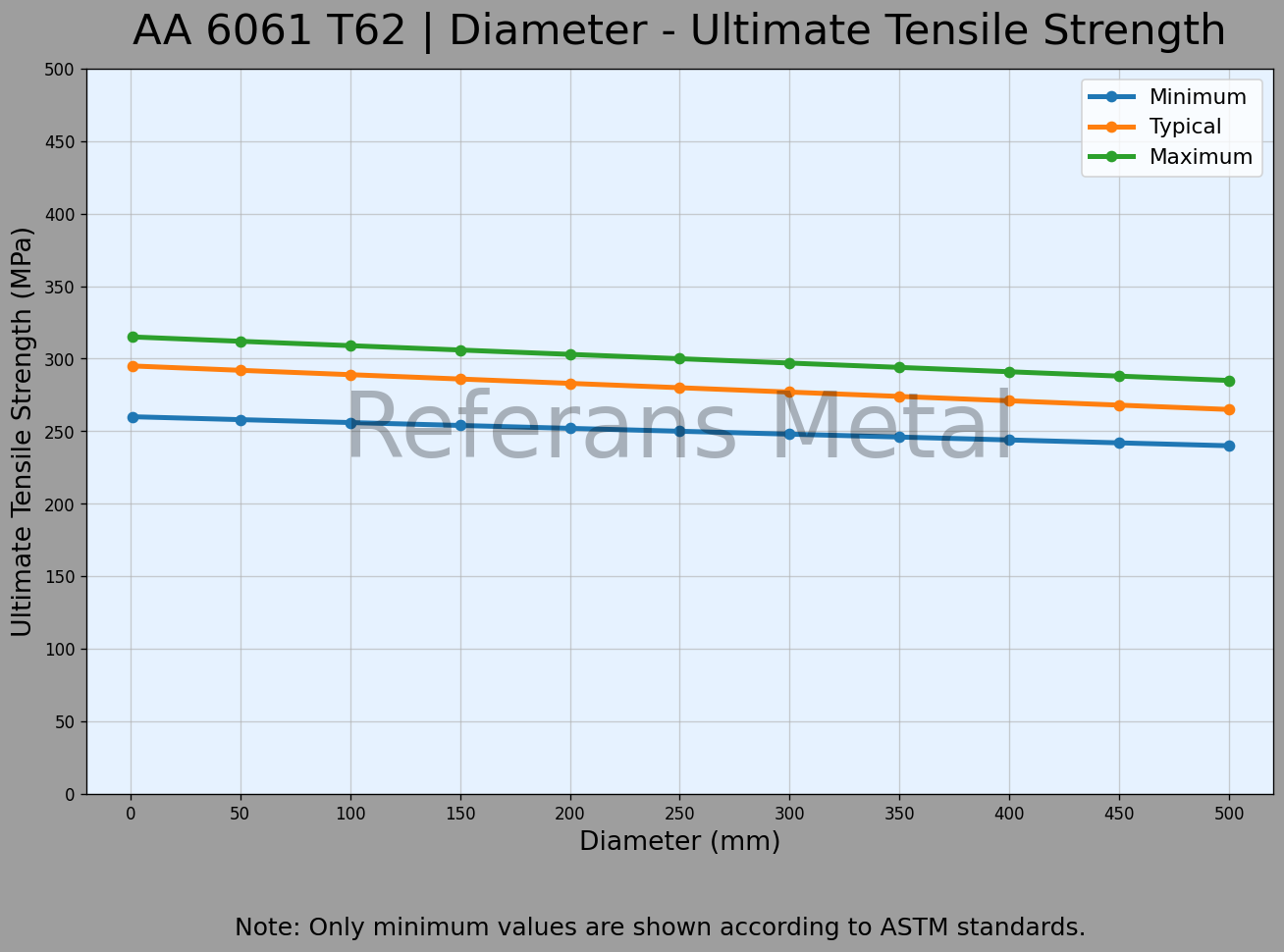
| 6061 T62 Diameter – Ultimate Tensile Strength Graph |
 |
6061 T62 aluminum alloy belongs to the Al-Mg-Si series and is strengthened through precipitation hardening, offering well-balanced mechanical properties. The T62 temper involves solution heat treatment, artificial aging, and controlled deformation. This alloy exhibits excellent corrosion resistance, making it suitable for atmospheric and many chemical environments. It performs well even in marine conditions, which is why it is commonly used in ship components and outdoor structures. Its corrosion resistance is significantly better than 2024 alloy, which has lower resistance.
In terms of strength, 6061 T62 provides medium-to-high strength along with good toughness. Although it has lower strength than 7075 alloy, it offers greater ductility and safer behavior compared to the more brittle nature of 7075. Compared to 5052 alloy, it delivers higher mechanical strength. Therefore, it is widely used in automotive parts, aerospace subcomponents, and machinery. It provides a balanced solution for structural applications where both strength and machinability are required.
Regarding machinability and bending properties, 6061 T62 performs very well. It offers excellent machinability with high surface quality. Its bendability is slightly better than the T6 temper, allowing the production of more complex shapes. While 5083 alloy performs better in bending, 6061 offers broader application versatility. It is widely used in profiles, pipes, and structural components.
In terms of coating and surface treatment, 6061 T62 is highly suitable. It responds well to anodizing processes, making it ideal for decorative and protective coatings. It is also compatible with painting and other surface treatments. It performs well under vibration and dynamic loads, making it suitable for machine frames, bicycle frames, and equipment exposed to vibrations. Compared to 7075, which can be more brittle under vibration, 6061 provides a more balanced response.
In terms of weldability, 6061 T62 offers excellent performance and can be easily welded using TIG/MIG methods. It is much more advantageous than 2024 and 7075 alloys, which can suffer significant strength loss after welding. This makes 6061 indispensable in construction, automotive, defense, and general engineering applications. Common uses include structural frames, bridges, pressure vessels, automotive chassis, and aerospace equipment.
Material Composition Standards
6061 T62 alloys are available according to the following standards:
• 6061 T62 Sheet; EN 2694, UNS A96061, WNR 3.3211, ISO AlMg1SiCu, ASTM B209
• 6061 T62 Plate; EN 2694, UNS A96061, WNR 3.3211, ISO AlMg1SiCu, ASTM B209
Key Properties of 6061 T62 Alloys:
- Strength: Medium
- Machinability: Good
- Weldability: Excellent
- Formability: Normal
- Corrosion Resistance: Very Good
- Heat Treatment: Yes
Common Applications of 6061 T62 Alloys:
High-pressure applications and storage tank connections,
Engine structures and railway carriages,
Aircraft and helicopter parts, including aerospace and aviation sectors.
Stock
We produce and supply 6061 T62 in sheets and plates.
- Plates
- Sheets
| Mechanical Properties | |||
| Thickness (mm) | Yield Strength (Min.) | Ultimate Strength (Min.) | Elongation A50 mm % |
| Over 12.5 up to & incl. 40.00 | 240 | 290 | %8 |
| Over 40.00 up to & incl. 80.00 | 240 | 290 | %6 |
| Over 80.00 up to & incl. 100.00 | 240 | 290 | %5 |
| Over 100.00 up to & incl. 150.00 | 240 | 275 | %5 |
| Over 150.00 up to & incl. 175.00 | 230 | 265 | %5 |
 Weight Calculator