
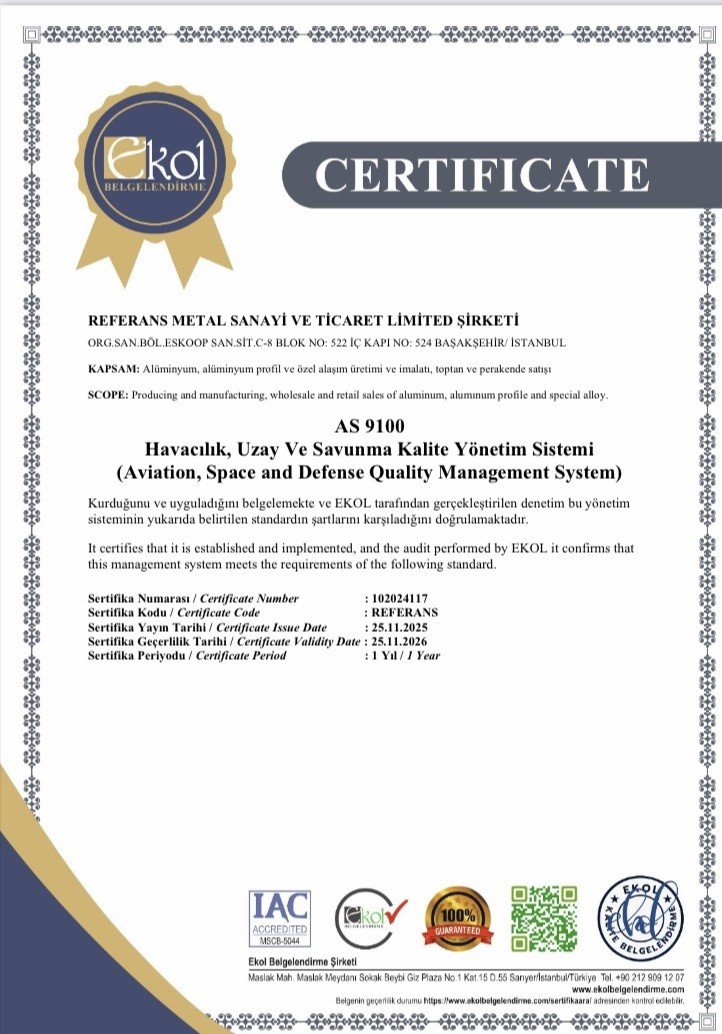
 AS 9100
 SPACE 2009
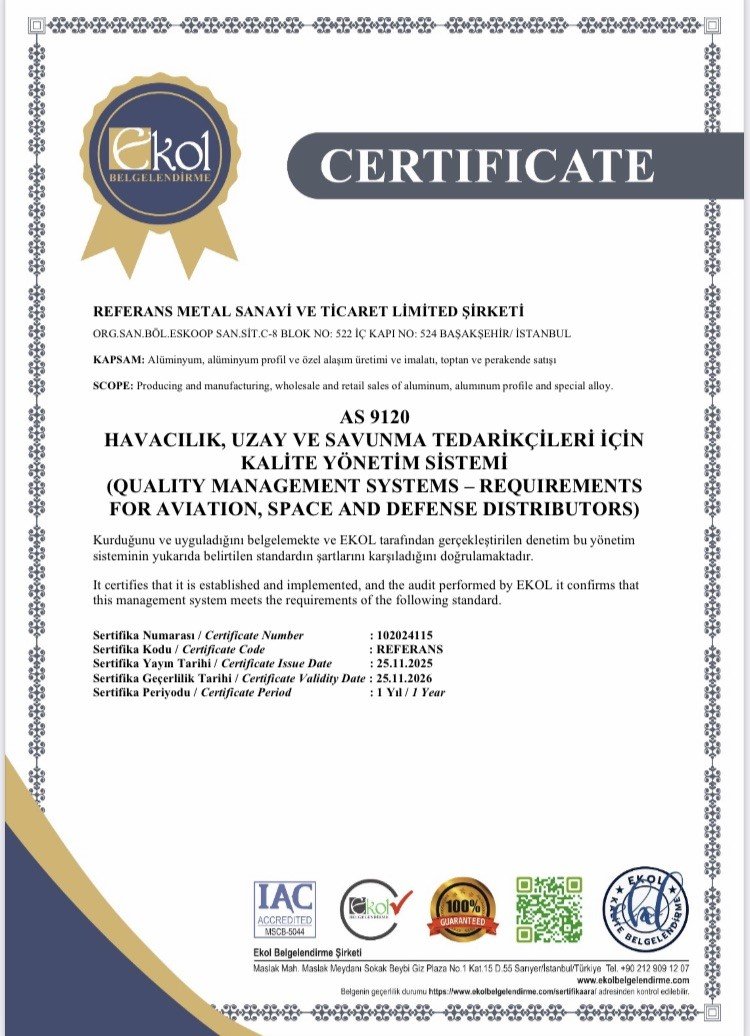 AS 9120




6063
ASTM B429 / AlMg0.7Si / 6063 / T52
| Chemical Properties | % Value |
| Silicon (Si) | 0,20 - 0,60 |
| Chromium (Cr) | 0,00 - 0,10 |
| Manganese (Mn) | 0,00 - 0,10 |
| Magnesium (Mg) | 0,45 - 0,90 |
| Copper (Cu) | 0,00 - 0,10 |
| Titanium (Ti) | 0,00 - 0,10 |
| Iron (Fe) | 0,00 - 0,35 |
| Zinc (Zn) | 0,00 - 0,10 |
| Aluminium (Al) | Balance |
| Physical Properties | Value |
| Density | 2,69 g/cm³ |
| Melting Point | 616 °C |
| Thermal Expansion | 23.4 µm/m.°C |
| Modulus of Elasticity | 69 GPa |
| Thermal Conductivity | 200 W/m.K |
| Electrical Resistivity | 53% IACS |
| Mechanical Properties | Value |
| Yield Strength | 140 MPa |
| Ultimate Strength | 180 MPa |
| Shear Strength | 100 MPa |
| Elongation A50 mm | 8% |
| Hardness | 65 HB |
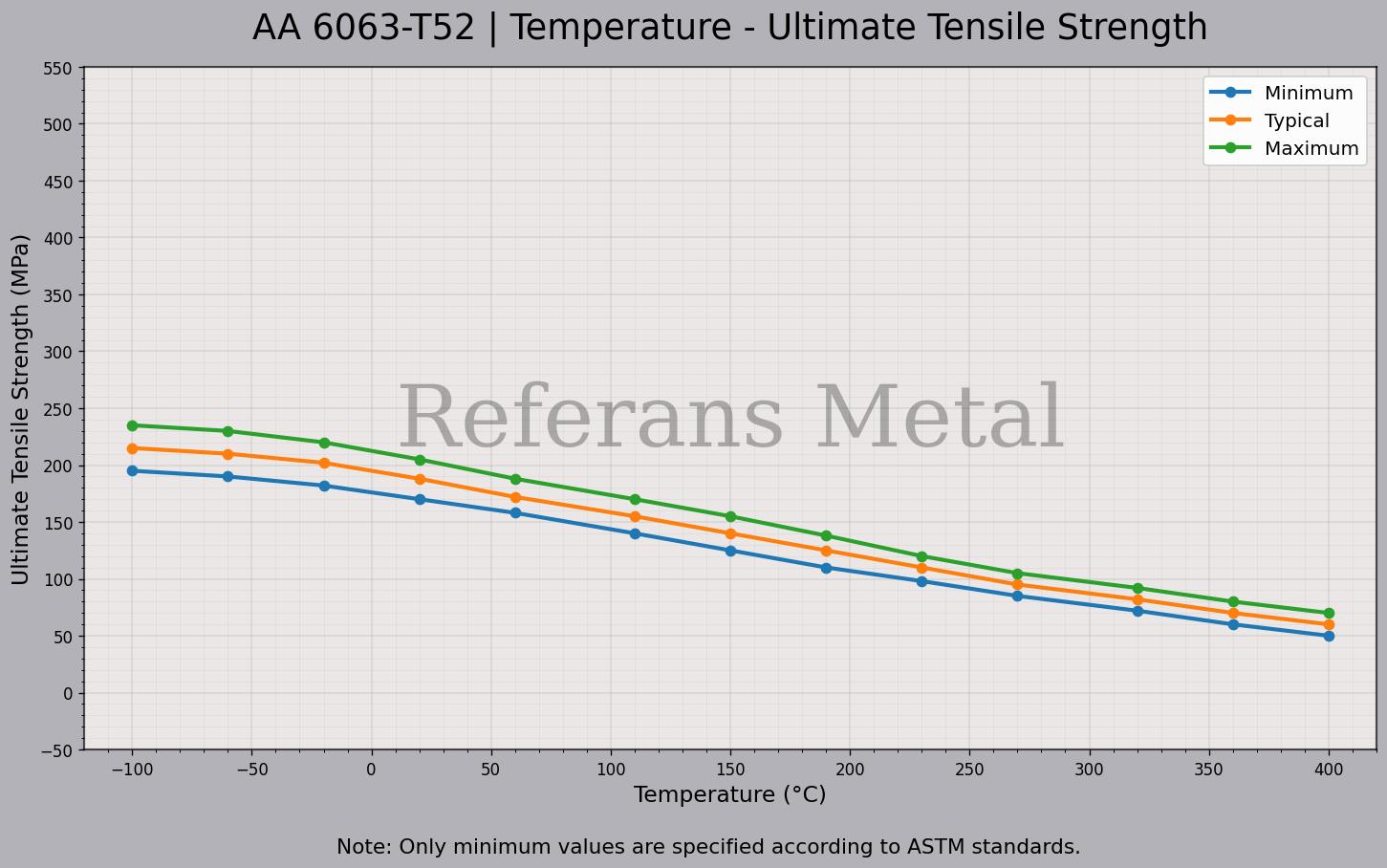
| 6063 T52 Temperature – Ultimate Tensile Strength Graph |
 |
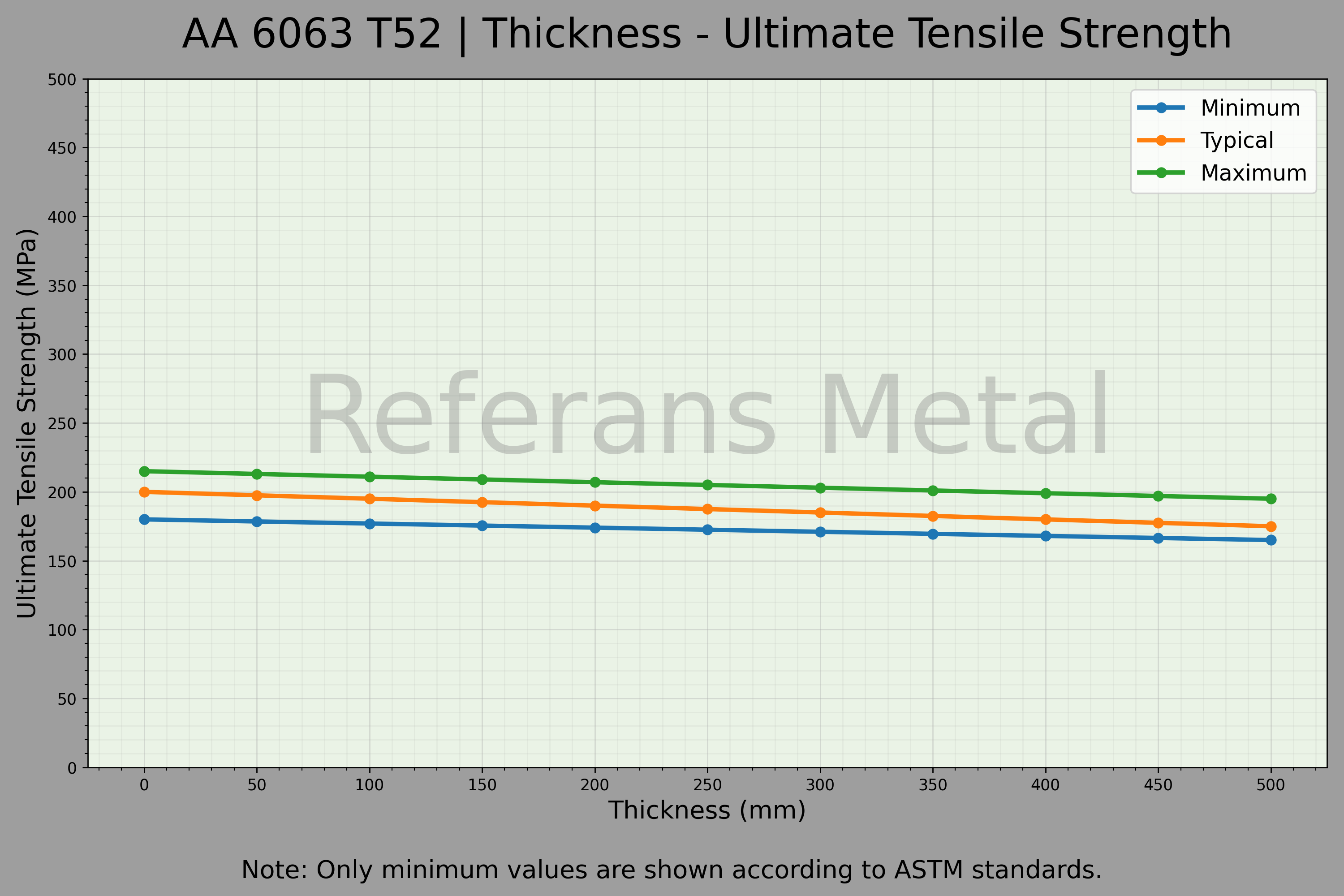
| 6063 T52 Thickness – Ultimate Tensile Strength Graph |
 |
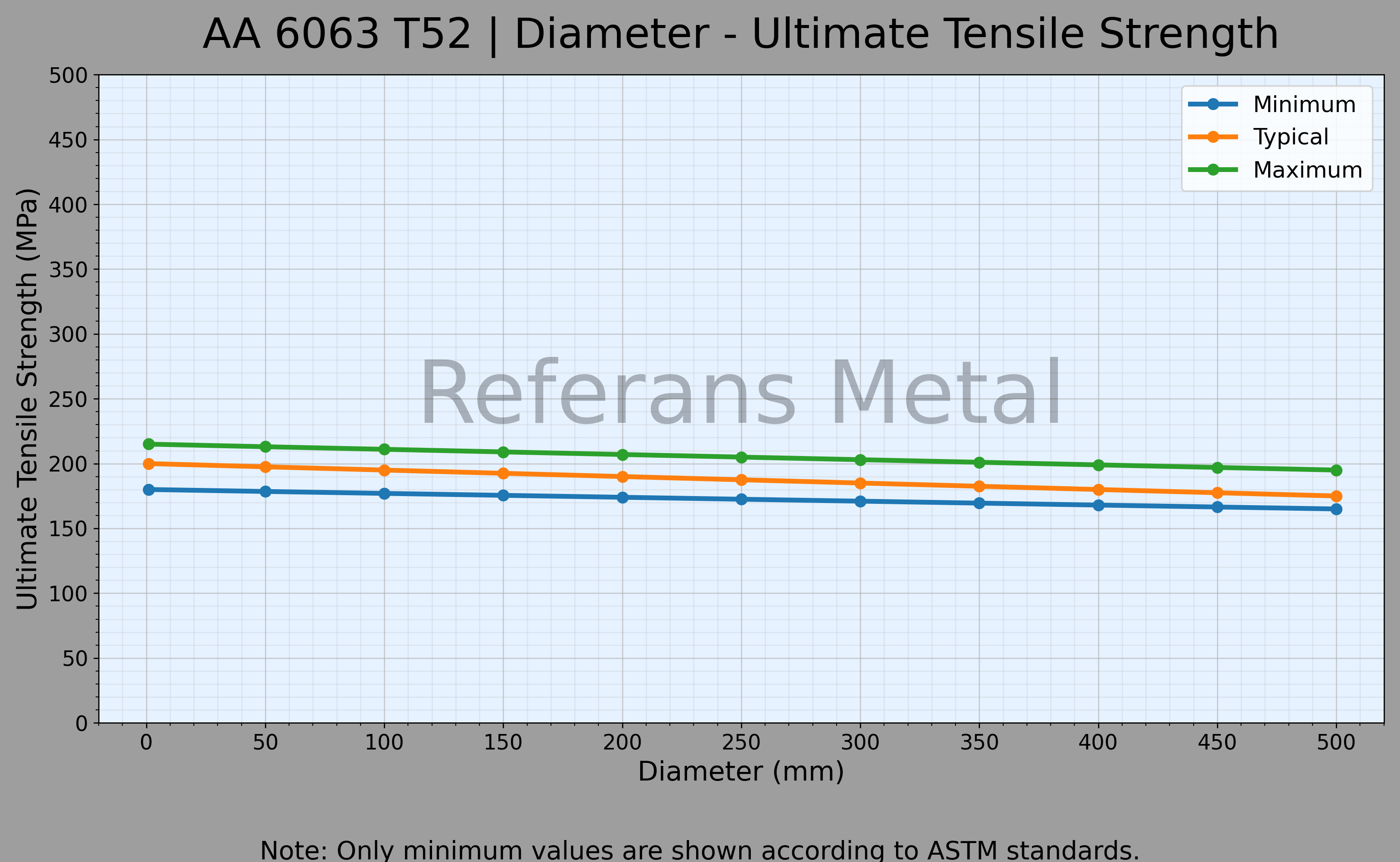
| 6063 T52 Diameter – Ultimate Tensile Strength Graph |
 |
The 6063 T52 aluminum alloy is specifically developed for extrusion applications and stands out with its high surface quality and aesthetic appearance. This alloy offers good corrosion resistance, allowing safe use in both indoor and outdoor environments. Its resistance to atmospheric conditions makes it especially preferred in architectural applications. Additionally, anodizing can further enhance surface protection and decorative appearance.
In terms of strength, the 6063 T52 alloy provides moderate mechanical strength. Compared to the 6061-T6 alloy, it has lower strength but is superior in terms of surface quality and extrusion capability. It also shows lower mechanical strength than the 6082 alloy but offers better formability. Compared to high-strength alloys such as 2024, its strength is lower, but its corrosion resistance is significantly higher.
Machinability and bending properties are among the key advantages of the 6063 T52 alloy. Thanks to its relatively soft structure, it is easy to shape and is particularly preferred in the production of complex profiles. The risk of cracking during bending operations is low. It is more bendable than 6061 and offers significantly better formability compared to high-strength alloys such as 7075. These properties make it possible to produce thin-walled and precise designs.
In terms of coating and surface treatments, 6063 is one of the best-performing alloys in the industry. Extremely smooth and homogeneous surfaces can be achieved during anodizing (anodic oxidation) processes. In this respect, it provides better surface quality than 6061 and 6082 alloys. It is also highly suitable for painting and other coating processes, which expands its decorative and architectural application areas.
Vibration response and weldability properties make this alloy suitable for structural applications. Its vibration damping capability is at a moderate level and provides advantages in lightweight structures. It can be easily joined using MIG and TIG welding methods, and there is no significant loss in mechanical properties after welding. Therefore, it is widely used in the automotive, construction, architectural façade systems, window and door profiles, and furniture industries.
MATERIAL COMPOSITION STANDARDS
6063 T52 is available according to the following standards:
• 6063 T52 Extrusion Round Bar; AMS QQ-A-200/9, ASTM B221, ASTM B429, UNS A96063, DIN AlMgSi0.5
• 6063 T52 Extrusion Flat Bar; AMS QQ-A-200/9, ASTM B221, ASTM B429, UNS A96063, DIN AlMgSi0.5
• 6063 T52 Extrusion Wire; AMS QQ-A-200/9, ASTM B221, ASTM B429, UNS A96063, DIN AlMgSi0.5
Characteristic Properties of 6063 T52:
- Strength: Medium
- Machinability: Good
- Weldability: Very good
- Forming: Medium-high
- Corrosion Resistance: Very good
- Heat Treatment: Yes
Some Common Applications for 6063 T52:
In irrigation channel materials,
In building framework systems and internal connection components,
In doors, stair railings, and many architectural applications.
INVENTORY
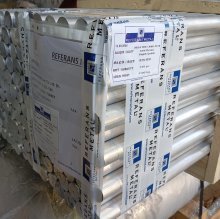
We produce and supply 6063 T52 in rod/bar and tube/profile forms.
- Rod / Bar
- Tube / Profile
 Weight Calculator