• Plates

  • Sheets

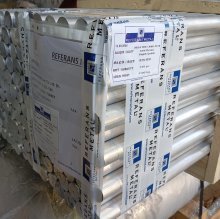
  • Rod/Round Bar/Flat Bar

  • Tube/Extrusions/Profile

5456

ASTM B928 / AlMg5Mn1 / 5456 / H321

Chemical Properties % Value
Silicon (Si)0,00 - 0,25
Chromium (Cr)0,05 - 0,20
Manganese (Mn)0,50 - 1,00
Magnesium (Mg)4,70 - 5,50
Copper (Cu)0,00 - 0,10
Titanium (Ti)0,00 - 0,20
Iron (Fe)0,00 - 0,40
Zinc (Zn)0,00 - 0,25
Aluminium (Al)Balance
Physical Properties Value
Density2,66 g/cm³
Melting Point568 °C
Thermal Expansion22.1 µm/m.°C
Modulus of Elasticity69 GPa
Thermal Conductivity116 W/m.K
Electrical Resistivity%29 IACS
Mechanical Properties Value
Proof Strength260 MPa
Yield Strength352 MPa
Shear Strength210 MPa
Elongation A50 mm%12
Hardness90 HB
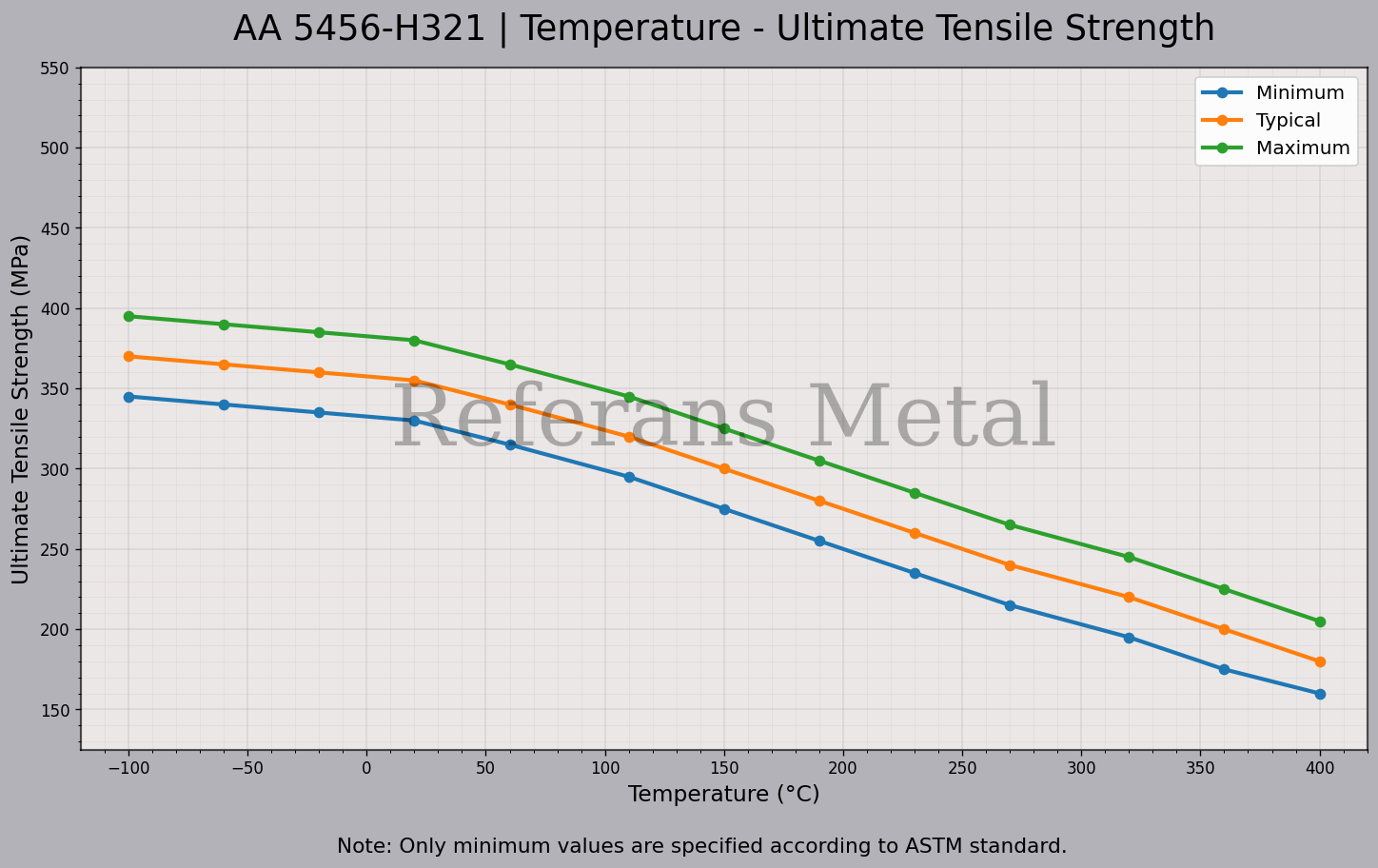
5456 H321 Temperature – Ultimate Tensile Strength Graph
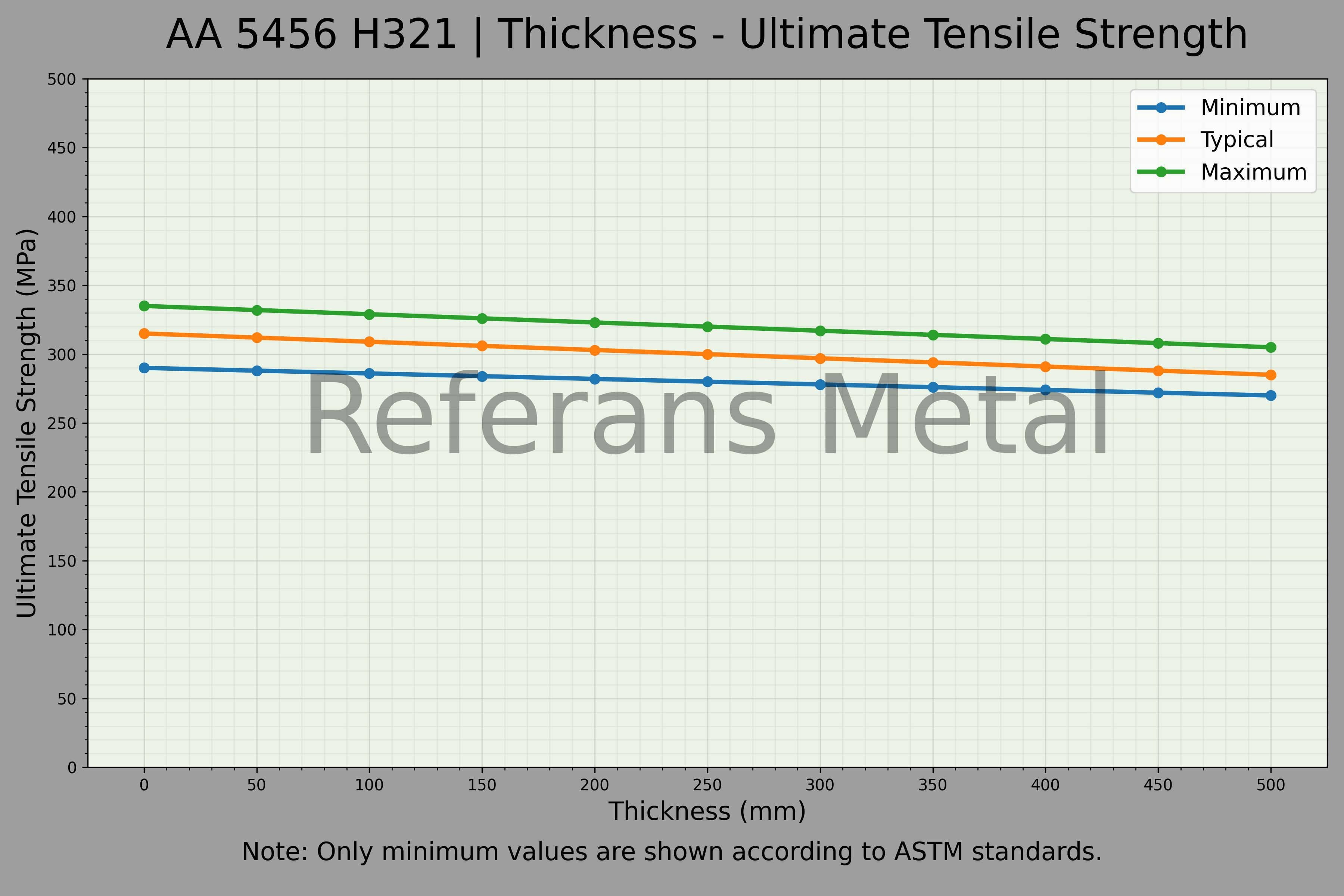
5456 H321 Thickness – Ultimate Tensile Strength Graph
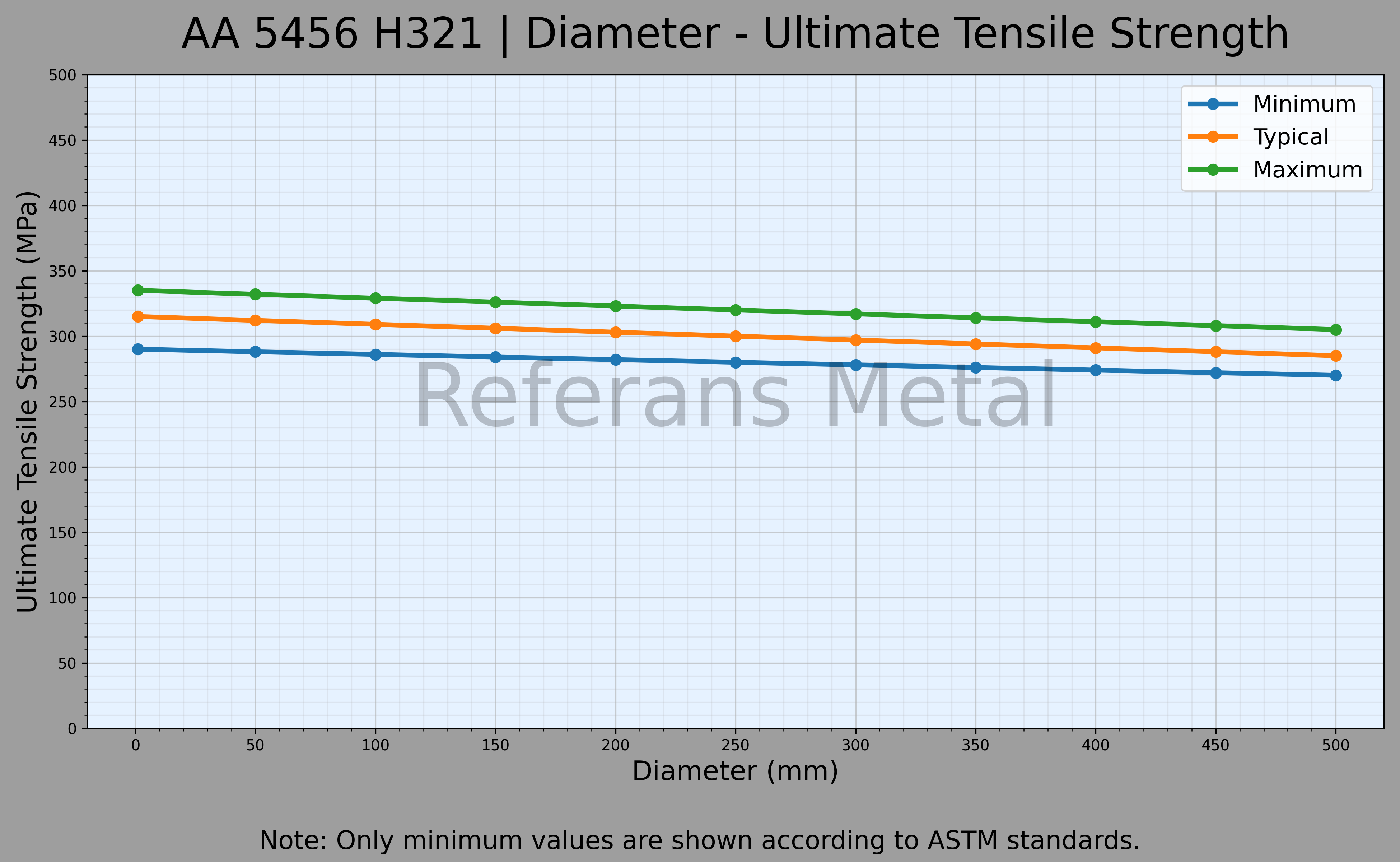
5456 H321 Diameter – Ultimate Tensile Strength Graph
Print

5456 H321 aluminum alloy is a high magnesium (Mg) content alloy belonging to the 5xxx series in a strain-hardened and stabilized temper condition. This alloy stands out with its very high corrosion resistance, high strength, and superior performance in marine environments. The H321 temper provides mechanical stability during long-term use due to stress stabilization. It offers excellent resistance to seawater, saline atmospheres, and aggressive environmental conditions.

In terms of strength, 5456 H321 is among the high-strength alloys within the 5xxx series. Compared to 5083 H116 alloy, it offers similar strength levels and in some cases shows higher strength potential. When compared to 5086 alloy, it provides higher strength. Compared to 6061-T6 alloy, it approaches similar strength levels but offers significantly superior corrosion resistance and weldability.

In terms of machinability, 5456 H321 alloy is moderate; it is not ideal for machining but is suitable for processing in sheet and plate form. Its bending capability is limited and forming operations must be performed carefully due to its high strength. Cold forming is possible but requires higher force and is generally preferred for limited deformation.

In terms of coating capability, 5456 H321 performs well and is suitable for surface treatments such as painting and anodizing. However, in most applications, additional coating is not required due to its natural corrosion resistance. In terms of vibration response, it offers good damping capacity and provides advantages especially under dynamic loads in marine structures.

Its weldability is very high and it can be safely welded using methods such as MIG and TIG. Some strength reductions may occur after welding, but overall performance remains high. The 5456 H321 alloy is widely used in applications such as ship hulls, marine structures, offshore platforms, military applications, and heavy-duty structures requiring high strength. It stands out especially in applications requiring high strength and long service life in marine environments.

MATERIAL COMPOSITION STANDARDS

5456 H321 can be available in the following standards:
• 5456 H321 Sheet; ISO AlMg5Mn1, ASTM B928, ASTM B209, AMS QQ-A-250/9, UNS A95456, MIL-A-19842C
• 5456 H321 Plate; ISO AlMg5Mn1, ASTM B928, ASTM B209, AMS QQ-A-250/9, UNS A95456, MIL-A-19842C


Characteristic Properties for 5456 H321: 

  • Strength: Good
  • Machinability: Poor
  • Weldability: Very Good
  • Formability: Low
  • Corrosion Resistance: Excellent
  • Heat Treatment: None
     

Some Well-Known Applications for 5456 H321: 
Construction of bungalow-type deck houses,
Structural parts for heavy loads,
Also used in water tanks.


STOCK
5456 H321 is produced/supplied in sheet and plate forms.

  • Sheet
  • Plate
DELIVERY: