
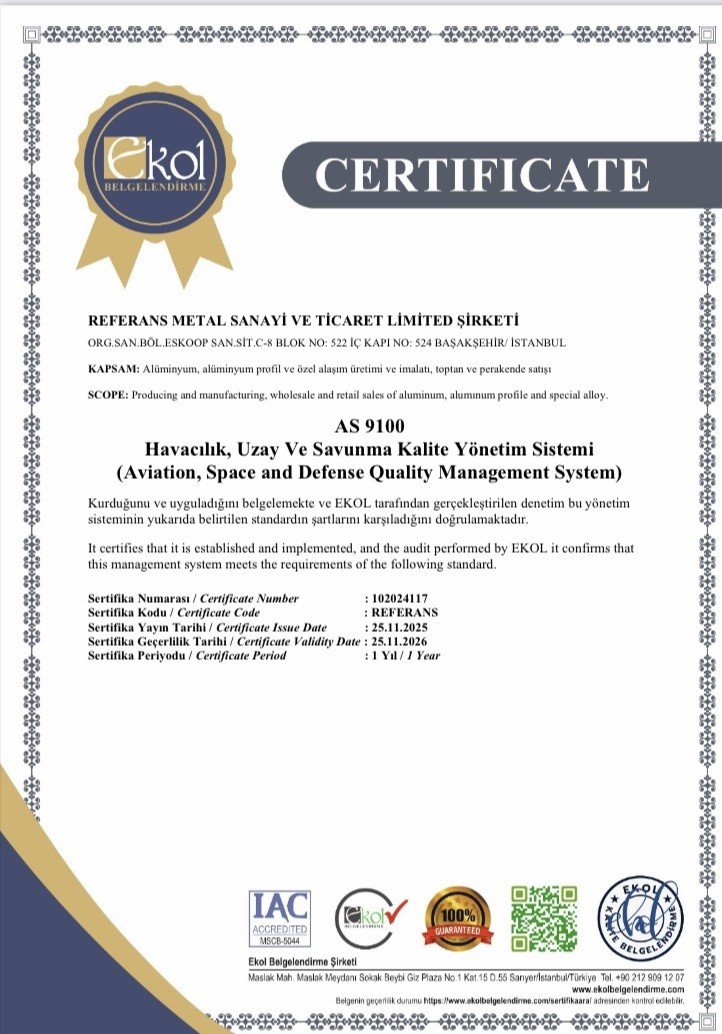
 AS 9100
 SPACE 2009
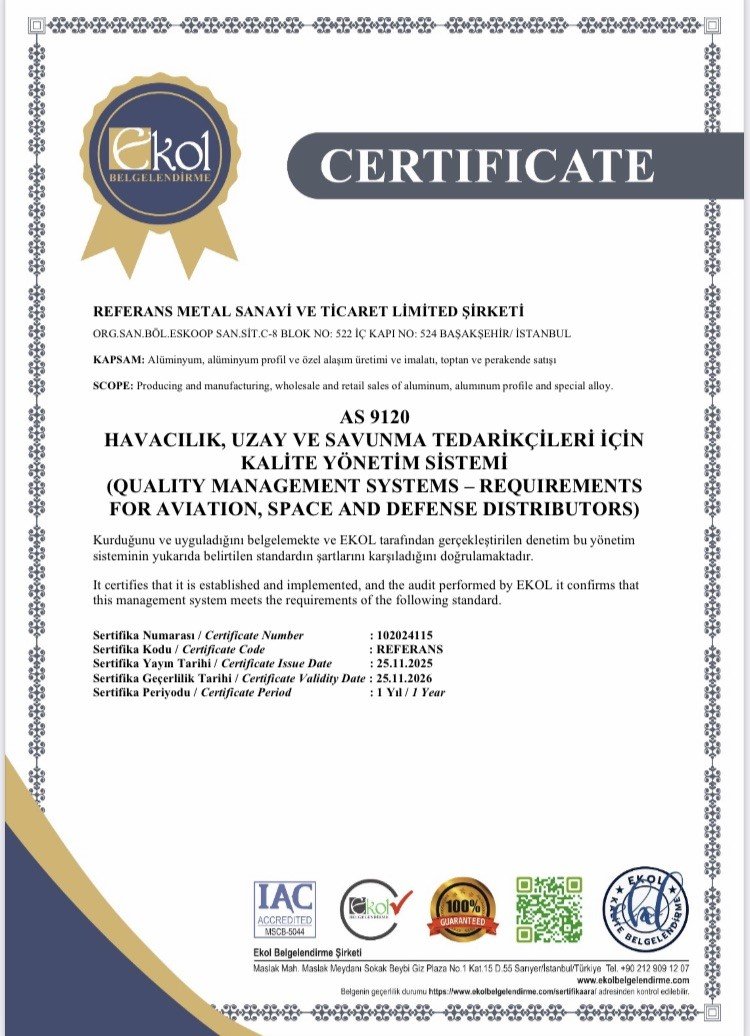 AS 9120




3003
AMS 4006 / AlMn1Cu / 3003 / O
| Chemical Properties | % Value |
| Silicon (Si) | 0,40 - 0,80 |
| Chromium (Cr) | 0,04 - 0,35 |
| Manganese (Mn) | 0,00 - 0,15 |
| Magnesium (Mg) | 0,80 - 1,20 |
| Copper (Cu) | 0,15 - 0,40 |
| Titanium (Ti) | 0,00 - 0,15 |
| Iron (Fe) | 0,00 - 0,70 |
| Zinc (Zn) | 0,00 - 0,25 |
| Aluminium (Al) | Balance |
| Physical Properties | Value |
| Density | 2,70 g/cm³ |
| Melting Point | 582 °C |
| Thermal Expansion | 23.4 x10^-6 /K |
| Modulus of Elasticity | 69 GPa |
| Thermal Conductivity | 170 W/m.K |
| Electrical Resistivity | %43 IACS |
| Mechanical Properties | Value |
| Proof Strength | 310 MPa |
| Yield Strength | 270 MPa |
| Shear Strength | 207 MPa |
| Elongation A50 mm | %15 |
| Hardness | 69 GPa |
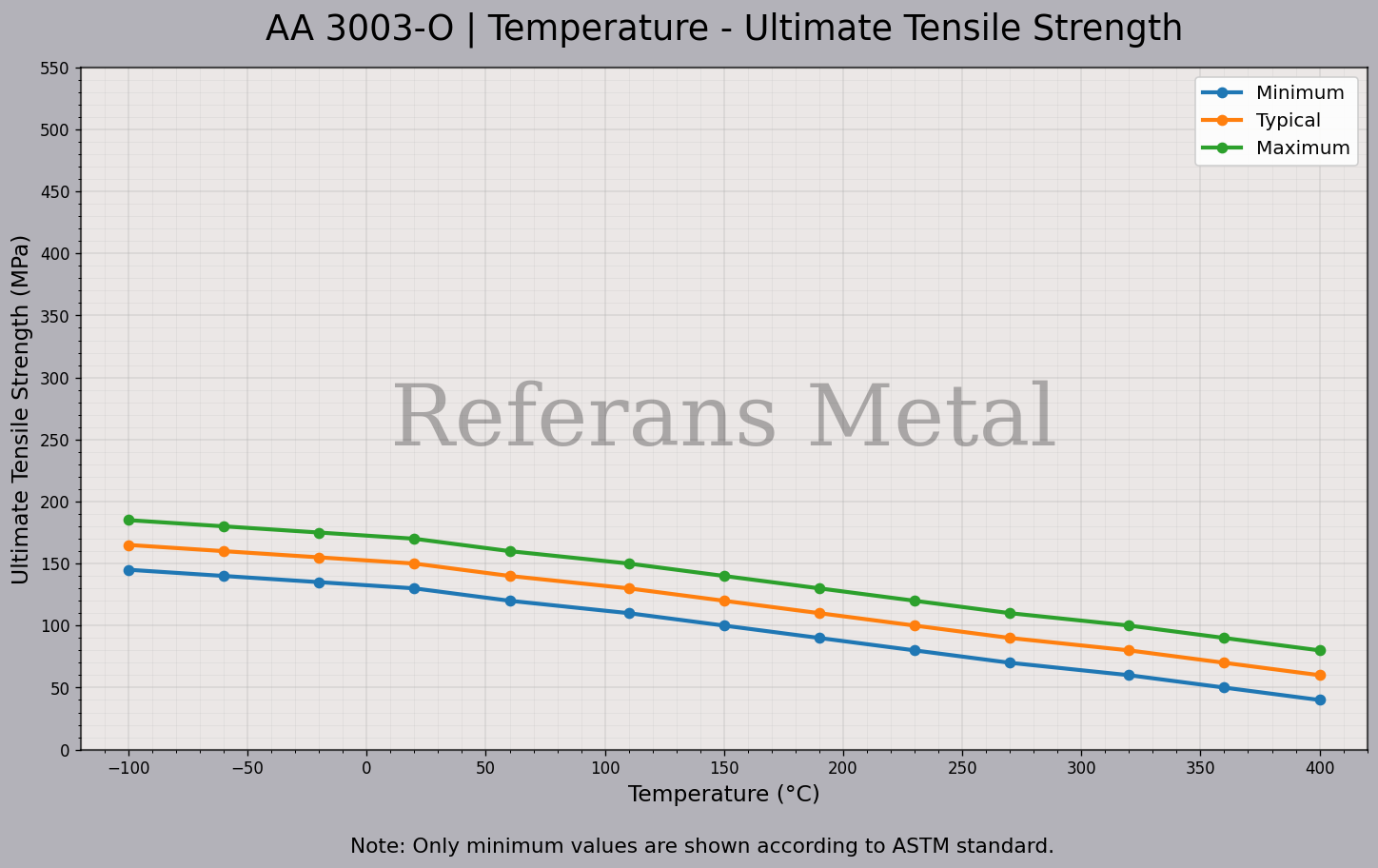
| 3003 O Temperature – Ultimate Tensile Strength Graph |
 |
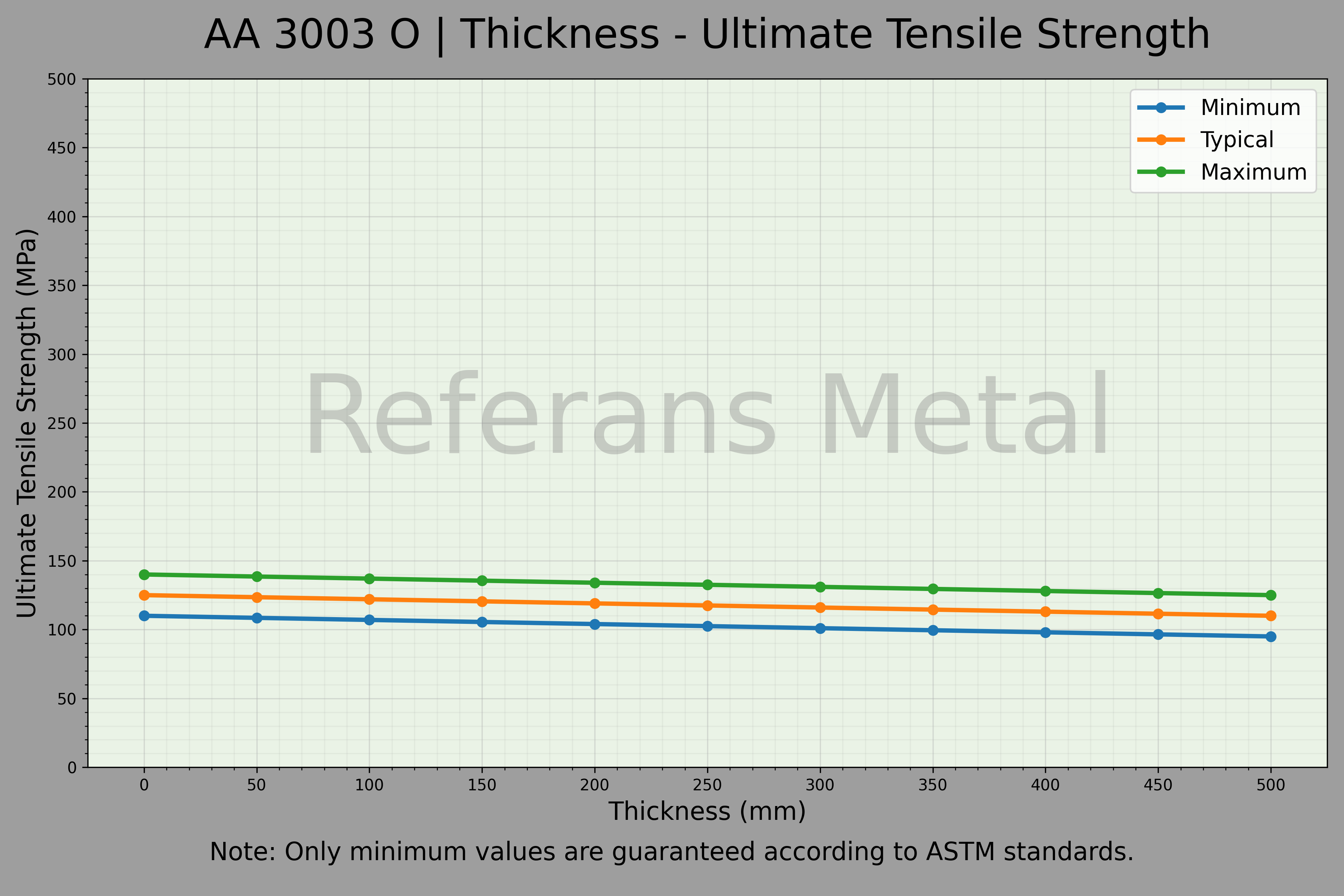
| 3003 O Thickness – Ultimate Tensile Strength Graph |
 |
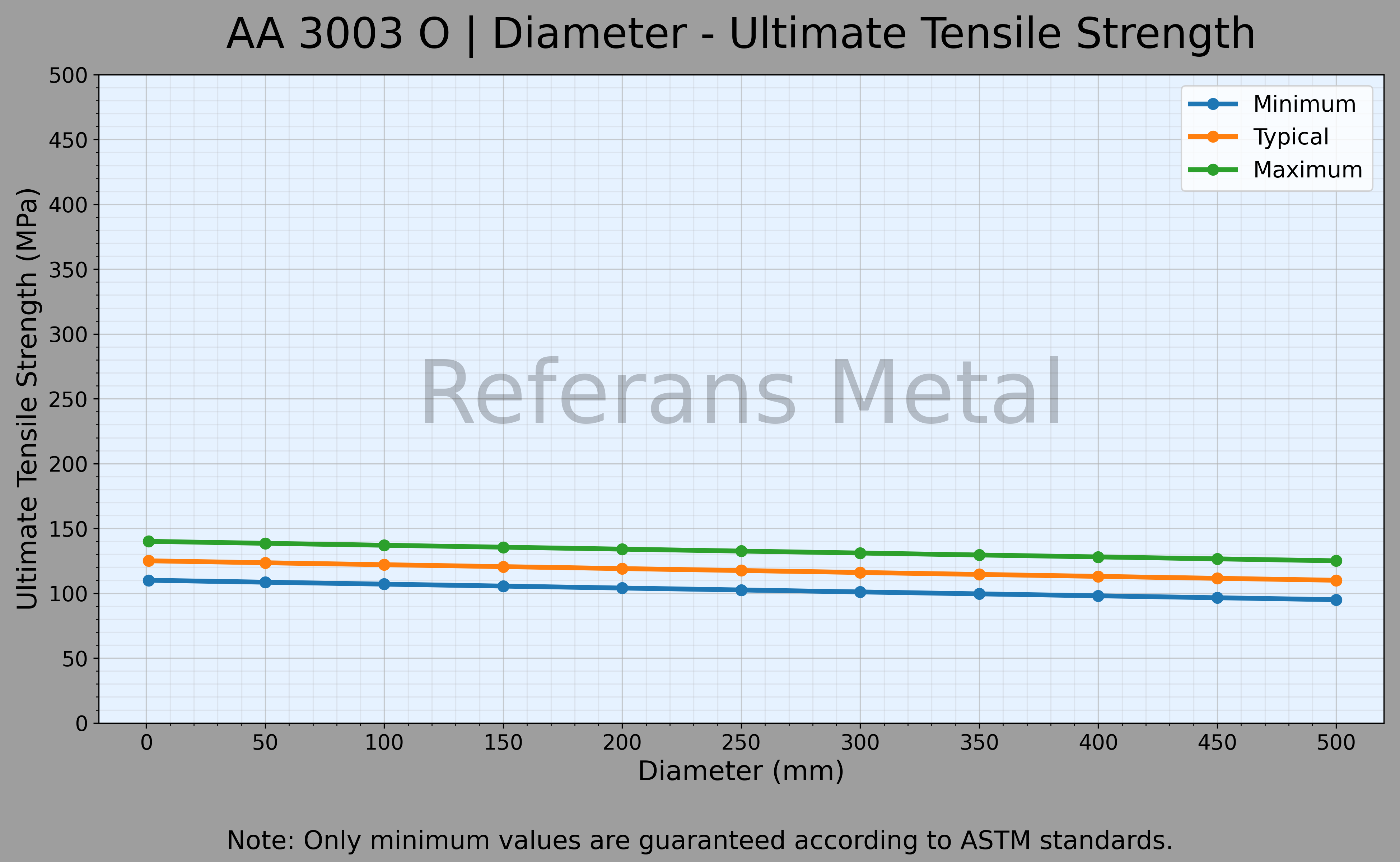
| 3003 O Diameter – Ultimate Tensile Strength Graph |
 |
3003 O aluminum alloy is a manganese (Mn) containing alloy belonging to the 3xxx series and is in a fully annealed temper condition. This condition provides maximum ductility and formability while reducing strength values. The alloy performs very well in terms of corrosion resistance and shows high resistance against atmospheric conditions, humid environments, and mild chemical effects. Therefore, it can be safely used in outdoor applications and chemical equipment.
In terms of strength, 3003 O provides lower strength compared to H tempers of the same alloy but has very high ductility. For example, compared to 3003 H112, it has lower yield and tensile strength but offers much better formability. Compared to 5052-H32, it has lower strength but is easier to form. When compared to 6061-T6, although it is significantly weaker in strength, it provides advantages in forming and surface processing capabilities.
In terms of machinability, 3003 O alloy is moderate; although it is not very suitable for machining, it is very easy to process in sheet and plate form. Its bending capability is excellent, with minimal risk of cracking. Therefore, it is an ideal material for deep drawing, bending, and complex forming processes. Due to its cold forming capability, it is widely preferred in mass production processes.
In terms of coating capability, it performs very well. It is highly suitable for anodizing, painting, and other surface coating processes. This feature provides a significant advantage in applications where aesthetic appearance is important. Additionally, it offers good damping in terms of vibration response, making it suitable for use in vibrating environments and contributing to noise reduction.
Its weldability is very high and it can be easily welded using standard methods such as MIG and TIG. This provides an important advantage in applications such as tanks, heat exchangers, and piping systems. The 3003 O alloy is widely used in many sectors such as HVAC systems, kitchen equipment, food processing facilities, chemical industry, and architectural applications. It stands out especially in applications requiring high formability and corrosion resistance.
MATERIAL COMPOSITION STANDARDS
3003 O is available in the following standards:
• 3003 O Sheet; AMS 4006, AMS QQ-A-250/2, ASTM B209, UNS A93003, AFNOR A-M1, UNE L-3810, UNI 9003/1 DIN AlMnCu, WNR 3.0517, ISO AlMn1Cu
• 3003 O Plate; AMS 4006, AMS QQ-A-250/2, ASTM B209, UNS A93003, AFNOR A-M1, UNE L-3810, UNI 9003/1 DIN AlMnCu, WNR 3.0517, ISO AlMn1Cu
Key Characteristics of 3003 O:
- Strength: Average
- Machinability: Above average
- Weldability: Excellent
- Formability: Good
- Corrosion Resistance: Excellent
- Heat Treatable: No
Well-Known Applications of 3003 O:
Used in the construction of oil tankers,
For internal air conditioning structures,
And in roofing applications within the construction industry.
STOCK
We supply 3003 O in sheet and plate form.
- Sheet
- Plate
 Weight Calculator