
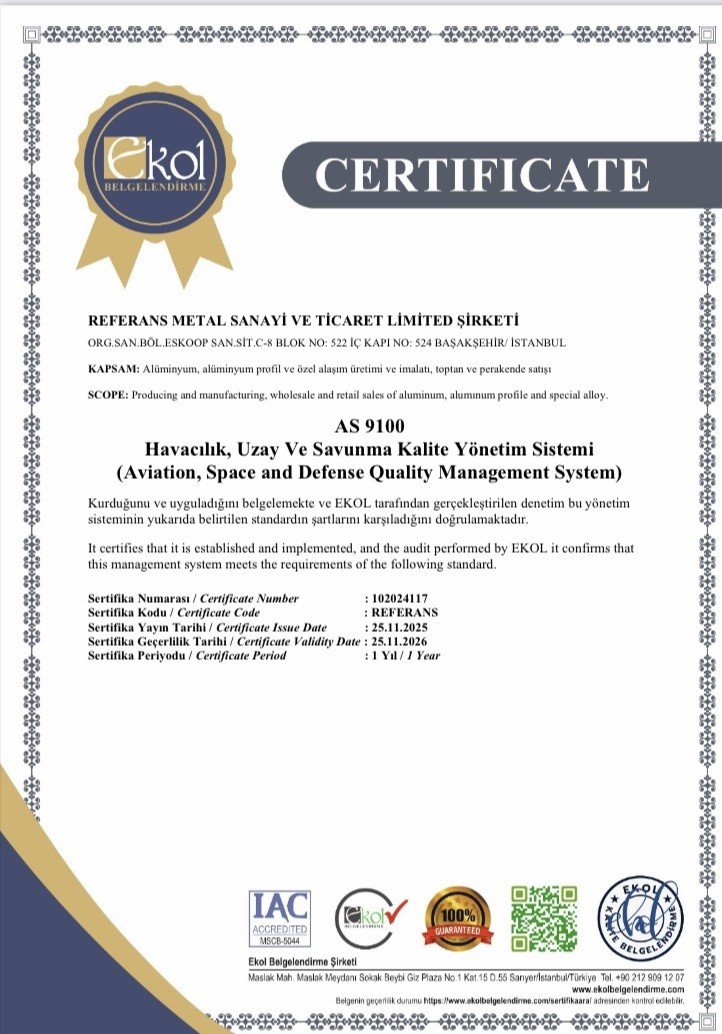
 AS 9100
 SPACE 2009
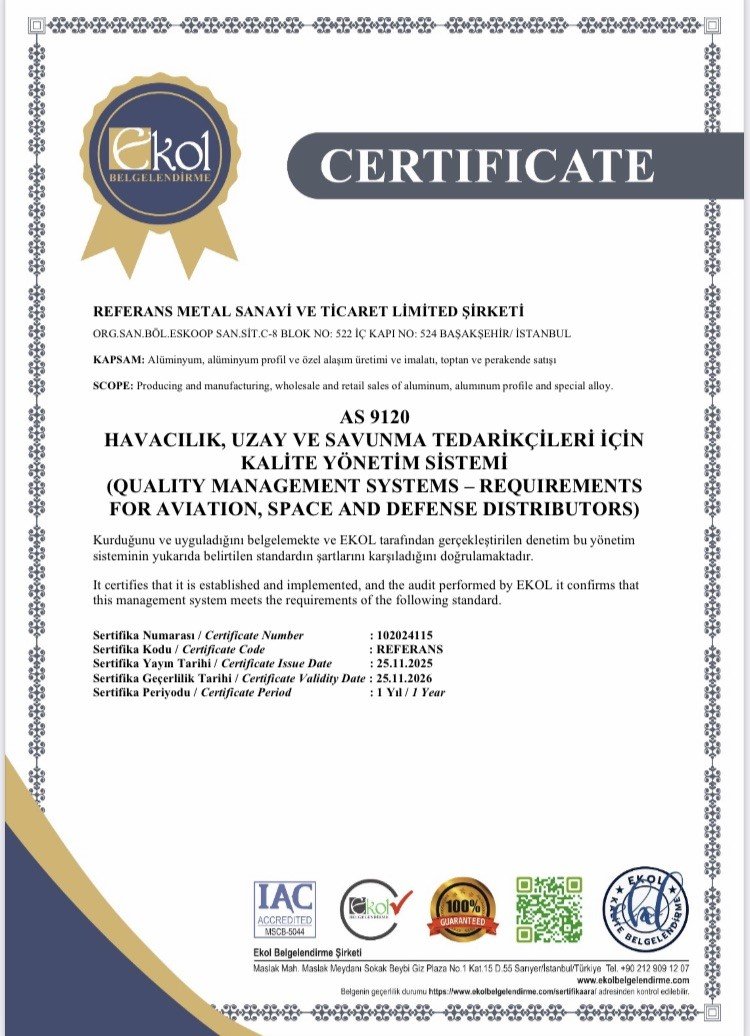 AS 9120




Plates
Sheets
Rod/Round Bar/Flat Bar
Tube/Extrusions/Profile
7076
ASTM B209 / AlZn6Mg / 7076 / T61
| Chemical Properties | % Value |
| Silicon (Si) | 0,00 - 0,40 |
| Chromium (Cr) | 0,18 - 0,28 |
| Manganese (Mn) | 0,00 - 0,30 |
| Magnesium (Mg) | 2,10 - 2,90 |
| Copper (Cu) | 1,20 - 2,00 |
| Titanium (Ti) | 0,00 - 0,20 |
| Iron (Fe) | 0,00 - 0,50 |
| Zinc (Zn) | 5,10 - 6,10 |
| Aluminium (Al) | Balance |
| Physical Properties | Value |
| Density | 2.84 g/cm³ |
| Melting Point | 466°C |
| Thermal Expansion | 23.2 µm/m.°C |
| Modulus of Elasticity | 71 GPa |
| Thermal Conductivity | 160 W/m.K |
| Electrical Resistivity | %33 IACS |
| Mechanical Properties | Value |
| Proof Strength | 470 MPa |
| Yield Strength | 510 MPa |
| Shear Strength | 310 MPa |
| Elongation A50 mm | %14 |
| Hardness | 150 HB |
7076 T61 Aluminum Alloy is a material notable for its high strength, excellent fatigue resistance, and good thermal stability. 7076, a zinc-heavy alloy, is widely used in the aerospace, automotive, and defense industries due to its superior mechanical properties. The T61 temper indicates that the alloy undergoes a solution heat treatment followed by controlled aging to enhance its strength and durability. This makes it suitable for structures and components subjected to heavy loads and harsh operating conditions.
This alloy is commonly used in aircraft structures, automotive chassis, sports equipment, and other high-performance applications. It offers a suitable option for anodizing; forming a protective oxide layer on the surface increases corrosion resistance and provides an aesthetic appearance. However, due to its high zinc content, care may be required during the anodizing process. Its weldability is limited; the high strength can increase the risk of cracking during welding. Therefore, careful processing and appropriate filler material selection are important in welding applications.
7076 T61 aluminum alloy has certain limitations in forming, as its high strength can make complex shaping operations challenging. However, with appropriate techniques, it can be successfully bent and shaped. Thanks to its fatigue resistance and mechanical stability, it performs excellently in high-vibration environments and ensures long-term reliability in components subjected to dynamic loads.
Corrosion resistance is naturally moderate; therefore, for use in aggressive environments, additional surface treatments or coatings are generally recommended. Its advantages include high strength, fatigue resistance, and thermal stability, while its disadvantages include limited weldability, complex forming requirements, and moderate corrosion resistance. These properties make 7076 T61 an ideal material for applications requiring high mechanical durability and performance.
MATERIAL COMPOSITION STANDARDS
7076 T61 can be produced according to the following standards:
• 7076 T61 Sheet / Plate; UNS A97076, ASTM B209
Characteristic Properties of 7076 T61:
- Strength: Excellent
- Machinability: Very Good
- Weldability: Moderate
- Formability: Average
- Corrosion Resistance: Poor
- Heat Treatment: Yes
Common Applications of 7076 T61:
Helicopter rotor blades,
Automotive chassis manufacturing,
High-strength aerospace applications.
STOCK
Available as 7076 T61 sheet.
- Sheet / Plate
| Mechanical Properties | |||
| Thickness (mm) | Proof Strength (Min.) | Yield Strength (Min.) | Elongation A50 mm % |
| Over 0.4 up to & incl. 12.5 | 145 MPa | 275 MPa | %10 |
 Weight Calculator