
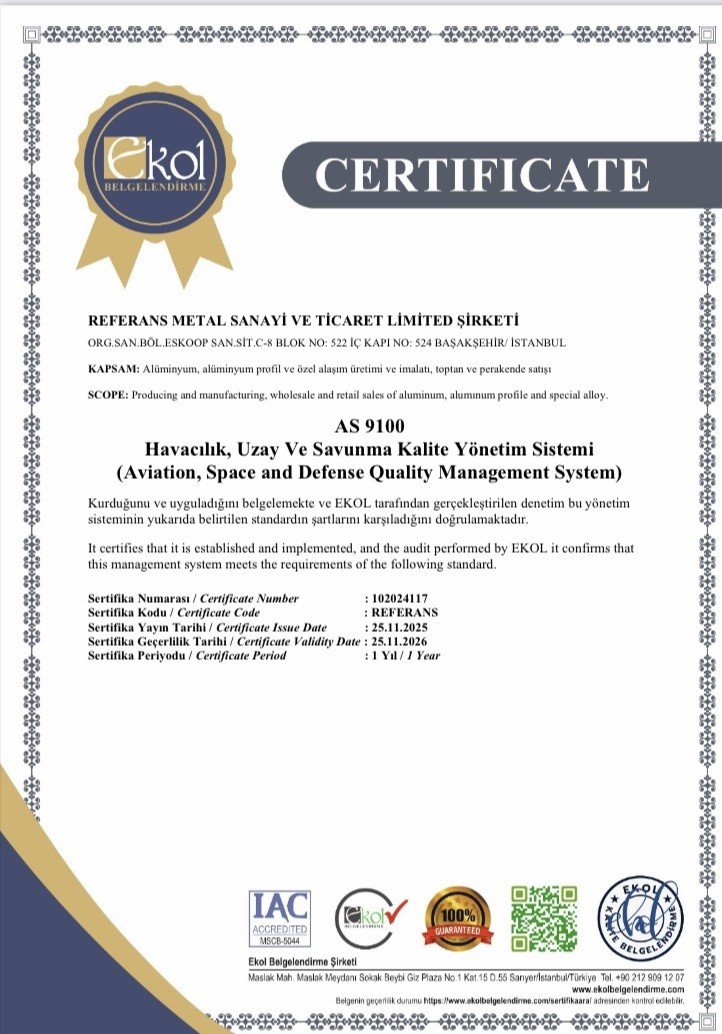
 AS 9100
 SPACE 2009
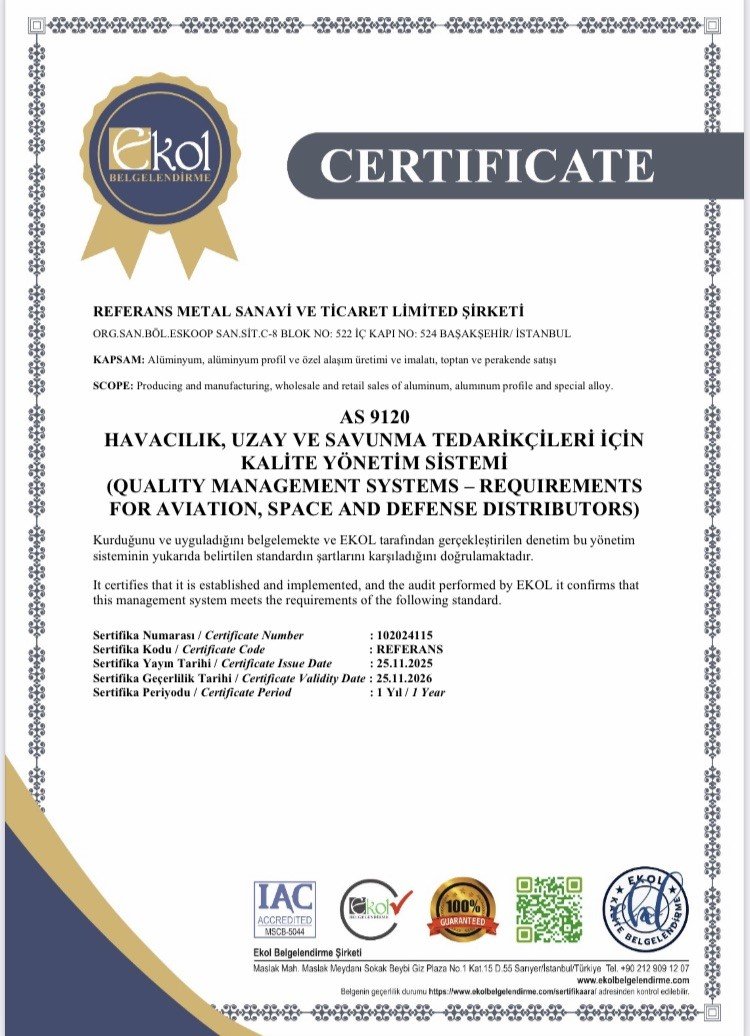 AS 9120


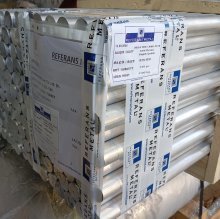

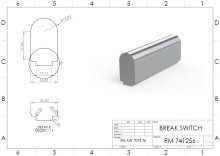

Plates
Sheets
Rod/Round Bar/Flat Bar
Tube/Extrusions/Profile
7075
QQ-A-250/24 / AlZn5.5MgCu / 7075 / T7651
| Chemical Properties | % Value |
| Silicon (Si) | 0,00 - 0,40 |
| Chromium (Cr) | 0,18 - 0,28 |
| Manganese (Mn) | 0,00 - 0,30 |
| Magnesium (Mg) | 2,10 - 2,90 |
| Copper (Cu) | 1,20 - 2,00 |
| Titanium (Ti) | 0,00 - 0,20 |
| Iron (Fe) | 0,00 - 0,50 |
| Zinc (Zn) | 5,10 - 6,10 |
| Aluminium (Al) | Balance |
| Physical Properties | Value |
| Density | 2.81 g/cm³ |
| Melting Point | 480 °C |
| Thermal Expansion | 23 µm/m.°C |
| Modulus of Elasticity | 71 GPa |
| Thermal Conductivity | 150 W/m.K |
| Electrical Resistivity | %33 IACS |
| Mechanical Properties | Value |
| Yield Strength | 470 MPa |
| Ultimate Strength | 550 MPa |
| Shear Strength | 320 MPa |
| Elongation A50 mm | %8 |
| Hardness | 150 HB |
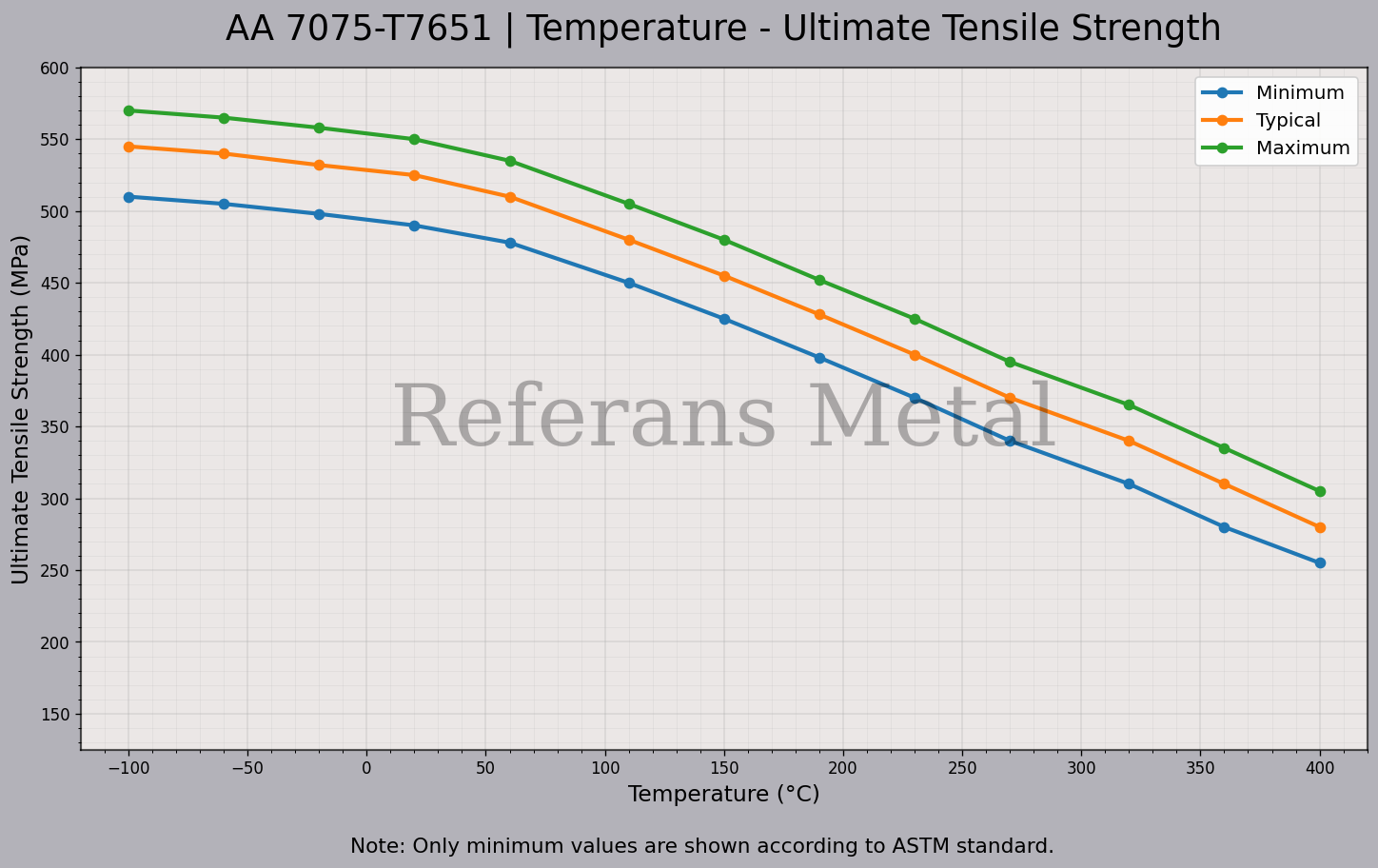
| 7075 T7651 Temperature – Ultimate Tensile Strength Graph |
 |
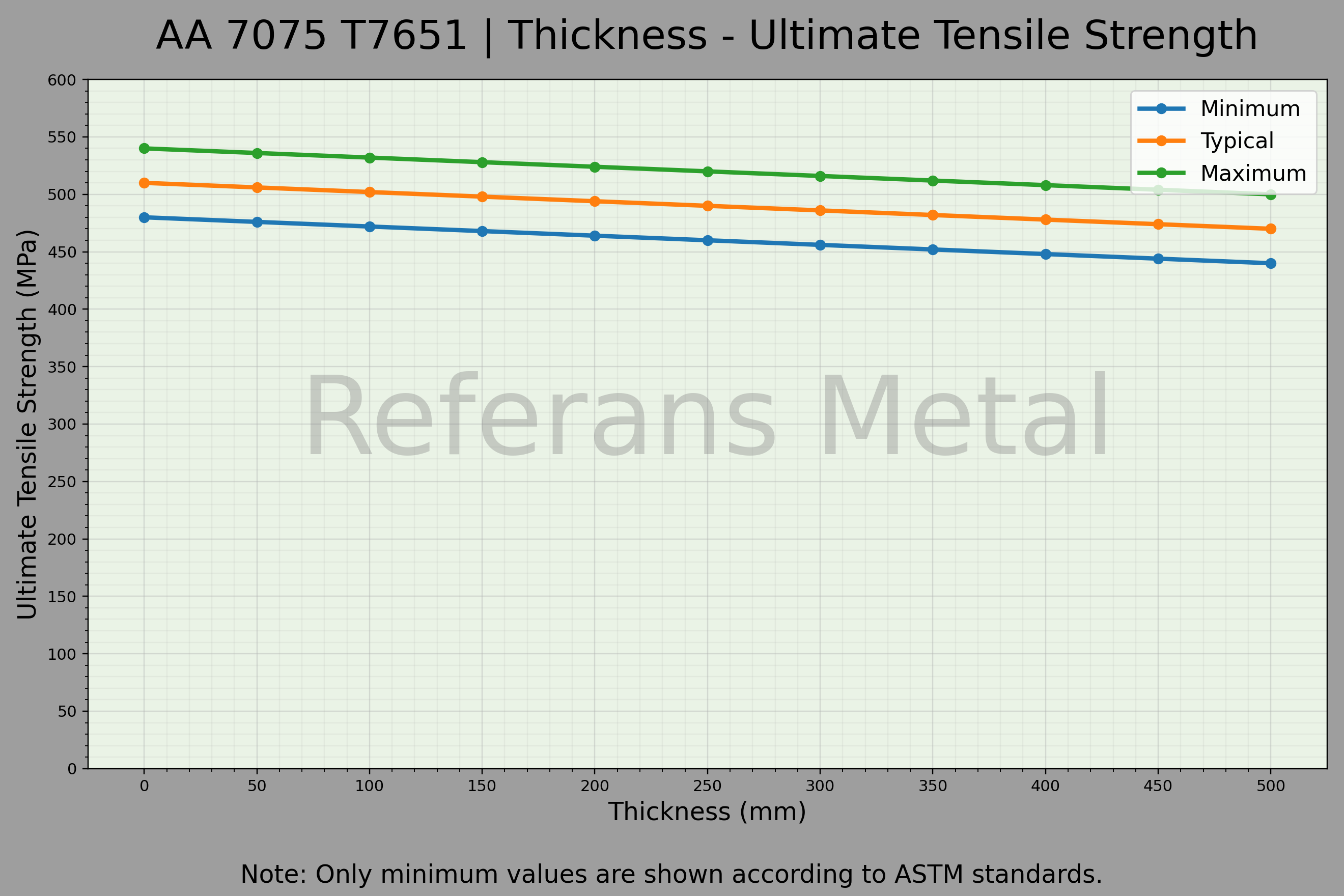
| 7075 T7651 Thickness – Ultimate Tensile Strength Graph |
 |
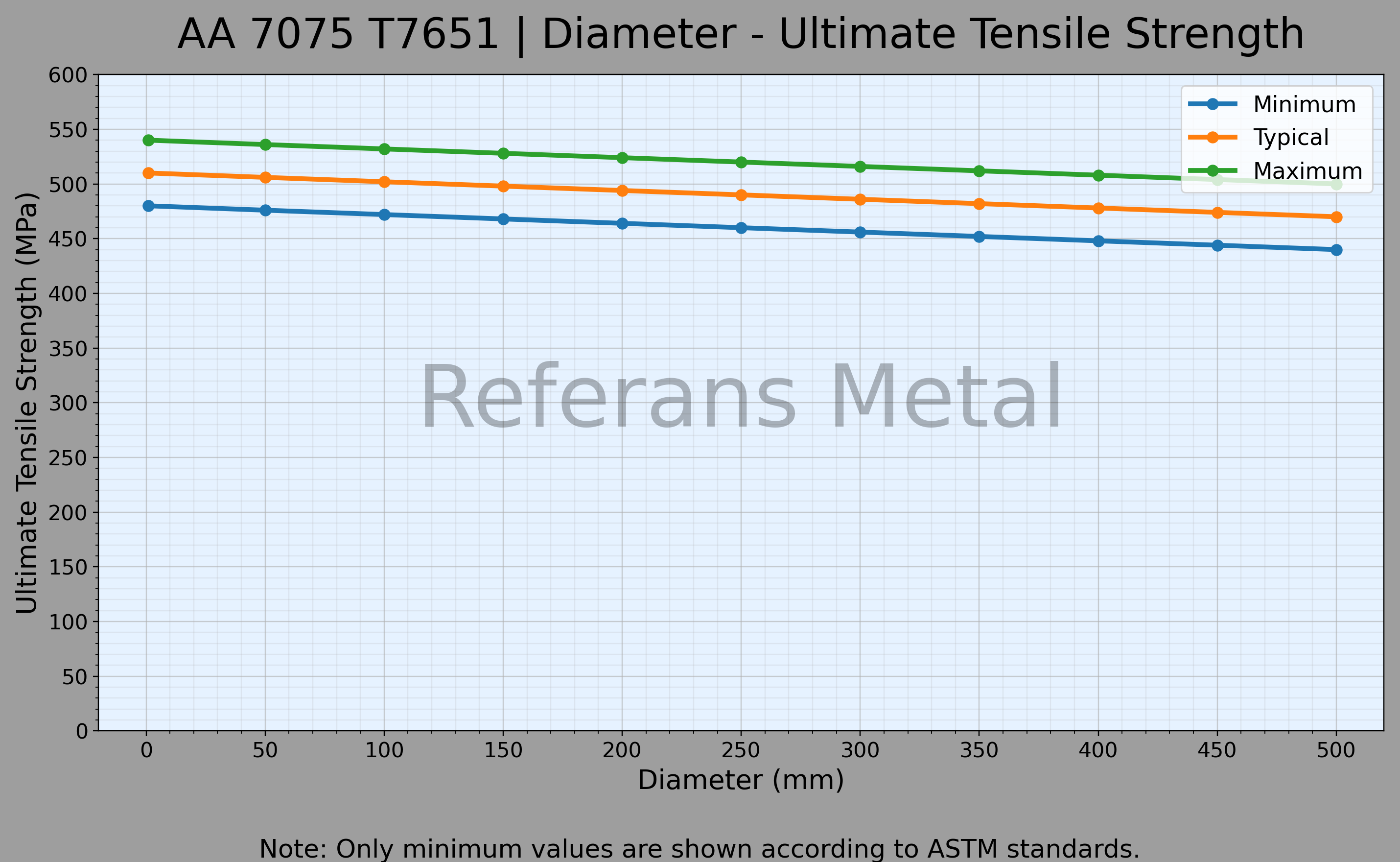
| 7075 T7651 Diameter – Ultimate Tensile Strength Graph |
 |
7075 T7651 aluminum alloy belongs to the Al-Zn-Mg-Cu based 7000 series and represents a temper condition characterized by enhanced resistance to stress corrosion cracking (SCC). The T7651 temper includes solution heat treatment, stress relieving by stretching, and advanced overaging. Compared to T6 and T651, it offers slightly lower strength but significantly improved SCC resistance and structural reliability.
 In terms of corrosion resistance, 7075 T7651 is one of the most SCC-resistant tempers within the 7075 family. It provides much better resistance to stress corrosion cracking than 7075-T6 and T651. However, its general corrosion resistance is still lower than that of 6000 series alloys. Therefore, anodizing or protective coatings are recommended in aggressive environments.
Regarding strength and mechanical properties, 7075 T7651 still provides high strength, although slightly lower than T6 and T7351 tempers. In return, toughness and resistance to crack propagation are significantly improved. Compared to 7050 alloy, it offers similar strength levels, while SCC resistance is generally lower, though this gap is significantly reduced in the T7651 temper. Compared to 2024 alloy, it provides much higher strength.
In terms of machinability, bendability, and weldability, 7075 T7651 offers good machinability and is suitable for machining applications. Its weldability is limited and generally not recommended. Its bending capability is low, and forming operations are typically performed before heat treatment. It is commonly used in plate, sheet, and forged products and provides high dimensional stability.
Regarding coating ability, vibration behavior, and applications, 7075 alloy is suitable for anodizing and protective coatings, although its decorative surface quality is limited. Its vibration damping capacity is low. Main application areas include aerospace industry, military applications, tooling and fixtures, mechanical components, and high load-bearing structural parts. 7075 T7651 is preferred in applications requiring high strength combined with maximum SCC resistance.
MATERIAL COMPOSITION STANDARDS
7075 T7651 is available according to the following standards:
• 7075 T7651 Sheet/Plate; AMS QQ-A-250/24, ASTM B209, AIR 9048-710
• 7075 T7651 Foil; AMS QQ-A-250/24, ASTM B209, AIR 9048-710
7075 T7651 Characteristic Properties:
- Strength: Very High
- Machinability: Excellent
- Weldability: Poor
- Formability: Poor
- Corrosion Resistance: Good
- Heat Treatable: Yes
Some Well-Known Applications of 7075 T7651:
Components in the aerospace industry exposed to high strength and stress
Special fuel tanks
Shipbuilding industry
STOCK
7075 T7651 is available in Sheet/Plate and Foil forms.
- Foil
- Sheet / Plate
| Mechanical Properties | |||
| Thickness (mm) | Yield Strength (Min.) | Ultimate Strength (Min.) | Elongation A50 mm % |
| over 12.7 up to & incl. 25.4 | 410 MPa | 486 MPa | 6 |
| over 6.35 up to & incl. 12.7 | 418 MPa | 491 MPa | 8 |
 Weight Calculator