
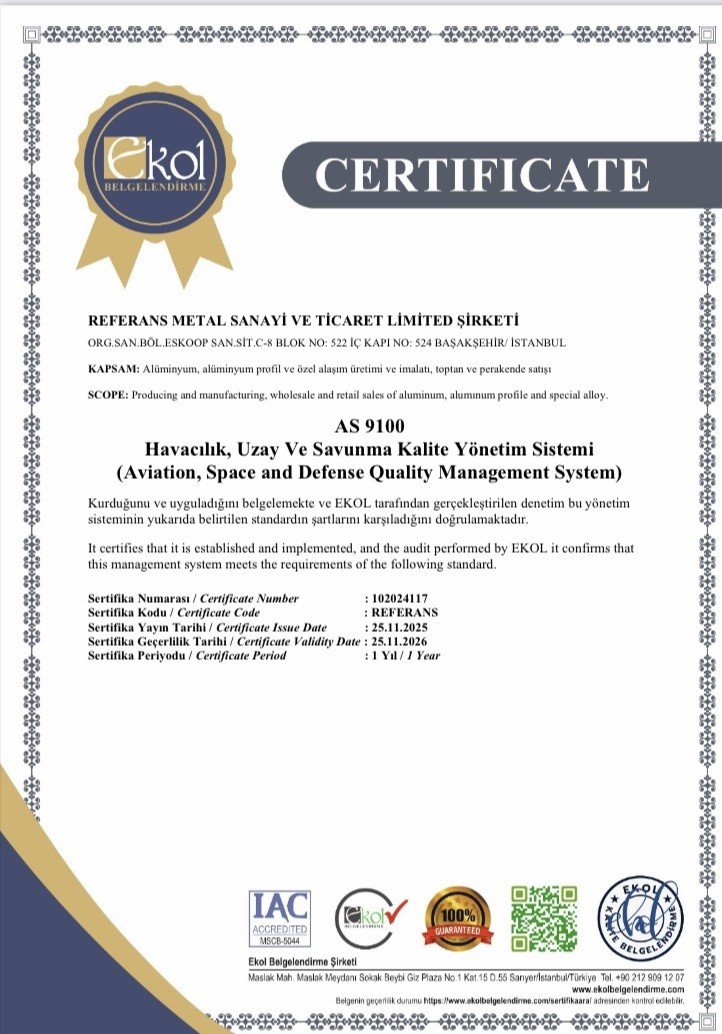
 AS 9100
 SPACE 2009
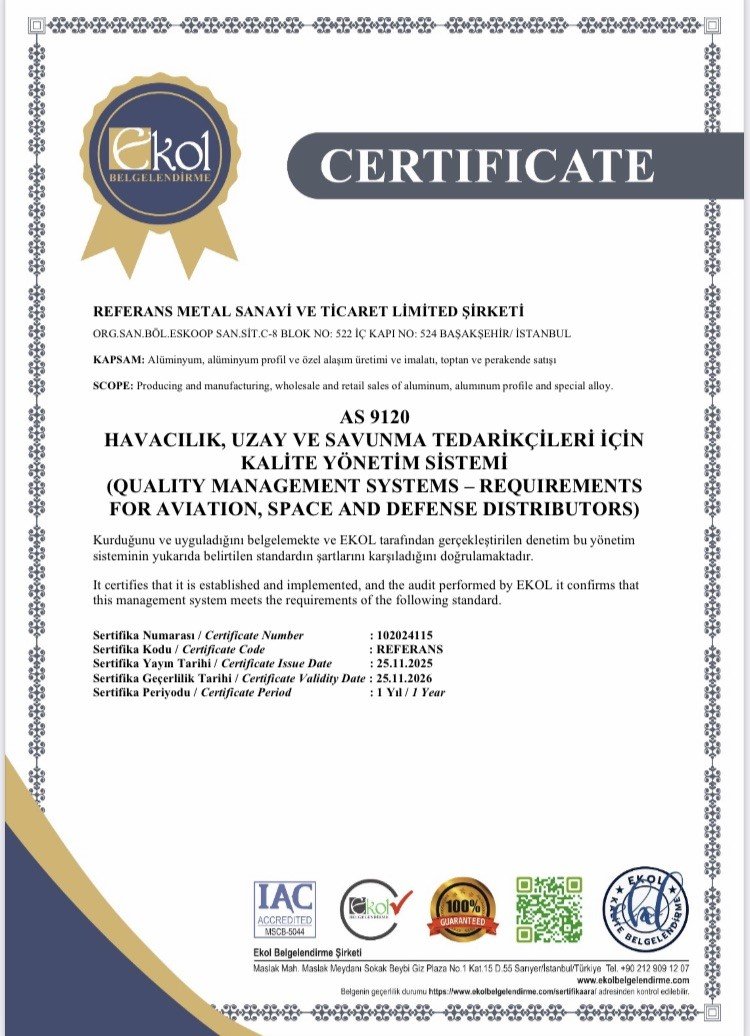 AS 9120


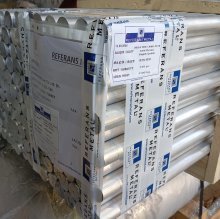

Plates
Sheets
Rod/Round Bar/Flat Bar
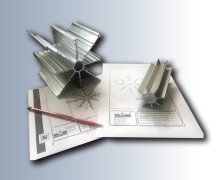
Tube/Extrusions/Profile
2024 clad
AMS QQ-A-250/5 / AlCu4Mg1 / 2024 clad / T3
| Chemical Properties | % Value |
| Silicon (Si) | 0,00 - 0,50 |
| Chromium (Cr) | 0,00 - 0,10 |
| Manganese (Mn) | 0,30 - 0,90 |
| Magnesium (Mg) | 1,20 - 1,90 |
| Copper (Cu) | 3,80 - 4,90 |
| Titanium (Ti) | 0,00 - 0,20 |
| Iron (Fe) | 0,00 - 0,50 |
| Zinc (Zn) | 0,00 - 0,25 |
| Aluminium (Al) | Balance |
| Physical Properties | Value |
| Density | 2.78 g/cm³ |
| Melting Point | 502 °C |
| Thermal Expansion | 22.9 µm/m°C |
| Modulus of Elasticity | 73.1 GPa |
| Thermal Conductivity | 121 W/m.K |
| Electrical Resistivity | 30% IACS |
| Mechanical Properties | Value |
| Proof Strength | 310 MPa |
| Yield Strength | 448 MPa |
| Shear Strength | 276 MPa |
| Elongation A50 mm | 15% |
| Hardness | 120 HB |
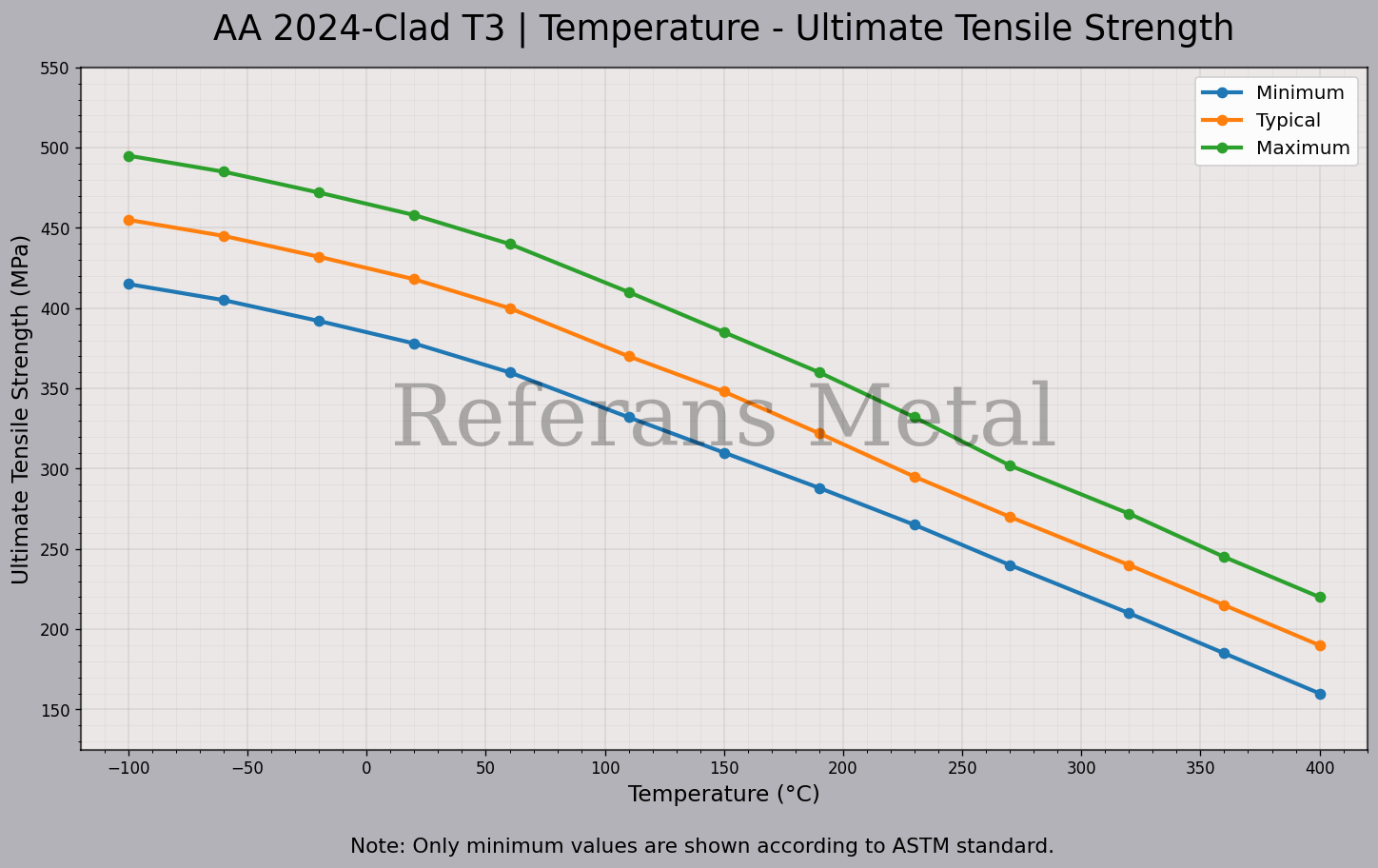
| 2024 Clad T3 Temperature – Ultimate Tensile Strength Graph |
 |
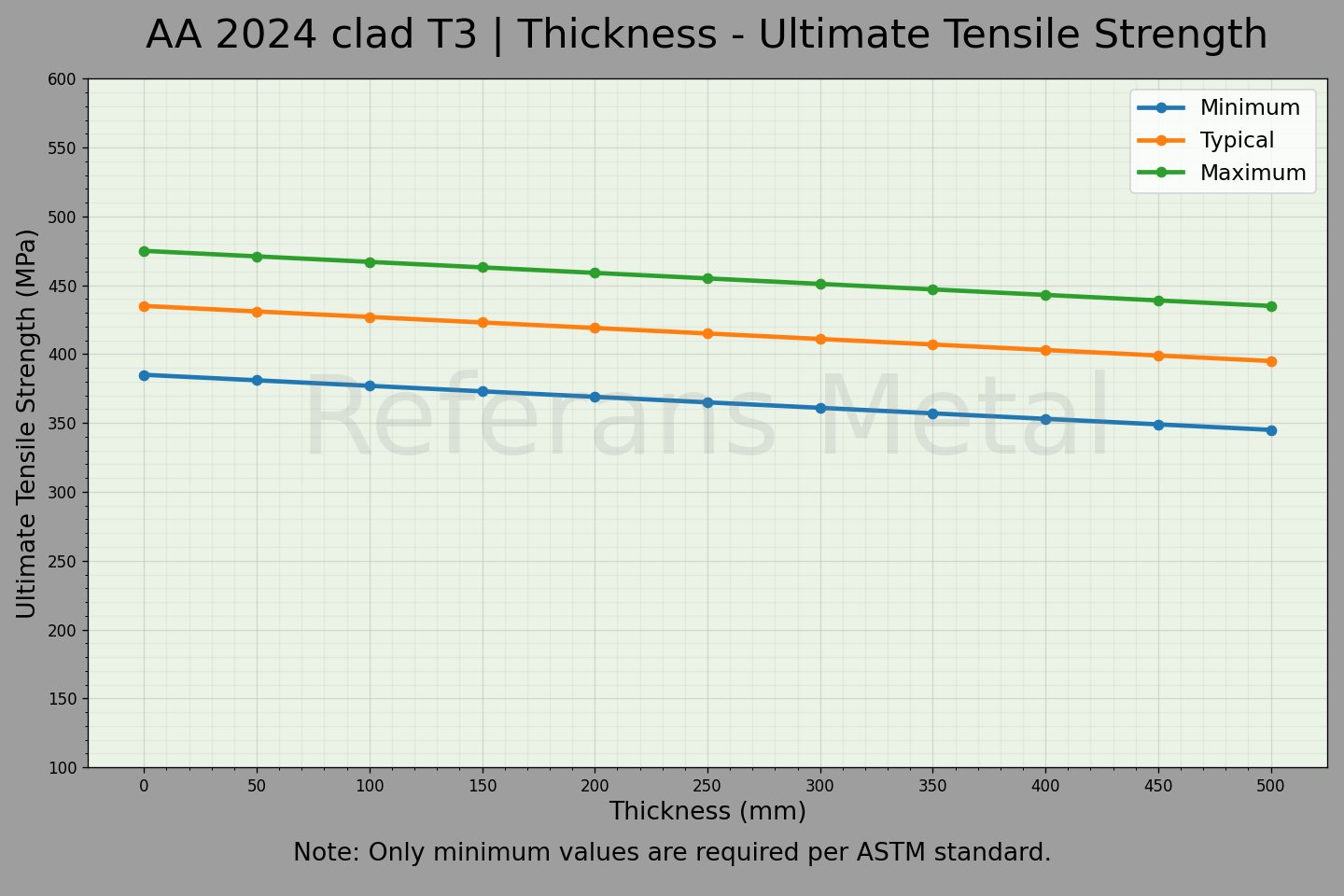
| 2024 Clad T3 Thickness – Ultimate Tensile Strength Graph |
 |
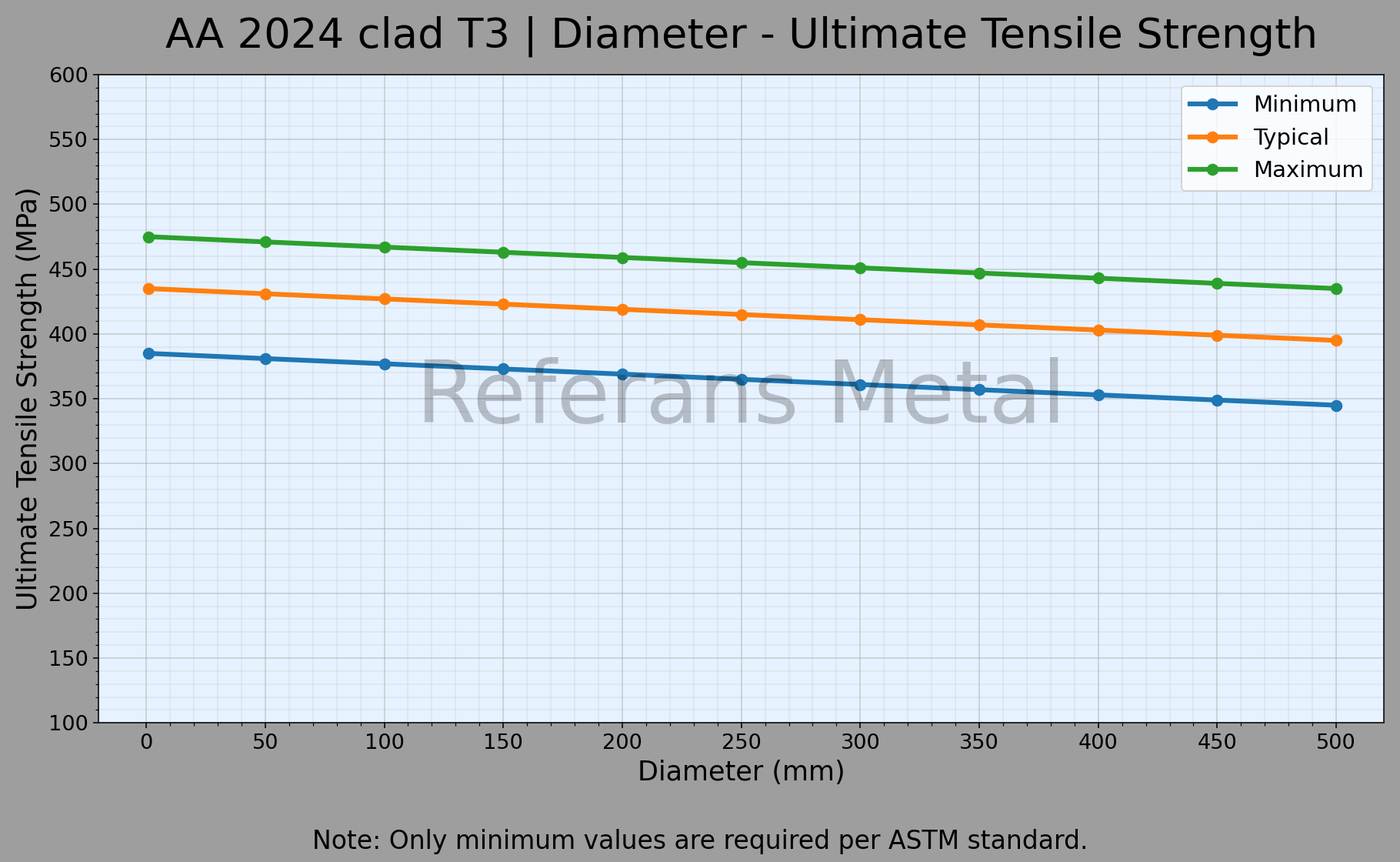
| 2024 Clad T3 Diameter – Ultimate Tensile Strength Graph |
 |
The 2024 clad T3 aluminum alloy is a copper-based (Al-Cu) alloy developed for applications requiring high strength and good fatigue resistance. The “clad” form significantly improves corrosion resistance thanks to a pure aluminum layer on the surface. The T3 temper indicates that the alloy is solution heat-treated, cold worked, and naturally aged. This structure provides high strength while maintaining a certain level of ductility.
In terms of corrosion resistance, the 2024 alloy alone is considered weak, but with clad coating it becomes quite resistant under atmospheric conditions. However, compared to alloys with inherently higher corrosion resistance such as 6061-T6, it still requires careful use. In marine environments, it is not as resistant as 5083, but thanks to the clad layer, it provides sufficient performance in aerospace applications.
In terms of strength, the 2024-T3 alloy has high tensile and yield strength, showing performance close to 7075-T6, although not as high. However, it offers significantly higher strength than 6061-T6. Its fatigue strength is also very good, making it suitable for structures subjected to vibration loads. However, the high strength negatively affects its weldability, and mechanical fastening methods are generally preferred.
In terms of machinability and formability, the 2024-T3 alloy has good machinability, but tool wear must be considered due to its hardness. Its bending capability is limited in the T3 temper, and there is a risk of cracking at small bend radii. In this respect, more ductile alloys such as 5052 are more advantageous. It is also suitable for surface coating processes (such as anodizing), but the clad layer requires attention during such treatments.
In terms of vibration behavior and applications, the 2024 clad T3 alloy is widely used in aircraft fuselages, wing skins, and structural components due to its high fatigue resistance. It performs stably under vibration, but it is not as rigid as higher-strength alloys like 7075. It is preferred in aerospace, automotive, and defense industries, but due to its poor weldability, riveted or bolted joints are typically used.
MATERIAL COMPOSITION STANDARDS
Alclad 2024 T3 can be supplied according to the following standards:
• Alclad 2024 T3 Sheet; AMS 4041, AMS QQ-A-250/5, AIR 9048-140, ASTM B209, BSL 109, WS 3.1364, EN 2090, ABS 5044, ASNA 3012
Characteristic Properties of 2024 T3 Clad:
- Strength: Above Average
- Machinability: Good
- Weldability: Moderate (Spot welding is the preferred method)
- Formability: Poor
- Corrosion Resistance: Fair
- Heat Treatment: Yes
Some Well-Known Applications for 2024 T3 Clad:
Aircraft floor beams,
Aircraft engine covers,
Also used in under-seat compartments.
STOCK
Alclad 2024 T3 is supplied in sheet form.
- Sheet
 Weight Calculator