
 AS 9100
 SPACE 2009
 AS 9120




Plates
Sheets
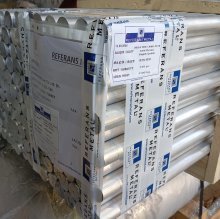
Rod/Round Bar/Flat Bar
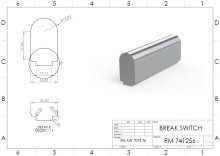
Tube/Extrusions/Profile
7150
AMS 4345 / AlZn6CuMgZr(A) / 7150 / T77511
| Chemical Properties | % Value |
| Silicon (Si) | 0,00 - 0,12 |
| Chromium (Cr) | 0,00 - 0,04 |
| Manganese (Mn) | 0,00 - 0,10 |
| Magnesium (Mg) | 2,00 - 2,70 |
| Copper (Cu) | 1,9 - 2,50 |
| Titanium (Ti) | 0,00 - 0,06 |
| Iron (Fe) | 0,00 - 0,15 |
| Zinc (Zn) | 5,90 - 6,90 |
| Aluminium (Al) | Balance |
| Titanium + Zirconium (Ti+Zr) | 0,08 - 0,15 |
| Physical Properties | Value |
| Density | 2,86 g/cm³ |
| Mechanical Properties | Value |
| Proof Strength | 580 MPa |
| Yield Strength | 620 MPa |
| Shear Strength | 430 MPa |
| Elongation A50 mm | 9.0 % |
| Hardness | 125 HB |
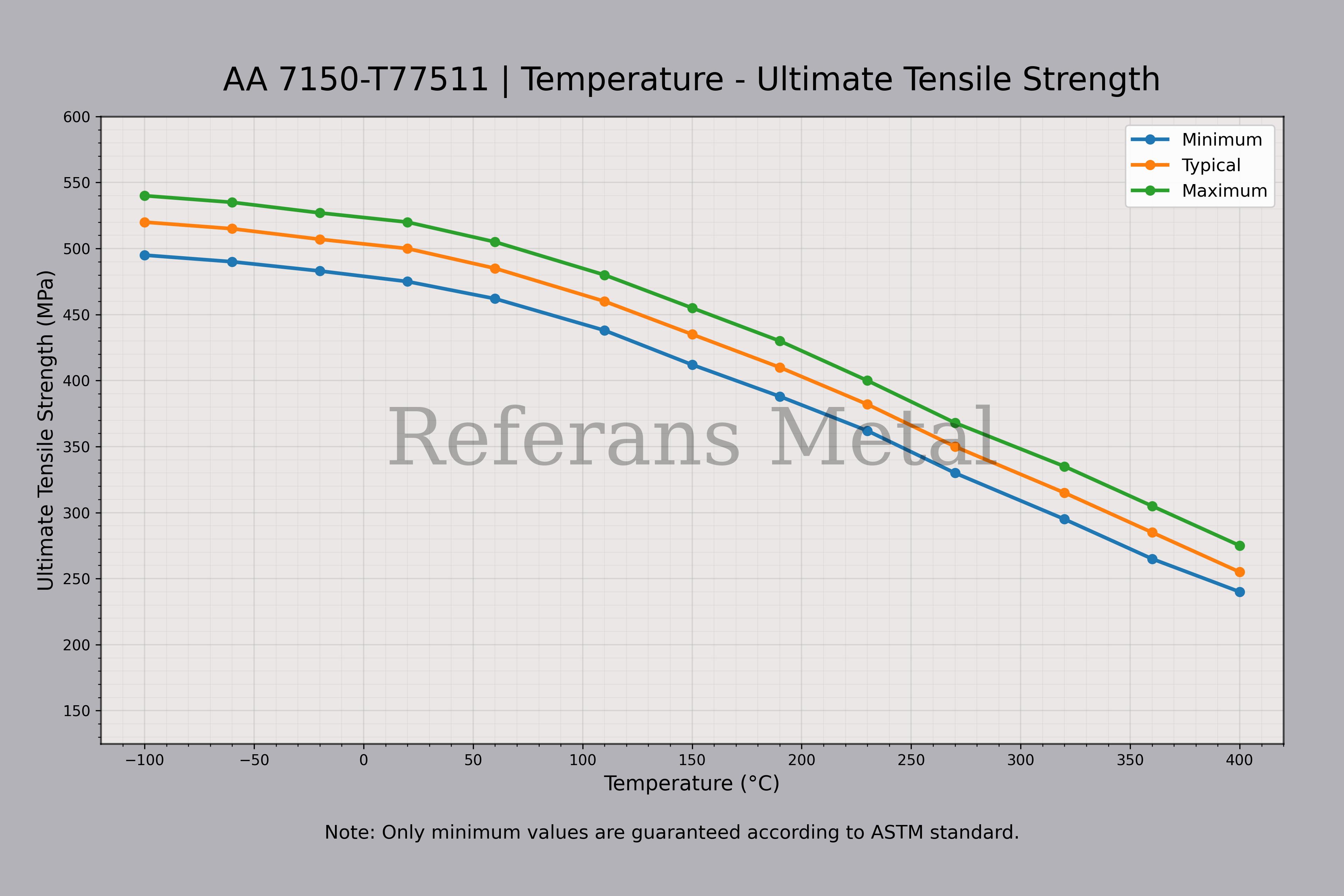
| 7150 T77511 Temperature – Ultimate Tensile Strength Graph |
 |
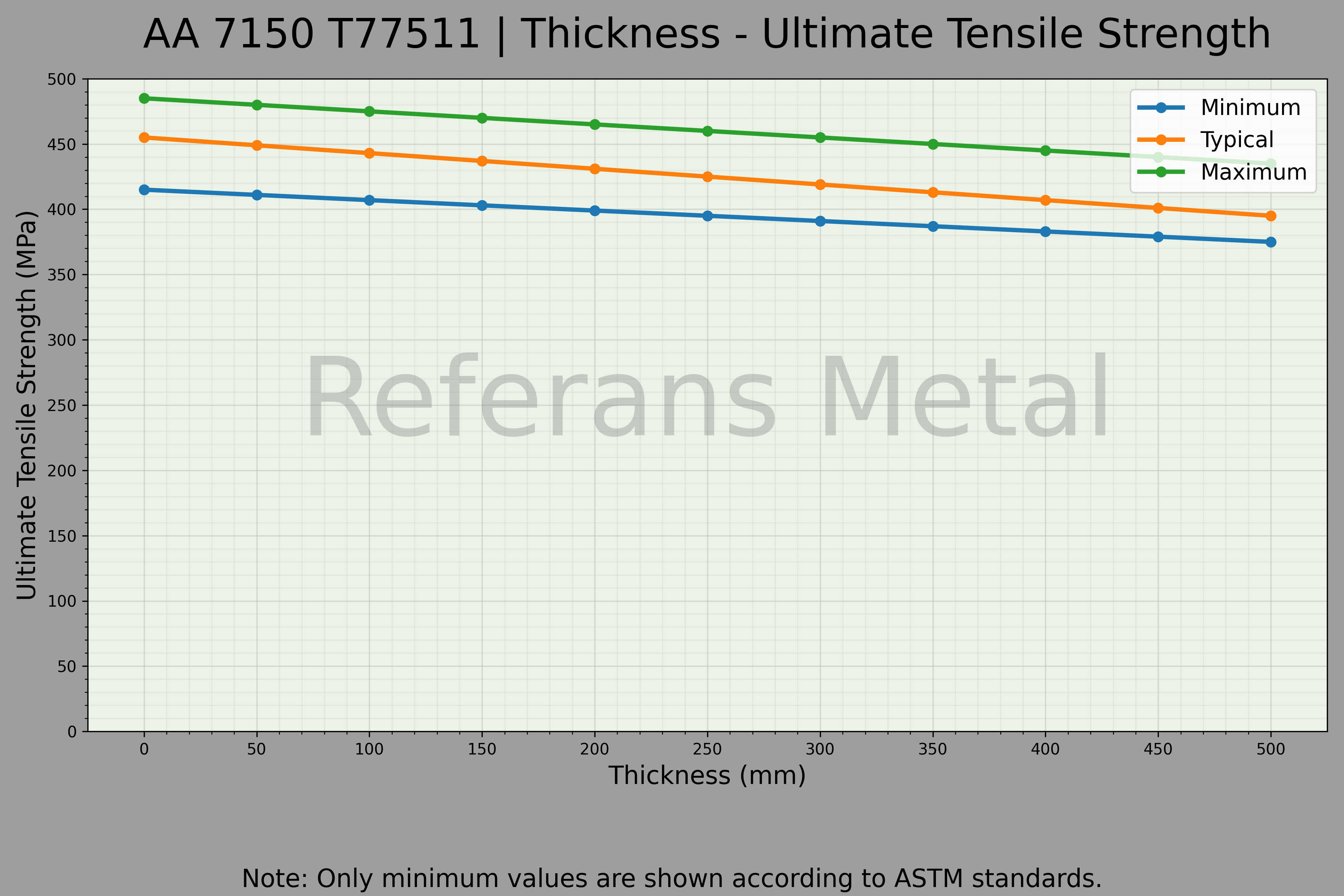
| 7150 T77511 Thickness – Ultimate Tensile Strength Graph |
 |
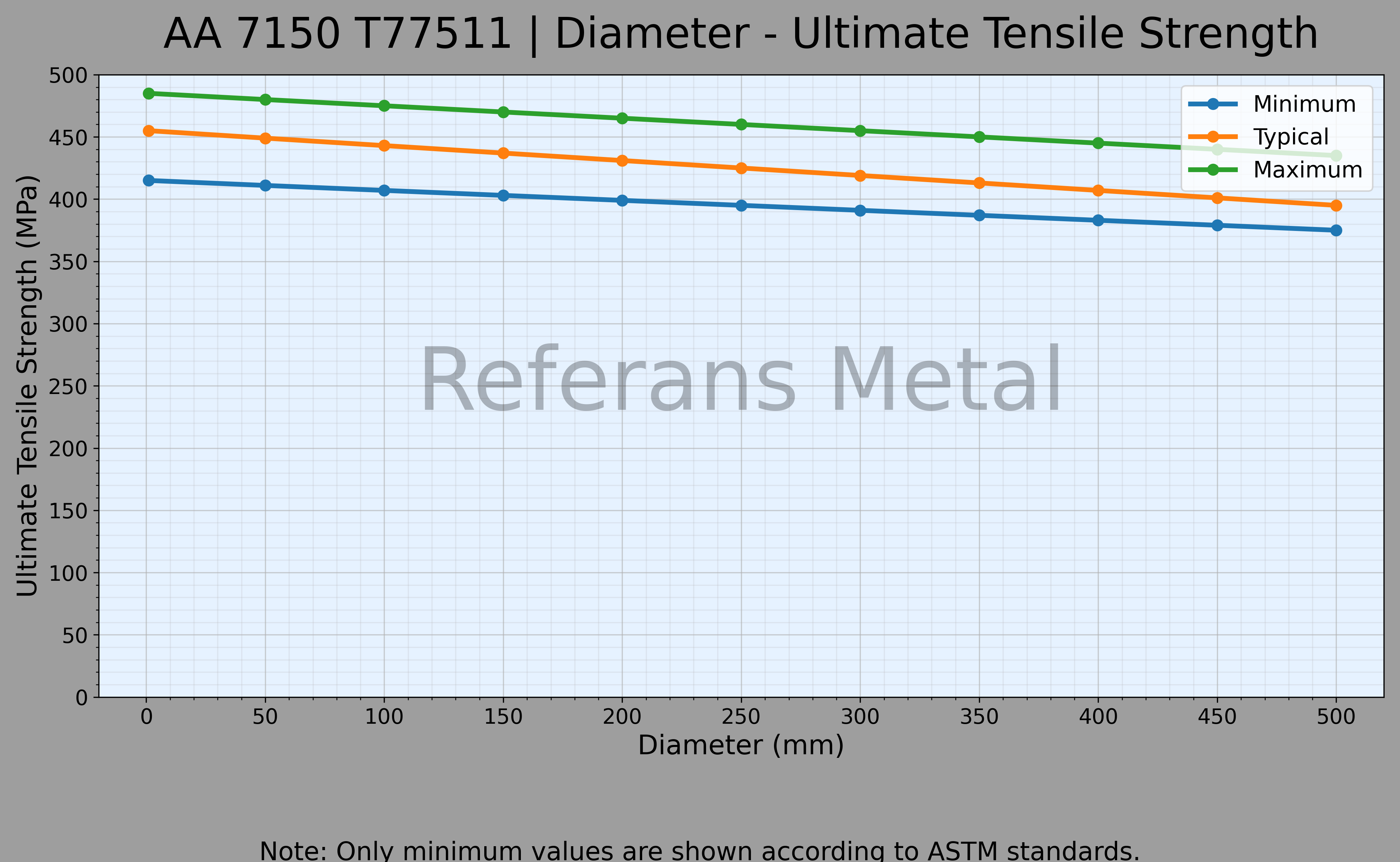
| 7150 T77511 Diameter – Ultimate Tensile Strength Graph |
 |
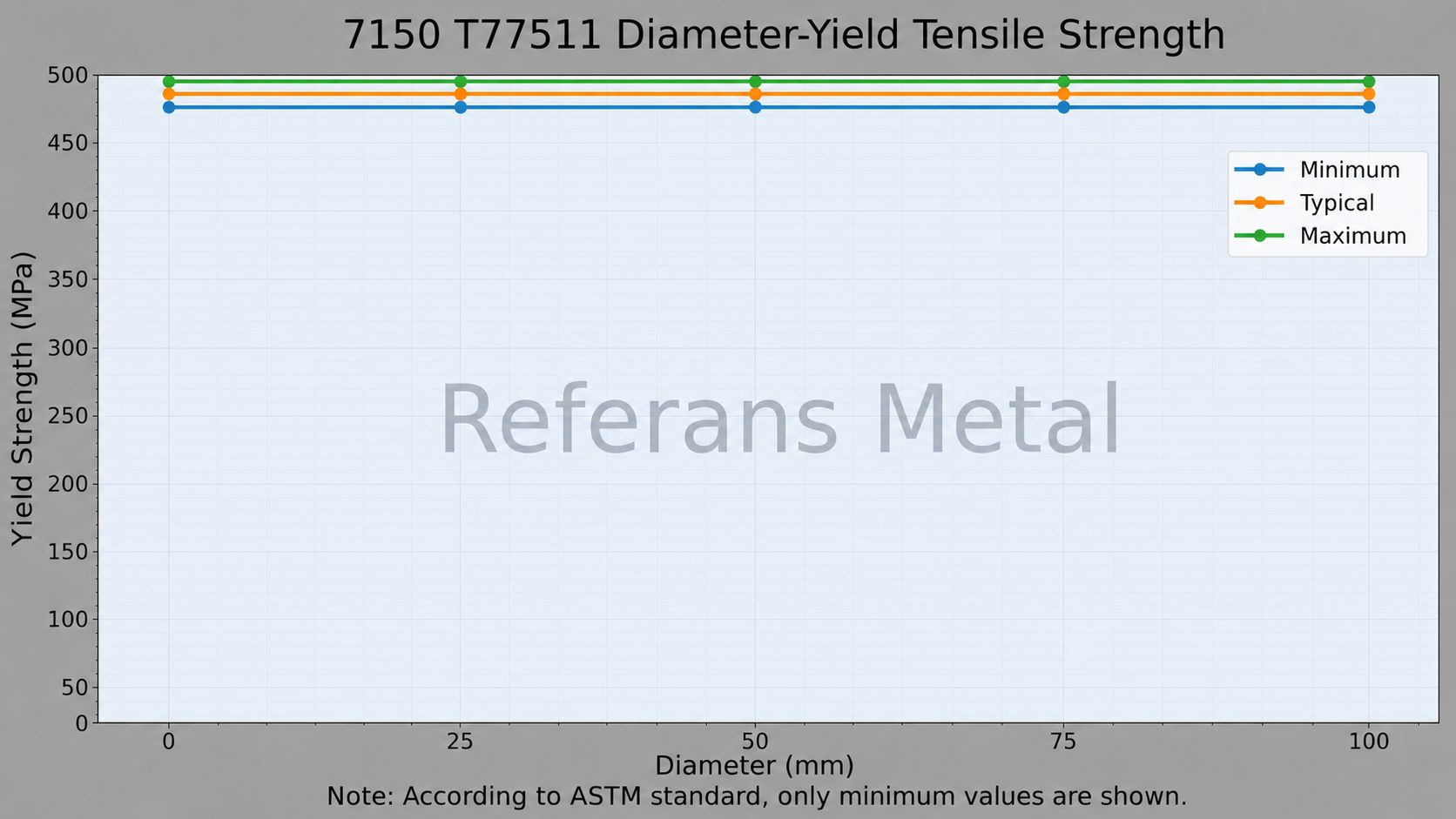
| 7150 T77511 Diameter-Yield Tensile Strength |
 |
7150-T77511 aluminum alloy is a high-strength alloy from the 7xxx series, specifically developed for aerospace applications. It is strengthened with zinc (Zn), magnesium (Mg), and copper (Cu), and the T77511 temper is optimized through stress relief and overaging processes. This results in high strength combined with improved fracture toughness and resistance to stress corrosion cracking.
In terms of corrosion resistance, 7150-T77511 offers better stress corrosion cracking resistance compared to 7075-T6. It is particularly reliable in thick sections and high-stress applications. It shows similar corrosion performance to 7050, while being significantly superior to 2024. It is typically used with surface protection methods such as anodizing, alclad, or painting.
Regarding strength and mechanical properties, this alloy stands out with high yield and tensile strength. While having similar strength levels to 7075-T6, it provides higher fracture toughness and better fatigue performance. Compared to 7050, it offers similar strength but in some cases improved crack propagation resistance, making it ideal for critical aerospace components.
In terms of machinability, bending, and weldability, 7150-T77511 offers good machinability but has more limited formability compared to O temper alloys. Due to its high strength, bending operations must be performed carefully. Its weldability is generally poor; in this respect, 6061 is more advantageous. Therefore, mechanical fastening methods such as riveting are commonly used.
Regarding vibration behavior and applications, 7150-T77511 is widely used in aircraft wings, fuselage panels, and highly loaded structural components. Its high specific strength and fatigue resistance ensure reliable performance under dynamic loads. Compared to 7075, 7050, and 2024, it provides more balanced and reliable performance, especially in thick-section and safety-critical applications.
• 7150 T77511 Extruded Round Bar; AMS 4307, UNS A97150, ISO AlZn6CuMgZr, ASTM B221
• 7150 T77511 Extruded Flat Bar; AMS 4307, UNS A97150, ISO AlZn6CuMgZr, ASTM B221
• 7150 T77511 Extruded Tube; AMS 4307, UNS A97150, ISO AlZn6CuMgZr, ASTM B221
Choosing Factors for 7150 T77511
- Strength: High
- Machining: Good
- Weldability: Medium
- Formability: Weak
- Corrosion Resistance: Very good
- Heat Treating: Yes
Some Well-Known Applications for 7150 T77511
As a component of airplane seat rails,
In the structure of engines,
Also used in keels.
7150 T77511 is produced/supplied in round/flat bar adn tube/profile form.
- Round/Flat Bar
- Tube/Profile
| Mechanical Properties | |||
| Thickness (mm) | Proof Strength (Min.) | Yield Strength (Min.) | Elongation A50 mm % |
| 25,4 mm | 565 MPa | 607 MPa | %11 |
 Weight Calculator