
 AS 9100
 SPACE 2009
 AS 9120


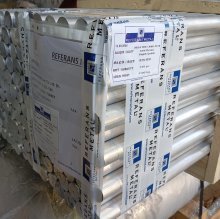


Plates
Sheets
Rod/Round Bar/Flat Bar
Tube/Extrusions/Profile
2014
AMS 4028 / AlCu4SiMg / 2014 / O
| Chemical Properties | % Value |
| Silicon (Si) | 0,50 - 1,20 |
| Chromium (Cr) | 0,00 - 0,10 |
| Manganese (Mn) | 0,40 - 1,20 |
| Magnesium (Mg) | 0,20 - 0,80 |
| Copper (Cu) | 3,90 - 5,00 |
| Titanium (Ti) | 0,00 - 0,15 |
| Iron (Fe) | 0,00 - 0,70 |
| Zinc (Zn) | 0,00 - 0,25 |
| Aluminium (Al) | Balance |
| Physical Properties | Value |
| Density | 2.80 g/cm³ |
| Melting Point | 507 °C |
| Thermal Expansion | 22.7 µm/m°C |
| Modulus of Elasticity | 73 GPa |
| Thermal Conductivity | 150 W/m.K |
| Electrical Resistivity | 40 % IACS |
| Mechanical Properties | Value |
| Proof Strength | 100 MPa |
| Yield Strength | 190 MPa |
| Shear Strength | 130 MPa |
| Elongation A50 mm | %17 |
| Hardness | 48 HB |
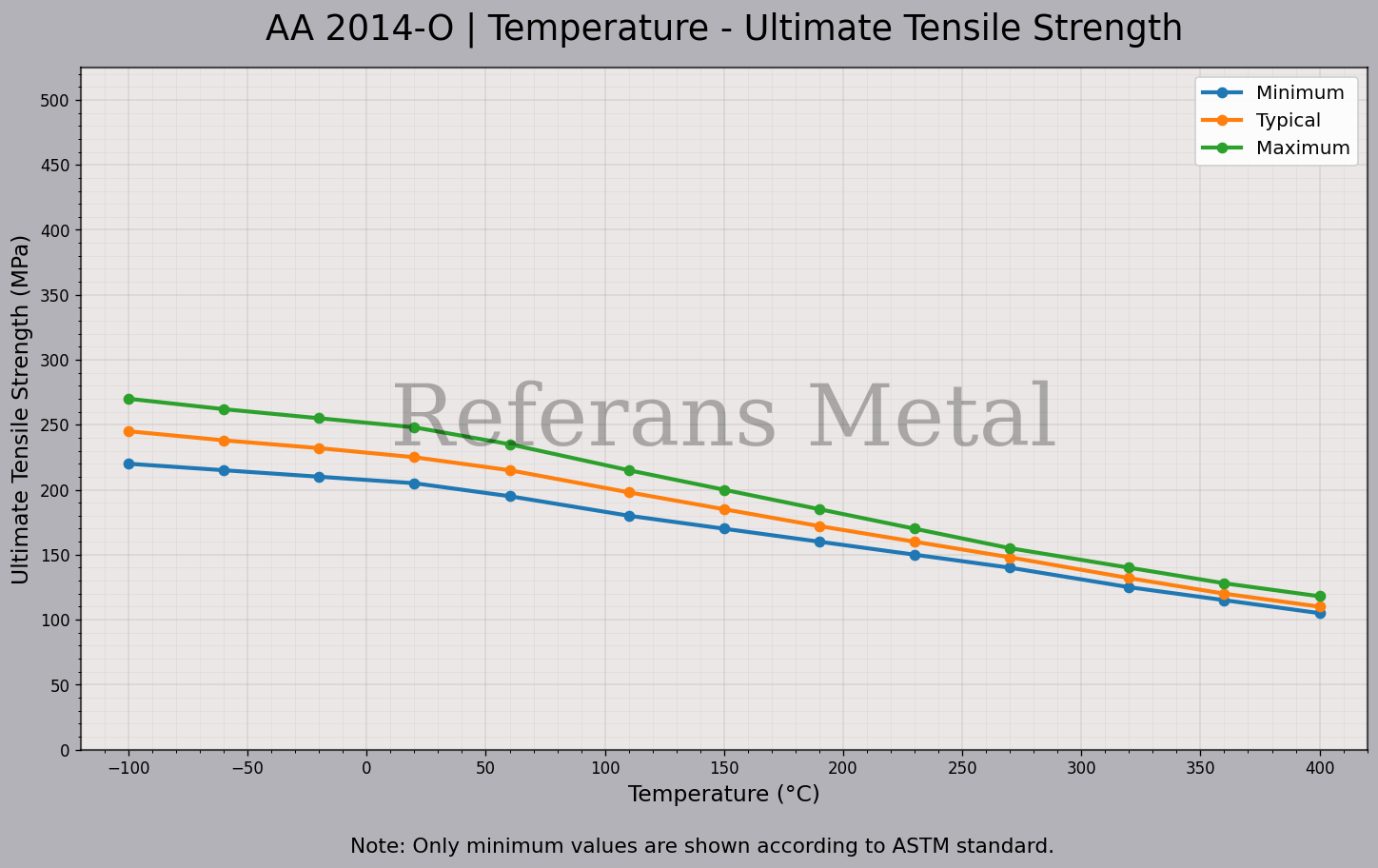
| 2014 O Temperature – Ultimate Tensile Strength Graph |
 |
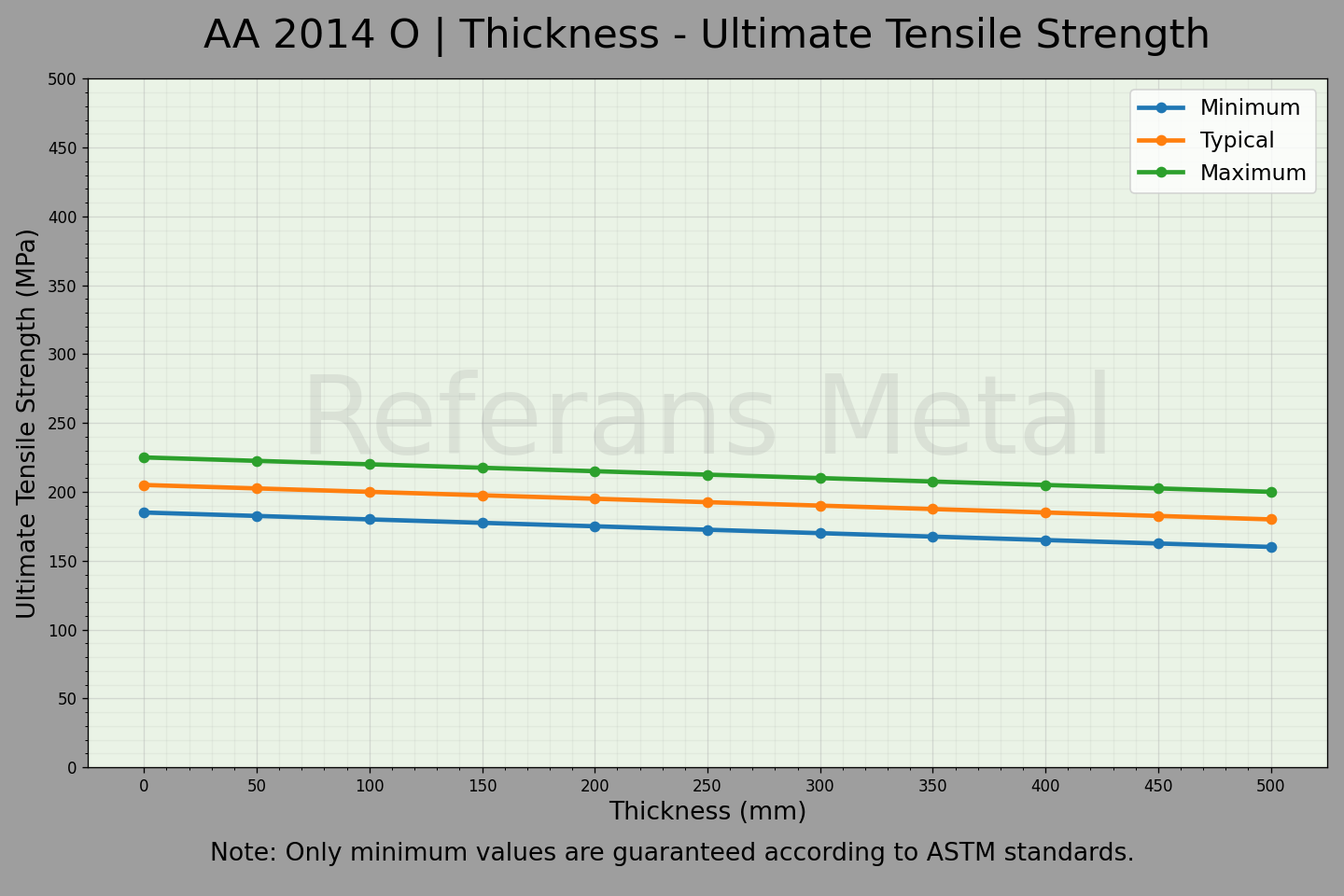
| 2014 O Thickness – Ultimate Tensile Strength Graph |
 |
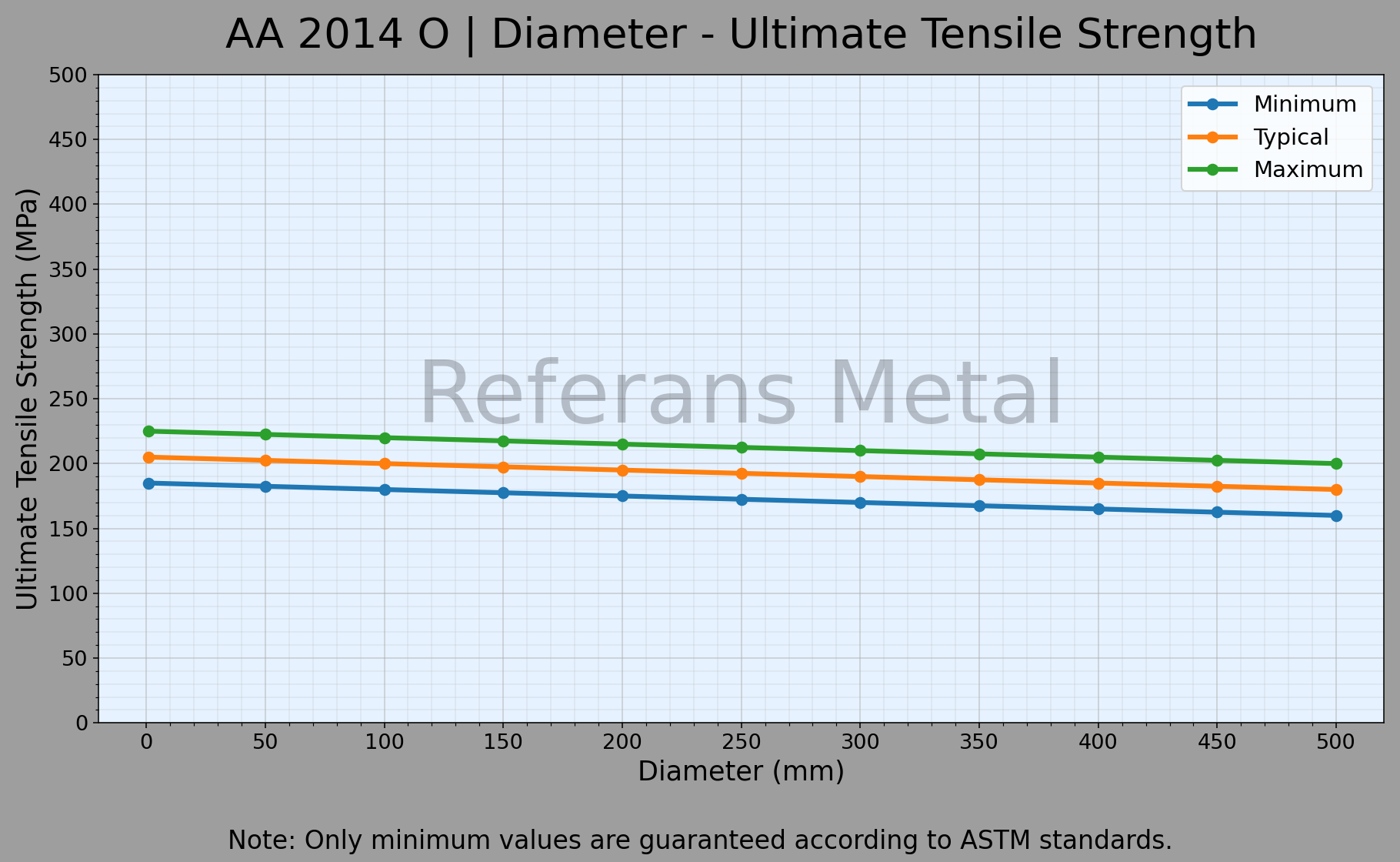
| 2014 O Diameter – Ultimate Tensile Strength Graph |
 |
2014-O aluminum alloy is a member of the Al-Cu (Aluminum-Copper) alloy family and is widely used in applications requiring high strength. The “O” temper indicates that the material is annealed, meaning it is in its softest and most ductile condition. This significantly improves the alloy’s formability and bending capability. However, in this temper the strength is lower compared to age-hardened tempers such as 2014-T6 or 2014-T651. Nevertheless, the alloy maintains an important place in aerospace and mechanical engineering due to its reliable mechanical performance.
The 2014-O alloy is known for its potential for high strength, although its corrosion resistance is generally considered moderate. Al-Cu alloys typically do not offer corrosion resistance as high as pure aluminum or 5xxx series alloys. For this reason, surface protection methods such as coatings or anodizing are commonly used in many applications. For example, the 6061 alloy provides better overall corrosion resistance, while the 7075 alloy can deliver much higher strength but is more sensitive to corrosion. In this context, the 2014 alloy offers a balanced combination of strength and machinability.
In terms of machinability, the 2014 alloy performs very well among aluminum alloys. Particularly in T6 or T651 tempers it offers excellent machinability and is commonly preferred for machining operations. In the O temper, its softer structure allows easier forming and bending operations. This property provides advantages in manufacturing components with complex geometries. The 2024 alloy is also widely used in aerospace applications, but the 2014 alloy often provides better machinability.
Regarding vibration behavior and mechanical response, the 2014 alloy offers high stiffness and good load-carrying capability. This makes it suitable for applications involving significant dynamic loads. The alloy is frequently used in aircraft structural components, fittings, high-strength fasteners, and machine parts. In comparison, marine alloys such as 5083 alloy provide superior corrosion resistance but do not offer the same level of strength as the 2014 alloy.
In terms of weldability, the 2014 alloy generally has limited welding capability, and mechanical fastening or riveting is often preferred. Like most Al-Cu alloys, it is susceptible to cracking after welding. However, welding may be possible in certain cases when appropriate methods and filler materials are used. Thanks to its combination of high strength potential, good machinability, and reliable mechanical performance, the 2014 alloy is widely used in industries such as aerospace, defense, heavy machinery manufacturing, and automotive engineering.
• 2014 O Plate; ISO AlCu4SiMg,MIL-A-21180,ASTM B209,UNS A92014,WNR 3.1255,AMS 4028 (replaced AMS 4014).
• 2014 O Sheet; ISO AlCu4SiMg,MIL-A-21180,ASTM B209,UNS A92014,WNR 3.1255,AMS 4028 (replaced AMS 4014).
• 2014 O Cold Drawn Round Bar; ASTM B211,UNS A92014,ASTM B928,WNR 3.1255.
• 2014 O Cold Drawn Flat Bar; ASTM B211,UNS A92014,ASTM B928,WNR 3.1255.
• 2014 O Cold Drawn Wire; ASTM B211,UNS A92014,ASTM B928,WNR 3.1255.
• 2014 O Cold Drawn Tube; ASTM B211,UNS A92014,ASTM B928,WNR 3.1255.
• 2014 O Extruded Round Bar; ASTM B221,UNS A92014,WNR 3.1255.
• 2014 O Extruded Flat Bar; ASTM B221,UNS A92014,WNR 3.1255.
• 2014 O Extruded Wire; ASTM B221,UNS A92014,WNR 3.1255.
• 2014 O Extruded Tube; ASTM B221,UNS A92014,WNR 3.1255.
Choosing Factors for 2014 O
- Strength: Great
- Machining: Very good
- Weldability: Poor
- Formability: Good
- Corrosion Resistance: Weak
- Heat Treating: Yes
Some Well-Known Applications for 2014 O
In the aerospace sector,
In pipelines and as truck and machinery equipment,
It is also used in power plants and in the automotive industry in general.
2014 O is produced/supplied in plate/sheet, round/flat bar and tube/profile forms.
- Plate/ Sheet
- Rod / Round Bar / Flat Bar
- Tube/Profile
| Mechanical Properties | |||
| Thickness (mm) | Proof Strength (Min.) | Yield Strength (Min.) | Elongation A50 mm % |
| Over 4.57 up to & incl. 12.7 mm | 100 MPa | 185 MPa | 15% |
| Over 12.7 up to & incl. 25.4 mm | 110 MPa | 200 MPa | 17% |
 Weight Calculator