
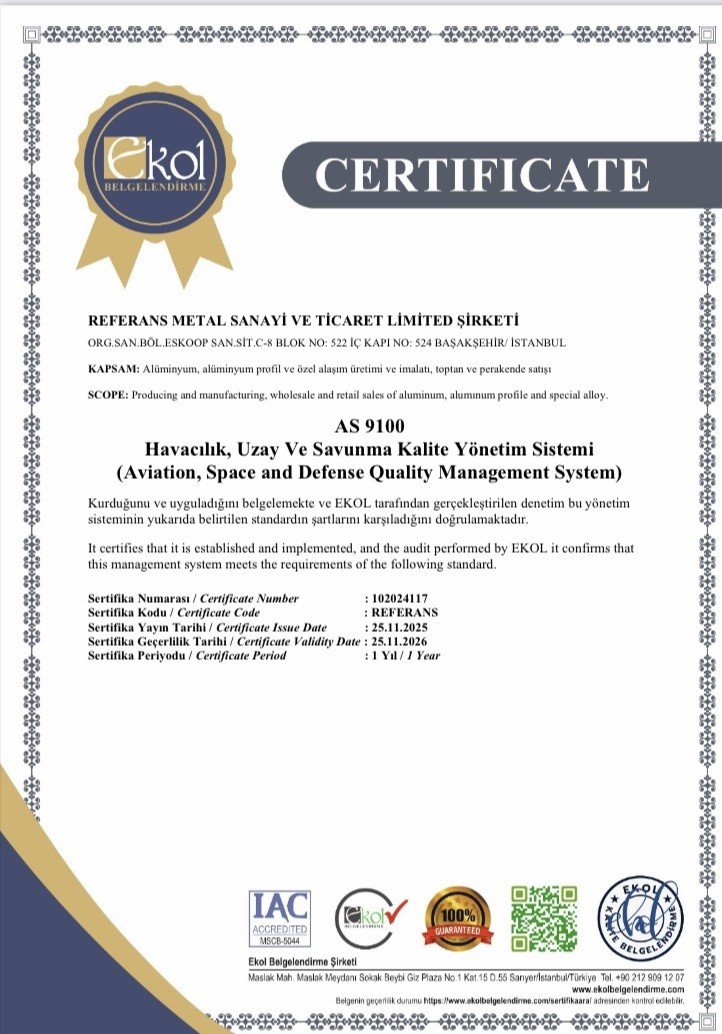
 AS 9100
 SPACE 2009
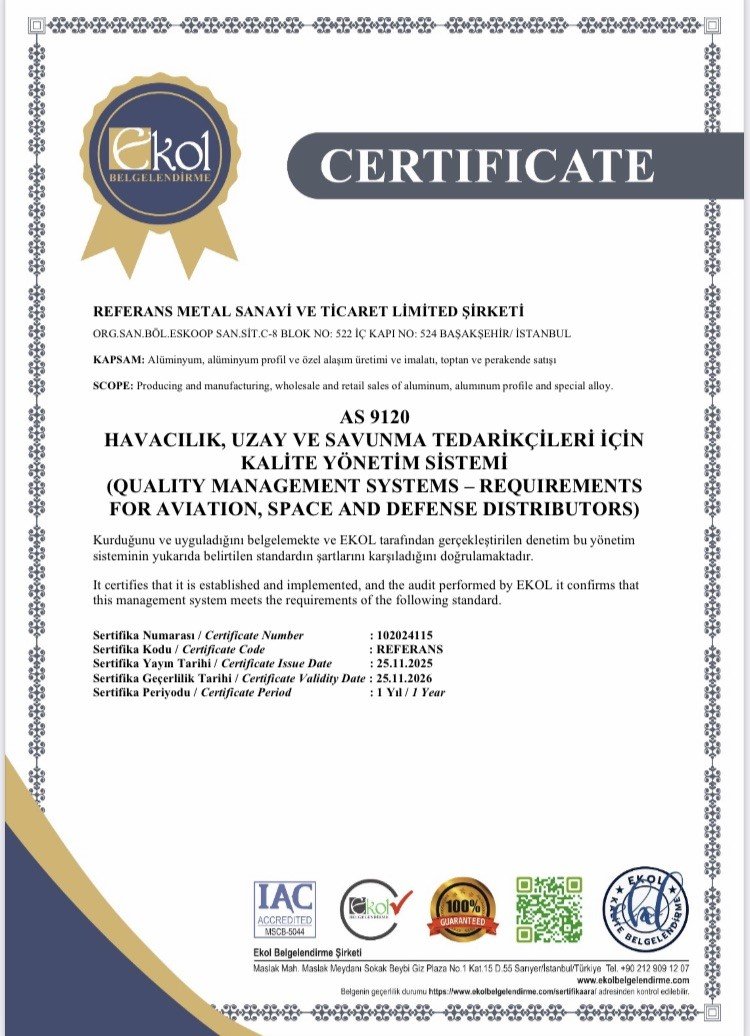 AS 9120




Plates
Sheets
Rod/Round Bar/Flat Bar
Tube/Extrusions/Profile
6060
EN AW / AlMgSi / AlMgSi0.5 / 6060 / T64
| Chemical Properties | % Value |
| Silicon (Si) | 0,30 - 0,60 |
| Chromium (Cr) | 0,04 - 0,35 |
| Manganese (Mn) | 0,00 - 0,10 |
| Magnesium (Mg) | 0,35 - 0,60 |
| Copper (Cu) | 0,15 - 0,40 |
| Titanium (Ti) | 0,00 - 0,15 |
| Iron (Fe) | 0,10 - 0,30 |
| Zinc (Zn) | 0,00 - 0,15 |
| Aluminium (Al) | Balance |
| Physical Properties | Value |
| Density | 2,70 g/cm³ |
| Melting Point | 610 °C |
| Thermal Expansion | 23 µm/m.°C |
| Modulus of Elasticity | 68 GPa |
| Thermal Conductivity | 210 W/m.K |
| Electrical Resistivity | %54 IACS |
| Mechanical Properties | Value |
| Proof Strength | 140 MPa |
| Yield Strength | 200 MPa |
| Shear Strength | 120 MPa |
| Elongation A50 mm | 13% |
| Hardness | 62 HB |
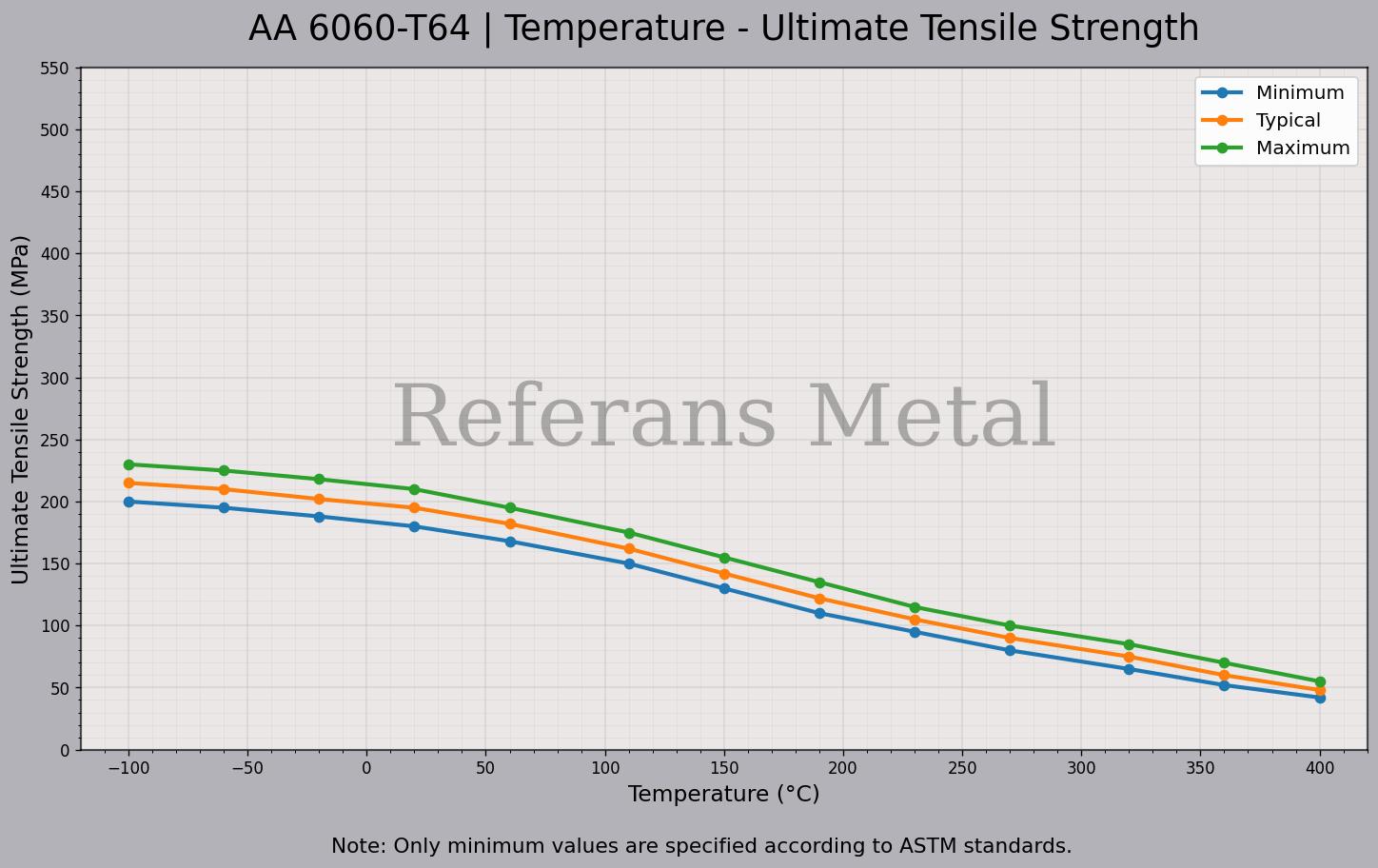
| 6060 T64 Temperature – Ultimate Tensile Strength Graph |
 |
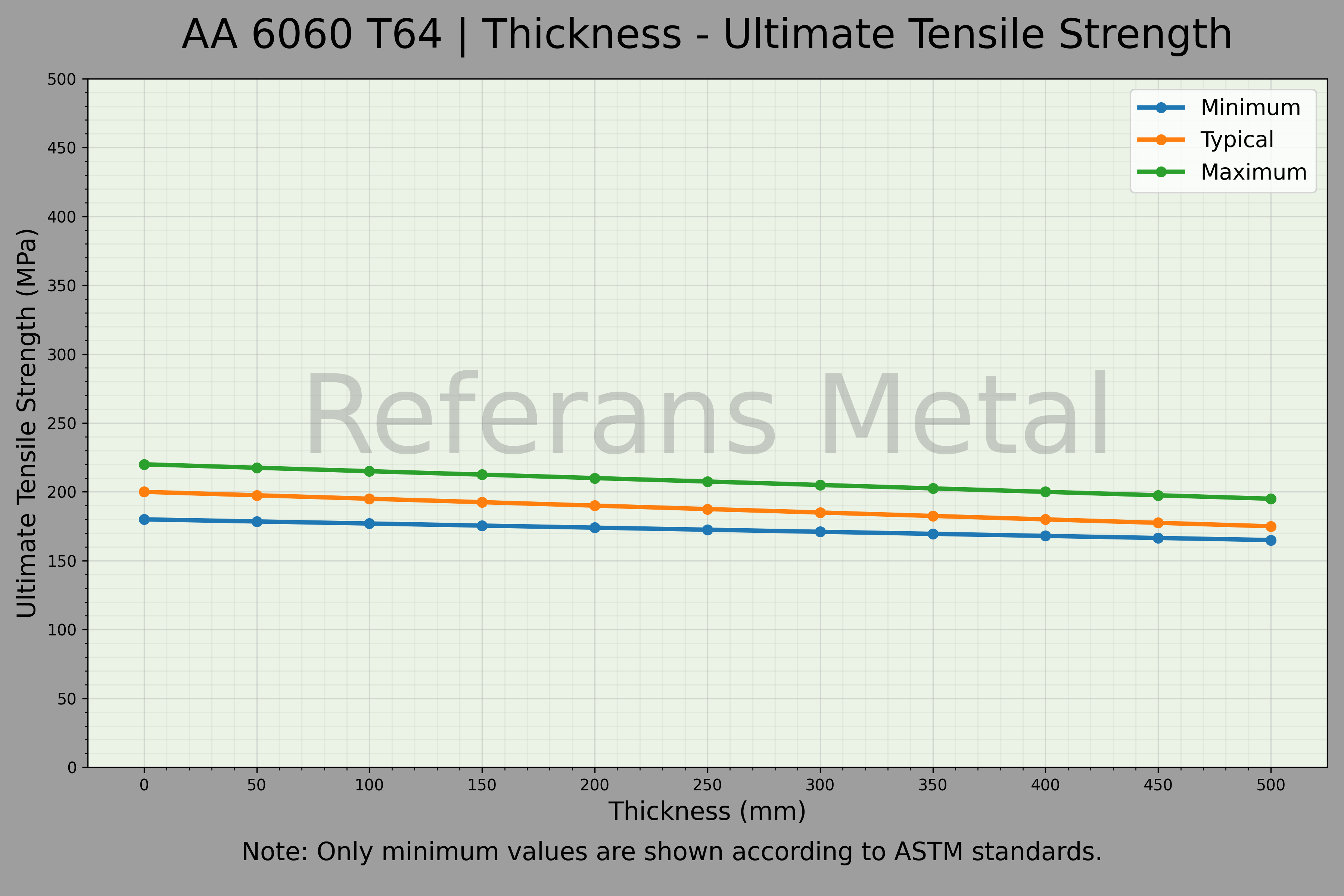
| 6060 T64 Thickness – Ultimate Tensile Strength Graph |
 |
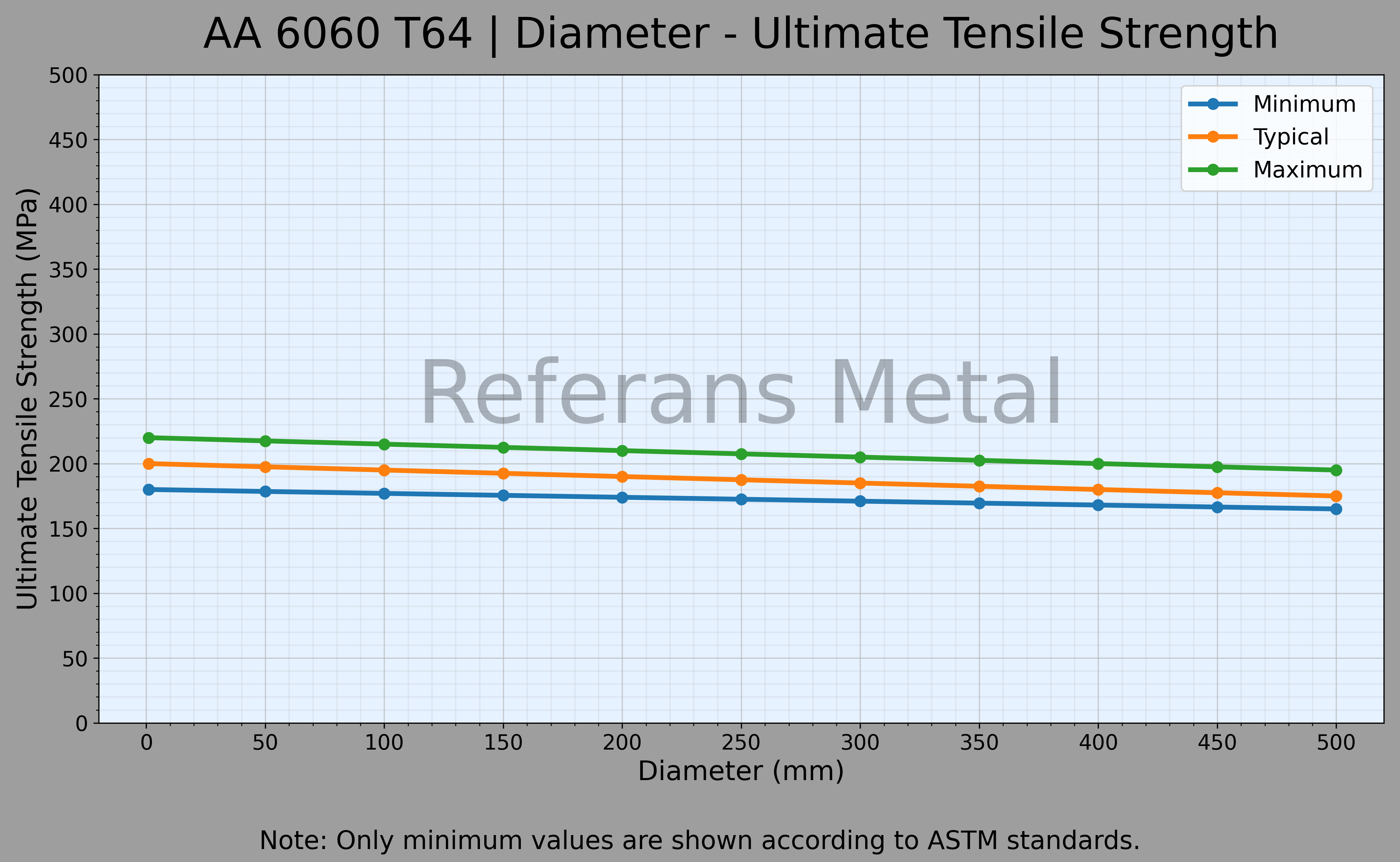
| 6060 T64 Diameter – Ultimate Tensile Strength Graph |
 |
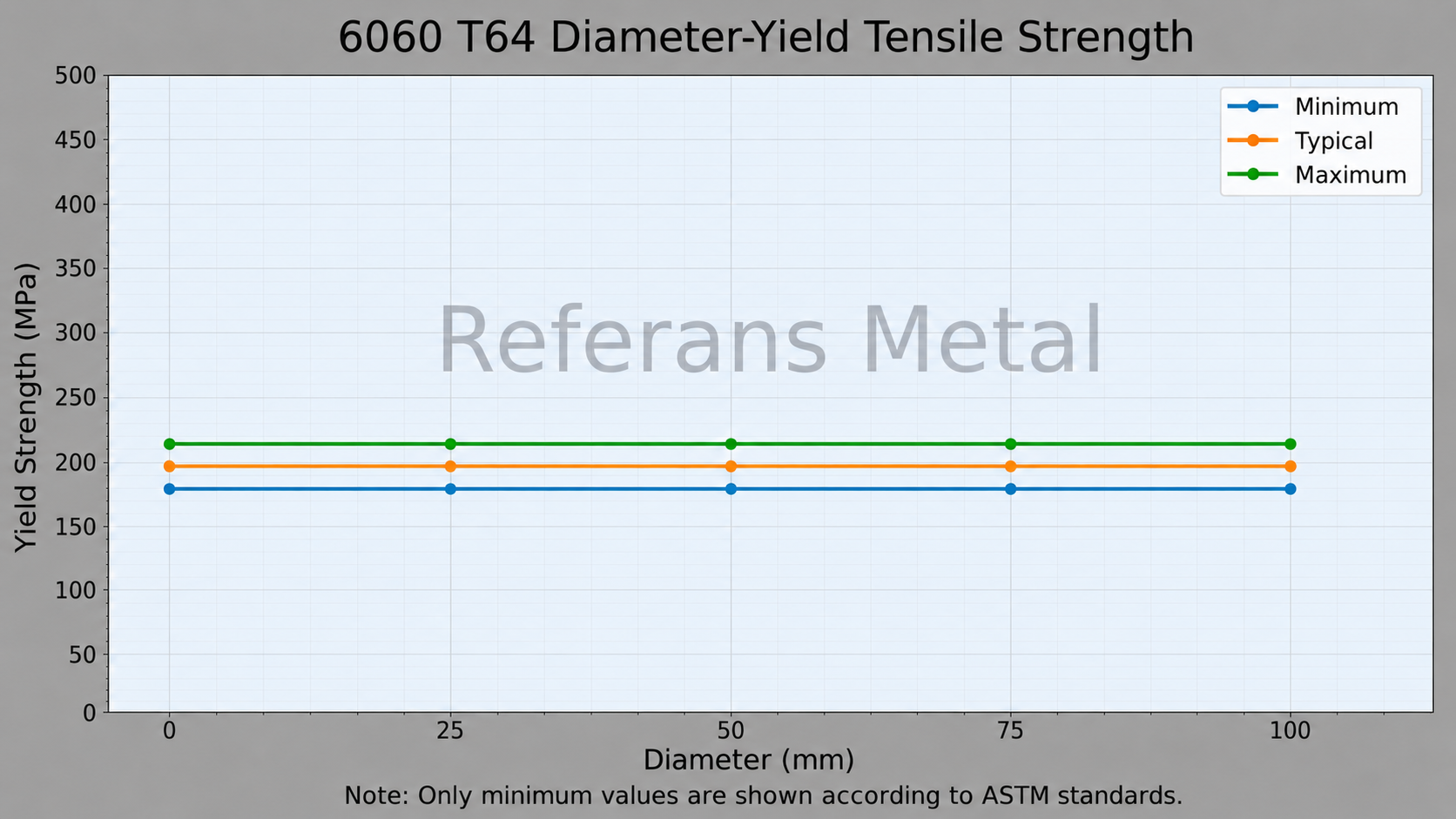
| 6060 T64 Diameter-Yield Tensile Strength |
 |
The 6060 T64 aluminum alloy belongs to the Al-Mg-Si (6000 series) group and is specifically developed for extrusion applications. The T64 temper is achieved through a combination of solution heat treatment, artificial aging, and controlled mechanical processing, providing a good balance of strength and excellent surface finish. Compared to 6063, 6060 offers slightly higher strength, while compared to 6082, it provides better formability and surface quality. Therefore, it is widely preferred in architectural and decorative applications.
In terms of corrosion resistance, the 6060 T64 alloy performs very well and exhibits high resistance to atmospheric conditions. Especially due to its excellent anodizing capability, a protective oxide layer can be formed, further enhancing corrosion resistance. This makes it ideal for façade applications, window systems, and structural components. Compared to 2000 series alloys (such as 2024), it offers much better corrosion resistance, although it is not as resistant as 5000 series alloys (such as 5754) in highly aggressive environments.
Regarding mechanical properties and strength, 6060 T64 provides moderate strength. Compared to 6082-T6, it has lower strength, but this allows for better extrusion performance and superior surface quality. Compared to 6063, it offers slightly higher strength values. This alloy is preferred in applications where aesthetics and lightness are more important than high load-bearing capacity.
In terms of machinability, bendability, and weldability, 6060 T64 demonstrates a well-balanced performance. It has good machining characteristics and allows for clean cutting surfaces. Its bending and forming capabilities are excellent, enabling complex profile designs. It is highly weldable and can be easily joined using TIG and MIG welding methods. Compared to 2000 series alloys, it offers significantly better weldability.
Regarding coating capability, vibration behavior, and applications, 6060 alloy is highly suitable for anodizing and painting due to its superior surface quality. Its vibration damping properties are moderate, making it suitable for non-structural but surface-sensitive applications. Typical uses include architectural profiles, window and door systems, automotive trim parts, furniture components, and decorative applications. Although it offers lower strength compared to high-strength alloys like 7075, it provides significantly better machinability and surface finish.
Choosing Factors for 6060 T6
- Strength: Mediocre
- Machining: Okay
- Weldability: Excellent
- Formability: Good
- Corrosion Resistance: Excellent
- Heat Treating: Yes
Some Well-Known Applications for 6060 T6
In complex cross-sectioned extruded shapes,
In pneumatic applications and cooling pipelines,
It is also used in motor housing.
- Rod / Round Bar / Flat Bar
- Tube/Profile
 Weight Calculator