
 AS 9100
 SPACE 2009
 AS 9120


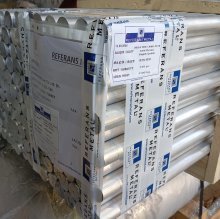


Plates
Sheets
Rod/Round Bar/Flat Bar
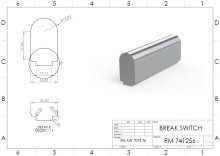
Tube/Extrusions/Profile
7475
AMS 4202 / AlZn5.5MgCu / 7475 / T7351
| Chemical Properties | % Value |
| Silicon (Si) | 0,00 - 0,10 |
| Chromium (Cr) | 0,18 - 0,25 |
| Manganese (Mn) | 0,00 - 0,06 |
| Magnesium (Mg) | 1,90 - 2,60 |
| Copper (Cu) | 1,20 - 1,90 |
| Titanium (Ti) | 0,00 - 0,06 |
| Iron (Fe) | 0,00 - 0,12 |
| Zinc (Zn) | 5,20 - 6,20 |
| Aluminium (Al) | Balance |
| Physical Properties | Value |
| Density | 2,81 g/cm³ |
| Melting Point | 477 °C |
| Thermal Expansion | 23 µm/m.°C |
| Modulus of Elasticity | 71,7 GPa |
| Thermal Conductivity | 163 W/m.K |
| Electrical Resistivity | %42 IACS |
| Mechanical Properties | Value |
| Yield Strength | 425 MPa |
| Ultimate Strength | 510 MPa |
| Shear Strength | 300 MPa |
| Elongation A50 mm | 12% |
| Hardness | 135 HB |
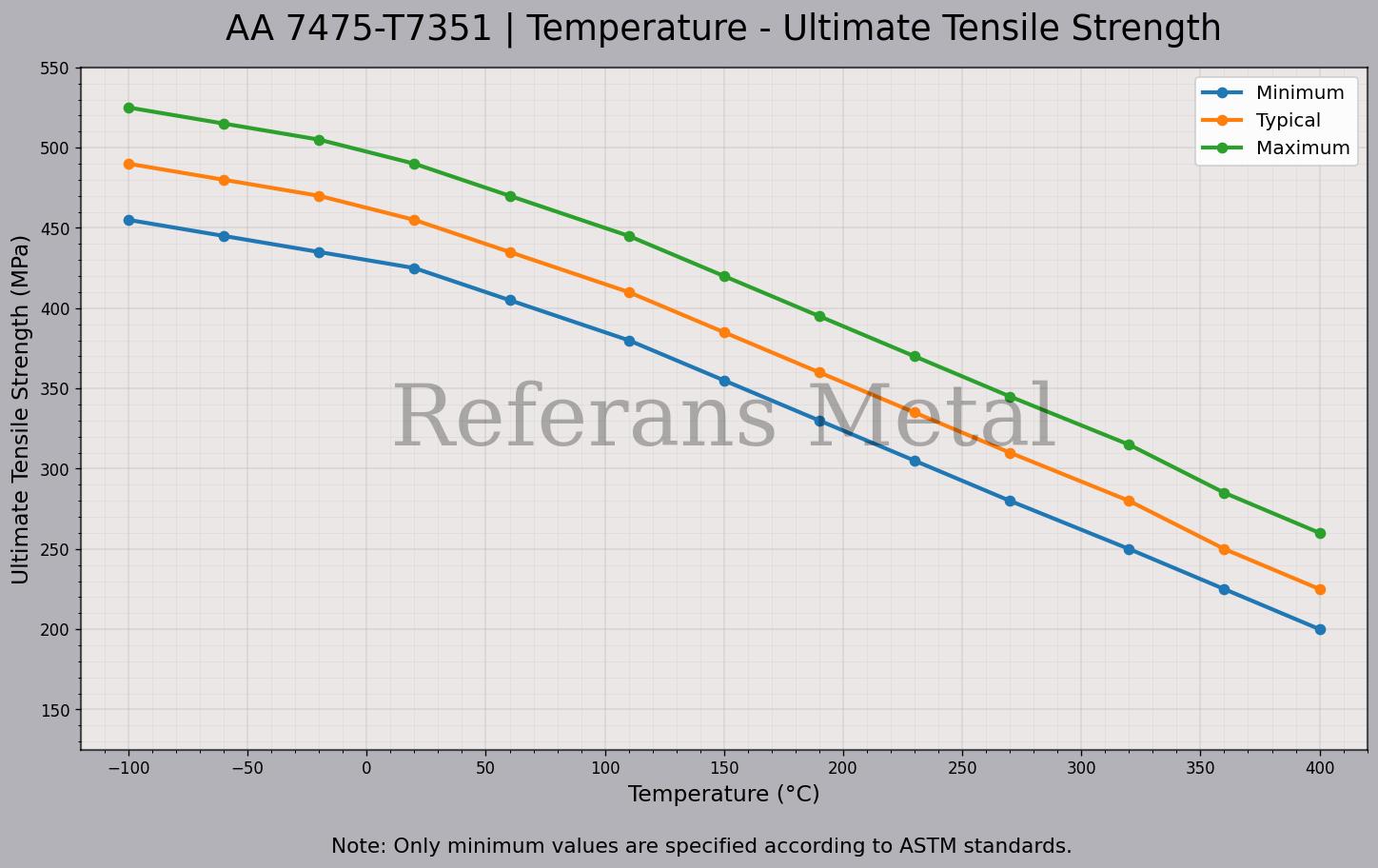
| 7475 T7351 Temperature – Ultimate Tensile Strength Graph |
 |
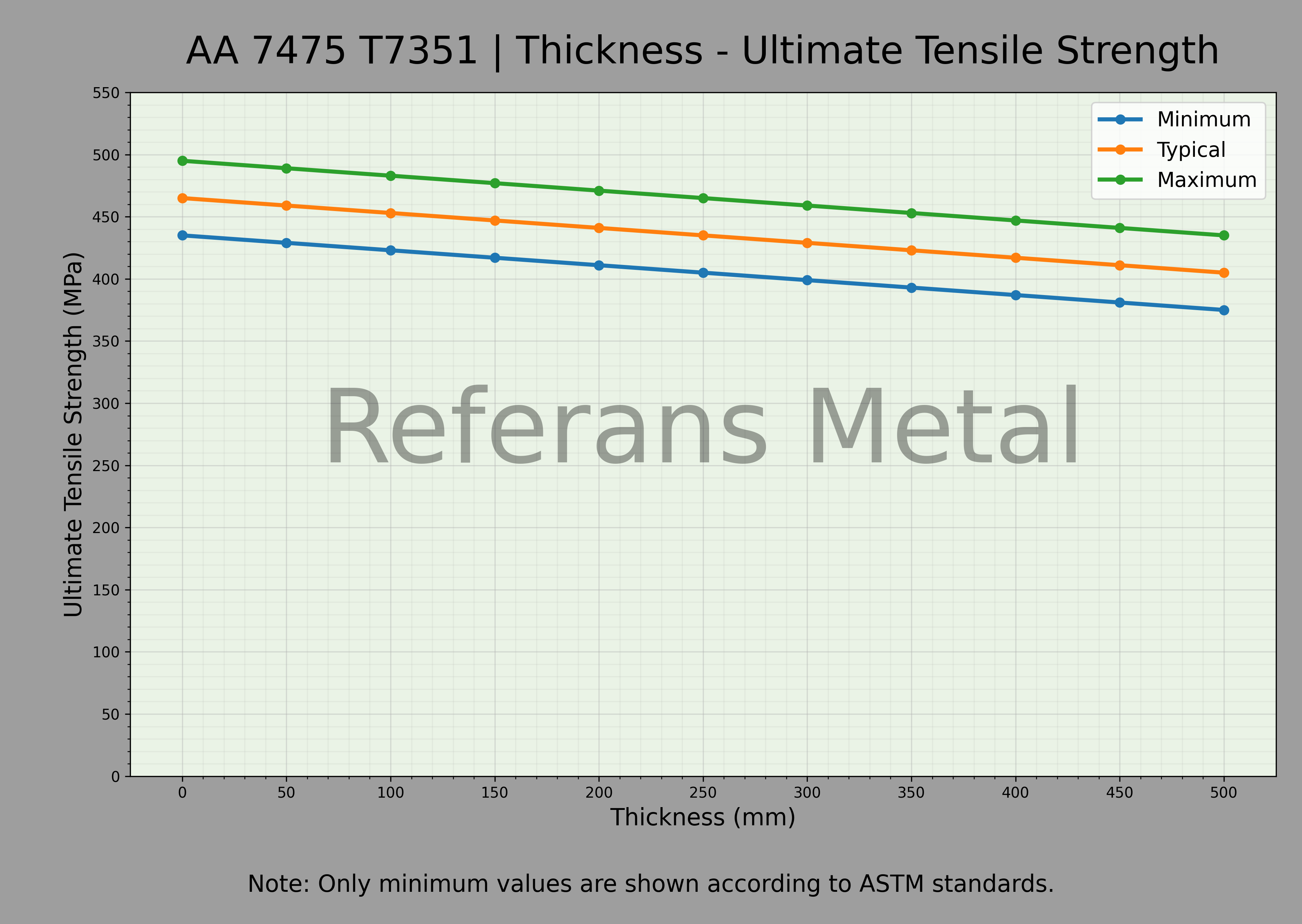
| 7475 T7351 Thickness – Ultimate Tensile Strength Graph |
 |
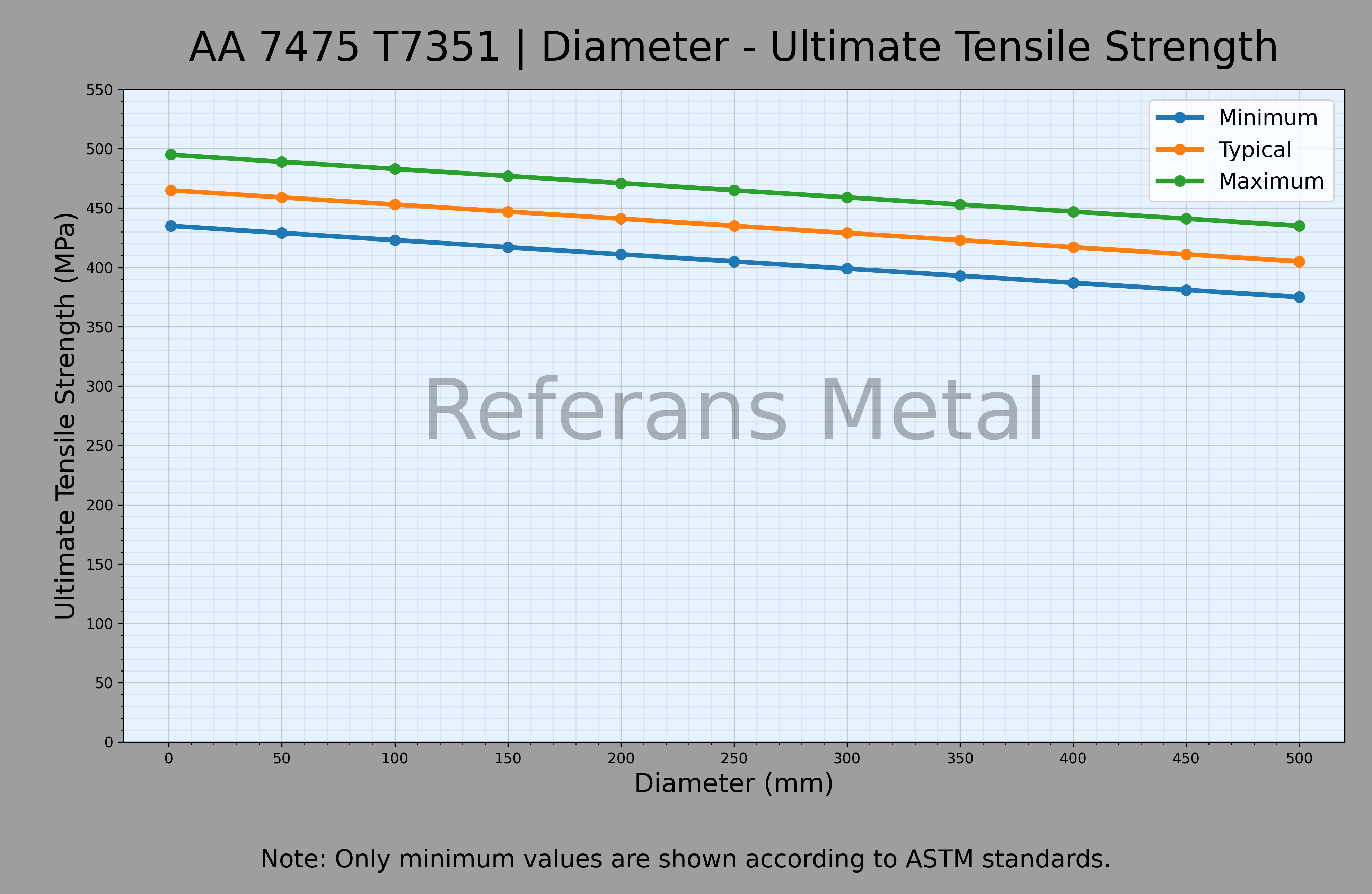
| 7475 T7351 Diameter – Ultimate Tensile Strength Graph |
 |
MATERIAL COMPOSITION STANDARDS
MINIMUM FRACTURE TOUGHNESS VALUES FOR 7475 T7351
(Fracture Toughness)
KIc: ksi√in.(MPa√m)*
Temper Thickness L-T T-L
T7351 1.250-4.000 in. 41.0 (45.0) 34.0 (37.3)
(31.75-101.60 mm)
Characteristic Properties for 7475 T7351:
- Strength: Good
- Machinability: Medium
- Weldability: Poor
- Formability: Normal
- Corrosion Resistance: High
- Heat Treatment: Yes
Some Known Applications for 7475 T7351:
Designs of steam exhaust systems operating at high temperatures.
Widely used in aerospace transportation and logistics applications.
Components in railway transportation vehicles.
STOCK
7475 T7351 is supplied in plate and sheet form.
- Plate
- Sheet
DELIVERY:
| Mechanical Properties | |||
| Thickness (mm) | Yield Strength (Min.) | Ultimate Strength (Min.) | Elongation A50 mm % |
| over 25.43 up to & incl. 38.10 | 414 MPa | 490 MPa | 9 |
| over 50.83 up to & incl. 63.50 | 393 MPa | 476 MPa | 8 |
| over 76.25 up to & incl. 88.90 | 365 MPa | 448 MPa | 8 |
 Weight Calculator