
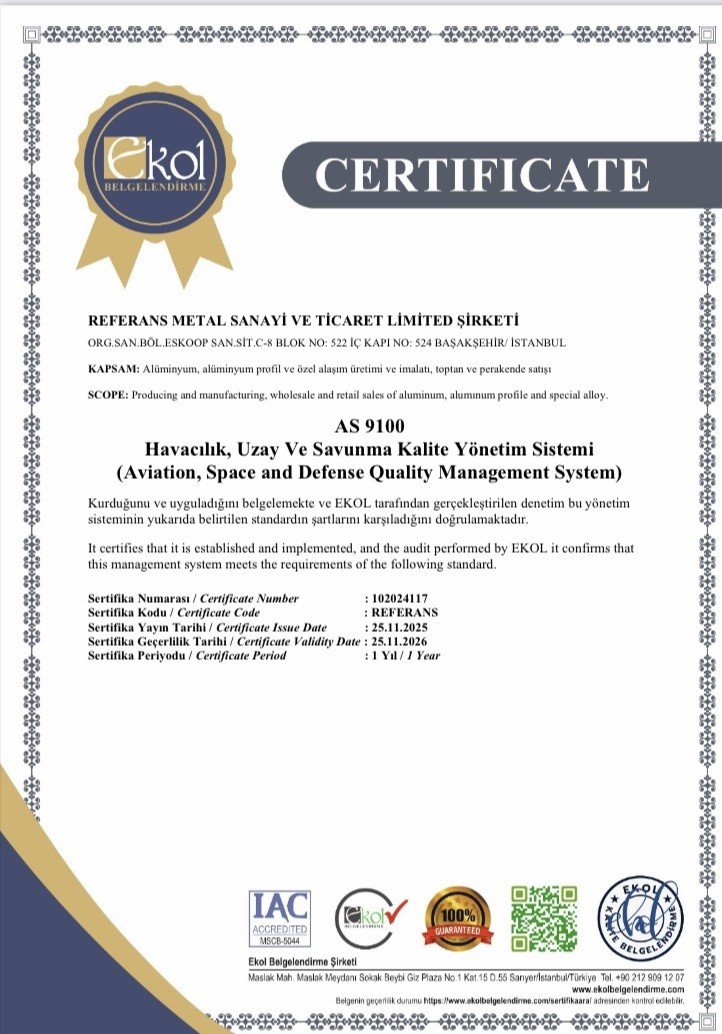
 AS 9100
 SPACE 2009
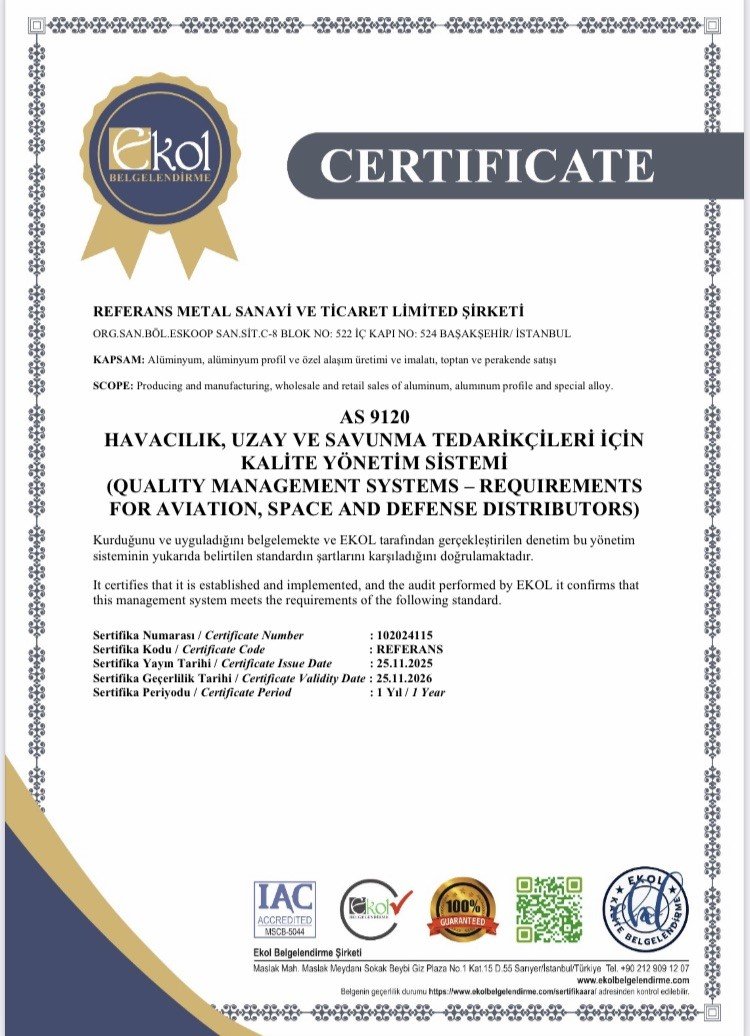 AS 9120




Plates
Sheets
Rod/Round Bar/Flat Bar
Tube/Extrusions/Profile
2219
AMS 4031 / AlCu6Mn / 2219 / O
| Chemical Properties | % Value |
| Silicon (Si) | 0,00 - 0,20 |
| Manganese (Mn) | 0,20 - 0,40 |
| Magnesium (Mg) | 0,00 - 0,02 |
| Copper (Cu) | 5,80 - 6,80 |
| Titanium (Ti) | 0,02 - 0,10 |
| Iron (Fe) | 0,00 - 0,30 |
| Zinc (Zn) | 0,00 - 0,10 |
| Aluminium (Al) | Balance |
| Physical Properties | Value |
| Density | 2,84 g/cm³ |
| Melting Point | 543 °C |
| Thermal Expansion | 22.3 µm/m.°C |
| Modulus of Elasticity | 74 GPa |
| Thermal Conductivity | 171 W/m.K |
| Electrical Resistivity | 44 % IACS |
| Mechanical Properties | Value |
| Proof Strength | 75.8 MPa |
| Yield Strength | 172 MPa |
| Shear Strength | 106 MPa |
| Elongation A50 mm | 15% |
| Hardness | 46 HB |
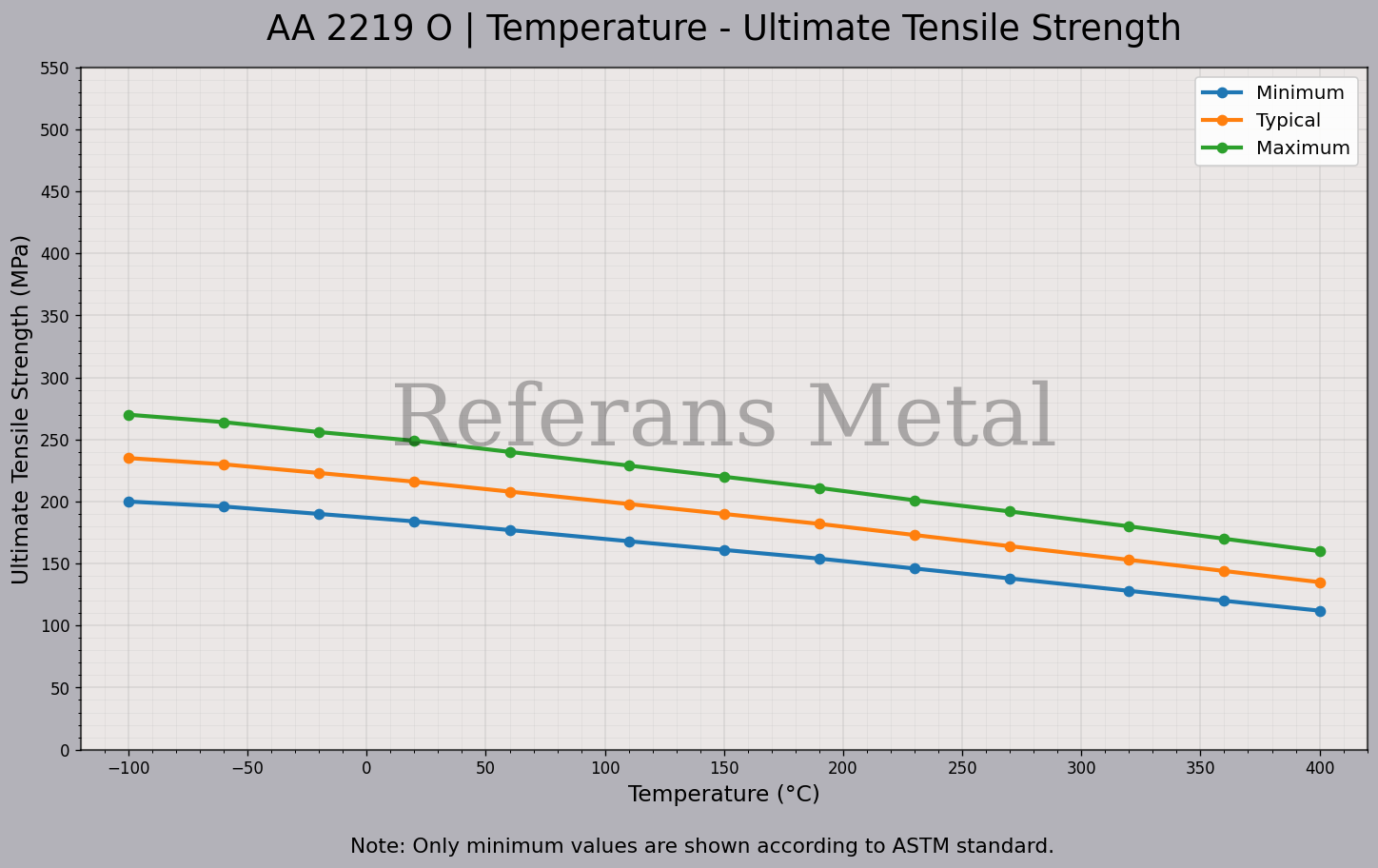
| 2219 O Temperature – Ultimate Tensile Strength Graph |
 |
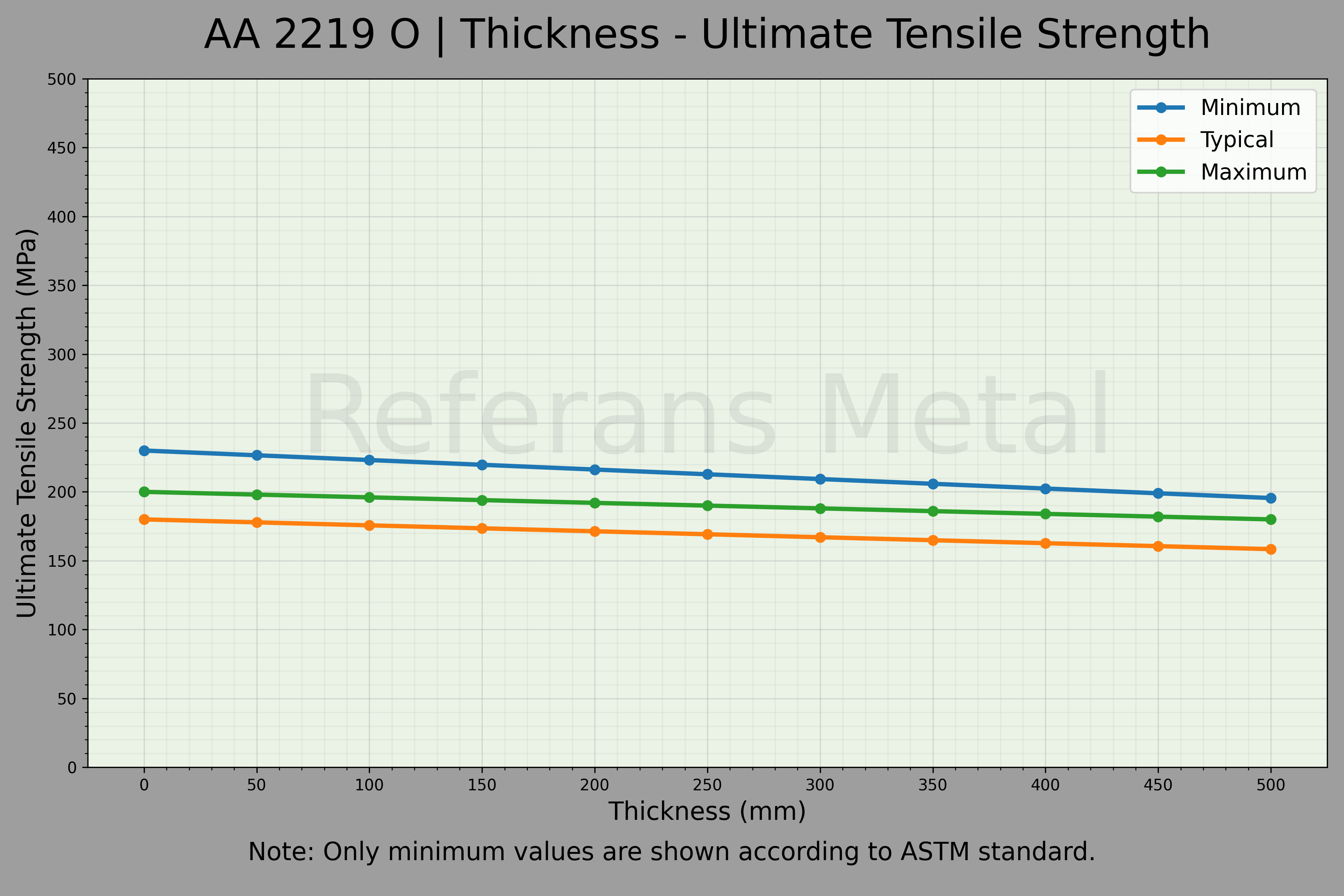
| 2219 O Thickness – Ultimate Tensile Strength Graph |
 |
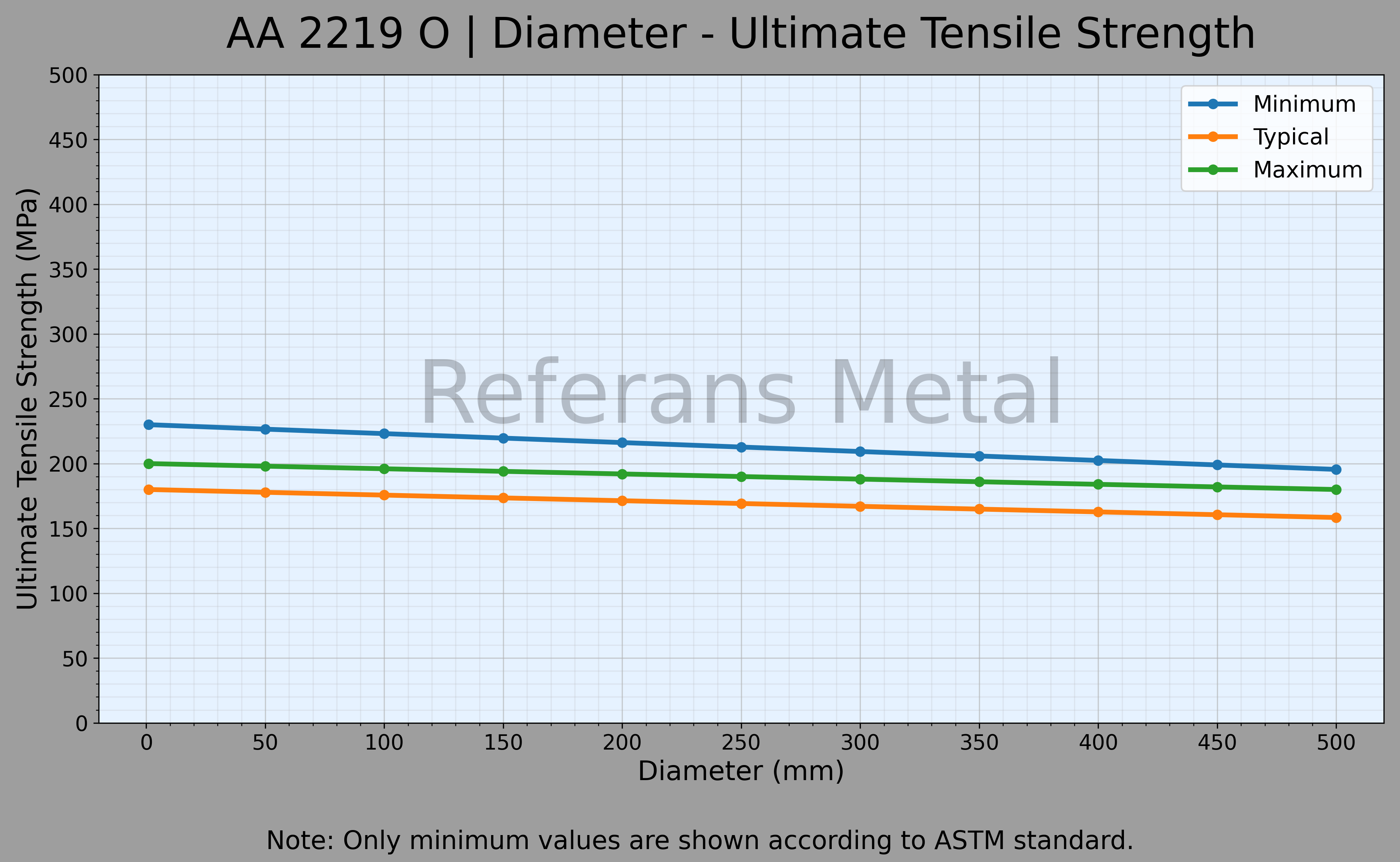
| 2219 O Diameter – Ultimate Tensile Strength Graph |
 |
Aluminum alloy 2219-O is an Al-Cu (aluminum-copper) series alloy that stands out particularly in applications requiring high-temperature strength. The 2219-O temper represents the annealed (softened) condition, offering maximum ductility and formability. This alloy is widely preferred in aerospace and aviation industries due to its ability to retain strength at elevated temperatures. Compared to alloys such as 2024 and 2014, 2219 demonstrates superior high-temperature performance, maintaining its mechanical properties even above 200°C.
In terms of corrosion resistance, 2219 alloy exhibits lower resistance than pure aluminum; however, this drawback can be significantly mitigated through appropriate coatings and surface treatments. Its coating capability is quite good, making it suitable for anodizing and painting processes. Compared to 6061 alloy, while 6061 has better natural corrosion resistance, the high-temperature performance of 2219 compensates for this difference in many applications. Therefore, it is preferred in environments dominated by thermal loads rather than chemical exposure.
Regarding strength and machinability, the 2219-O temper offers low strength but high ductility. This provides advantages in manufacturing complex geometries. Its machinability is generally good, but due to its softer structure compared to harder tempers like T6, careful machining is required. Compared to 7075 alloy, while 7075 offers significantly higher strength, 2219 stands out with better weldability and high-temperature resistance.
Bending properties and vibration response are among the strongest characteristics of 2219-O alloy. Its annealed structure allows for high deformation capability with a low risk of cracking, making it advantageous for producing complex-shaped components. Additionally, it exhibits stable behavior under vibration, ensuring reliability in structural applications. Compared to 5083 alloy, while 5083 offers better seawater resistance, 2219 provides superior high-temperature performance and post-weld strength advantages.
In terms of weldability, 2219 alloy is exceptionally weldable for an Al-Cu series alloy. Excellent results can be achieved using TIG and MIG welding methods, with minimal loss of strength after welding. Therefore, it is widely used in critical applications such as spacecraft, fuel tanks, pressure vessels, and aerospace structures. Overall, 2219-O alloy occupies a unique position among alloys like 2024, 6061, and 7075 due to its high-temperature strength, good formability, and superior weldability.
MATERIAL COMPOSITION STANDARDS
2219 O can be produced according to the following standards.
• 2219 O Plate; ASTM B209, UNS A92219, AMS 4031, AMS QQ-A-250/30A, ISO AlCu6Mn
• 2219 O Sheet; ASTM B209, UNS A92219, AMS 4031, AMS QQ-A-250/30A, ISO AlCu6Mn
• 2219 O Extrusion Rod; ASTM B221, UNS A92219, ISO AlCu6Mn
• 2219 O Extrusion Tube; ASTM B221, UNS A92219, ISO AlCu6Mn
• 2219 O Extrusion Flat Bar; ASTM B221, UNS A92219, ISO AlCu6Mn
• 2219 O Extrusion Wire; ASTM B221, UNS A92219, ISO AlCu6Mn
Characteristic Properties of 2219 O:
- Strength: Average
- Machinability: Poor
- Weldability: Excellent
- Formability: Good
- Corrosion Resistance: Above Average
- Heat Treatment: Yes
Some Well-Known Applications for 2219 O:
In the aerospace industry,
As a structural component of aircraft fuselages,
Also used in booster rockets.
STOCK
- Rod / Flat Bar
- Tube / Profile
 Weight Calculator