
 AS 9100
 SPACE 2009
 AS 9120




6061
EN AW / AlMg1SiCu / 6061 / T42
| Chemical Properties | % Value |
| Silicon (Si) | 0,40 - 0,80 |
| Chromium (Cr) | 0,04 - 0,35 |
| Manganese (Mn) | 0,00 - 0,15 |
| Magnesium (Mg) | 0,80 - 1,20 |
| Copper (Cu) | 0,15 - 0,40 |
| Titanium (Ti) | 0,00 - 0,15 |
| Iron (Fe) | 0,00 - 0,70 |
| Zinc (Zn) | 0,00 - 0,25 |
| Aluminium (Al) | Balance |
| Physical Properties | Value |
| Density | 2.70 g/cm³ |
| Melting Point | 582 °C |
| Thermal Expansion | 23.4 µm/m.°C |
| Modulus of Elasticity | 69 GPa |
| Thermal Conductivity | 170 W/m.K |
| Electrical Resistivity | 43% IACS |
| Mechanical Properties | Value |
| Yield Strength | 110 MPa |
| Ultimate Strength | 230 MPa |
| Shear Strength | 140 MPa |
| Elongation A50 mm | 18% |
| Hardness | 57 HB |
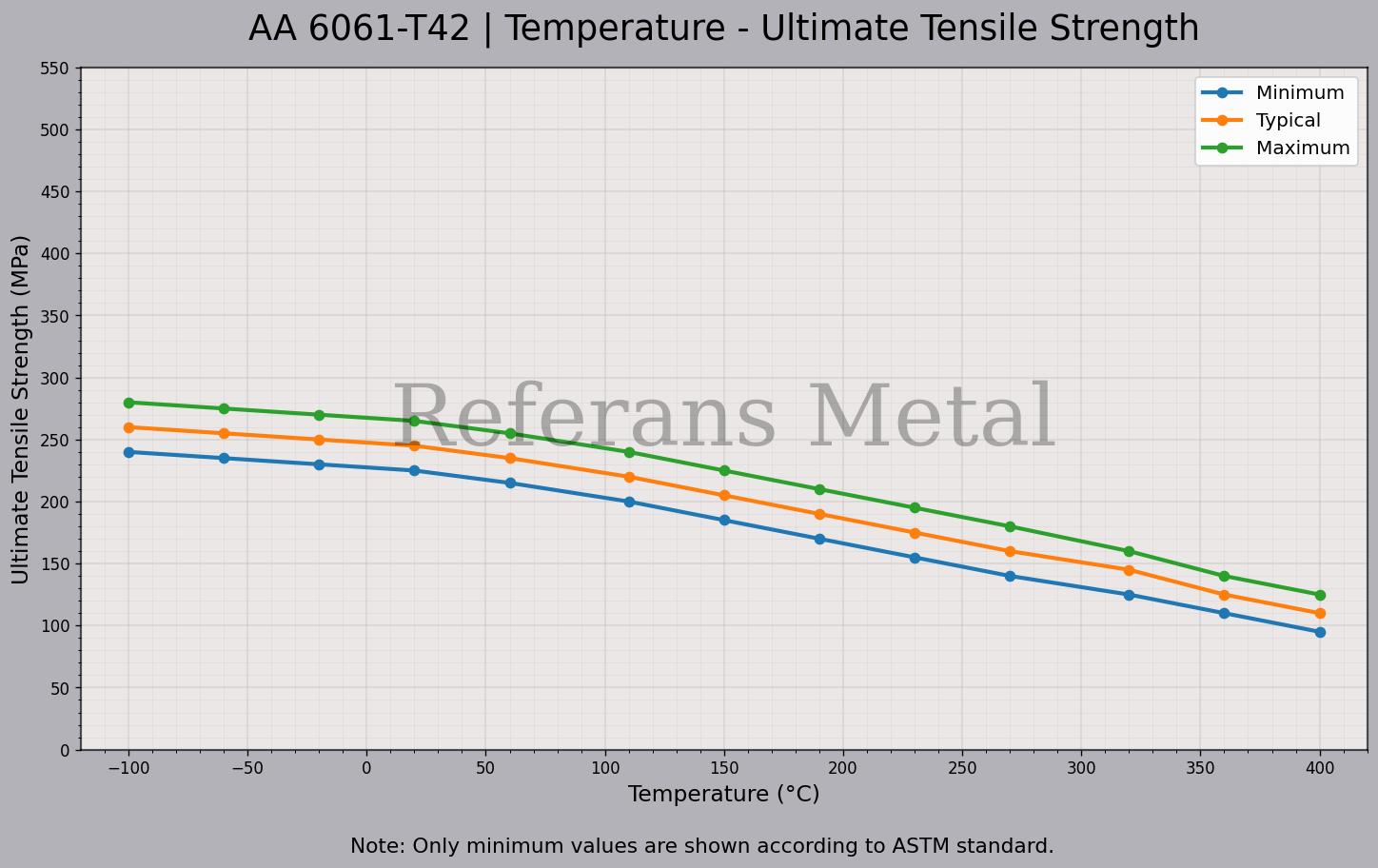
| 6061 T42 Temperature – Ultimate Tensile Strength Graph |
 |
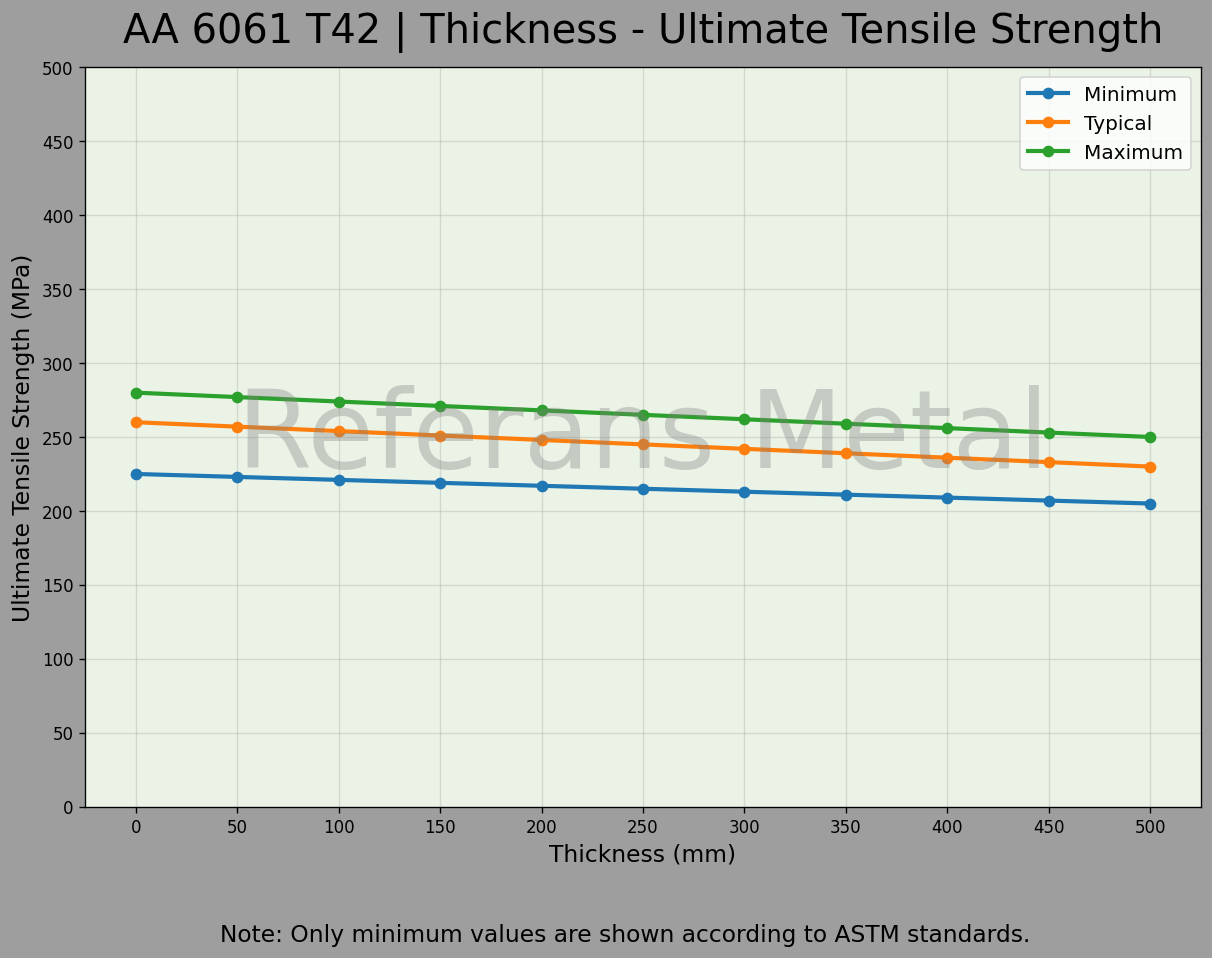
| 6061 T42 Thickness – Ultimate Tensile Strength Graph |
 |
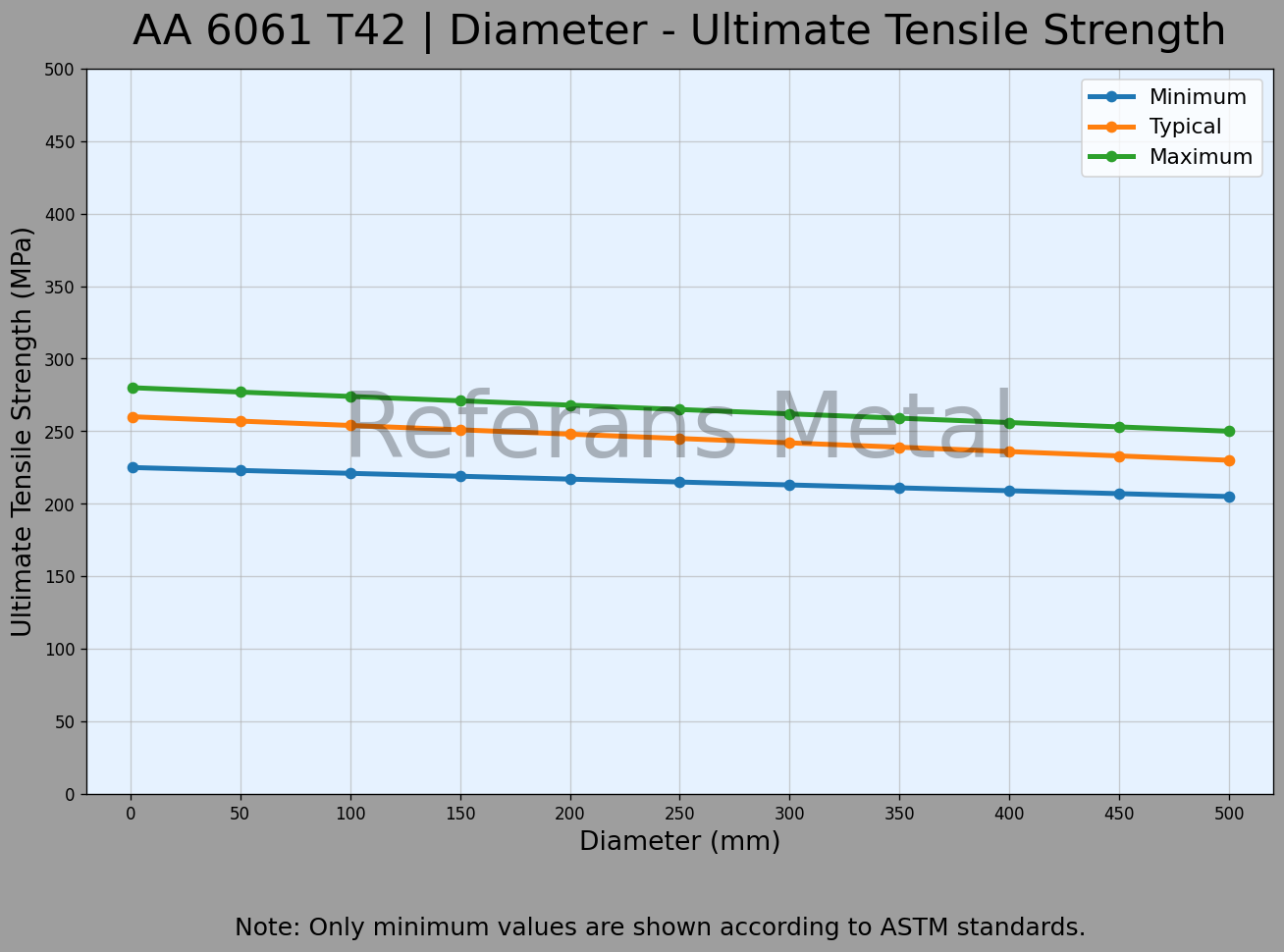
| 6061 T42 Diameter – Ultimate Tensile Strength Graph |
 |
6061-T42 aluminum alloy is a member of the 6xxx series, based on Mg-Si (magnesium-silicon) composition, and stands out with its combination of heat treatability, medium-to-high strength, and good corrosion resistance. The T42 temper indicates solution heat treatment followed by natural aging, providing a balanced level of mechanical properties. This alloy is widely used in both structural and general engineering applications.
In terms of corrosion resistance, 6061-T42 performs very well, especially in atmospheric conditions and mild chemical environments. It is highly suitable for anodizing, which enhances surface protection. This makes it advantageous in industries such as marine, construction, and automotive. Compared to alloy 2024, it offers significantly better corrosion resistance, while showing similar performance to 5083 alloy.
Regarding strength, 6061-T42 provides a moderate level of mechanical performance. Its yield strength and tensile strength are lower than high-strength alloys like 7075 but higher than 6063 alloy. Therefore, it offers a balanced solution for applications requiring both strength and formability. Additionally, its fatigue strength is sufficient for many engineering uses.
Machinability and bending properties are among the key advantages of 6061-T42. The alloy is known for good chip formation and low tool wear. It is also suitable for cold forming and bending operations under proper conditions. Compared to 2024, it is easier to form, although it does not reach the high formability levels of 5052 alloy.
Weldability is one of the strongest features of 6061-T42. It can be easily welded using TIG and MIG welding methods, with a low risk of cracking after welding. In addition, it shows balanced performance in terms of vibration response and damping capacity. Due to these properties, the alloy is widely used in aerospace, automotive, machinery manufacturing, structural profiles, and industrial equipment.
Material Composition Standards
6061 T42 is available according to the following standards:
• 6061 T42 Plate; UNS A96061, WNR 3.3211, ISO AlMg1SiCu, ASTM B209
• 6061 T42 Sheet; UNS A96061, WNR 3.3211, ISO AlMg1SiCu, ASTM B209
Key Characteristics of 6061 T42:
- Strength: Normal
- Machinability: Good
- Weldability: Very good
- Formability: Moderate
- Corrosion Resistance: Very good
- Heat Treatment: Yes
Some Well-Known Applications of 6061 T42:
Cargo doors of airplanes and helicopters,
In architectural applications,
Used as machinery equipment and fasteners in the machine industry.
Stock
We produce and supply 6061 T42 in Sheet/Plate forms.
- Sheet
- Plate
| Mechanical Properties | |||
| Thickness (mm) | Yield Strength (Min.) | Ultimate Strength (Min.) | Elongation A50 mm % |
| Over 0.4 up to & incl. 1.5 | 241 | 262 | %8 |
| Over 1.5 up to & incl. 3.0 | 241 | 262 | %14 |
| Over 3.0 up to & incl. 6.0 | 241 | 262 | %16 |
| Over 6.0 up to & incl. 12.0 | 241 | 262 | %18 |
 Weight Calculator