
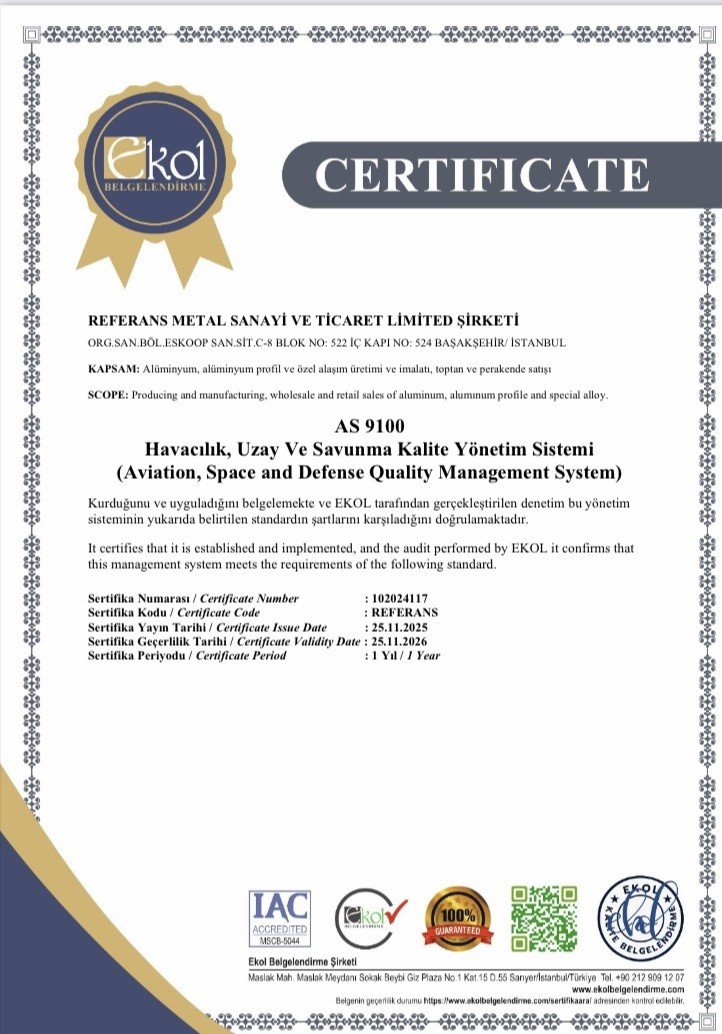
 AS 9100
 SPACE 2009
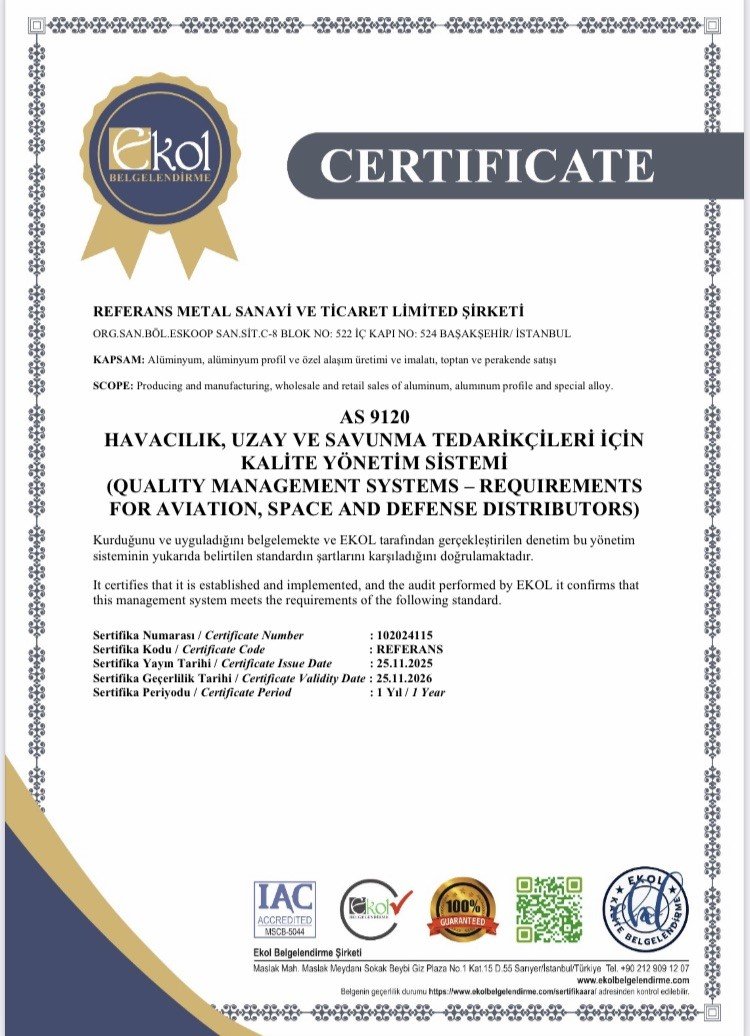 AS 9120




Plates
Sheets
Rod/Round Bar/Flat Bar
Tube/Extrusions/Profile
2011
ASTM B221 / AlCu6BiPb / 2011 / T451
| Chemical Properties | % Value |
| Silicon (Si) | 0,40 Max |
| Copper (Cu) | 5,00 - 6,00 |
| Lead (Pb) | 0,20 - 0,60 |
| Iron (Fe) | 0,70 Max |
| Zinc (Zn) | 0,00 - 0,30 |
| Aluminium (Al) | Balance |
| Physical Properties | Value |
| Density | 2.82 g/cm³ |
| Melting Point | 540 °C |
| Thermal Expansion | 21.4 µm/m.°C |
| Modulus of Elasticity | 70 GPa |
| Thermal Conductivity | 140 W/m.K |
| Electrical Resistivity | 35% IACS |
| Mechanical Properties | Value |
| Proof Strength | 140 MPa |
| Yield Strength | 300 MPa |
| Shear Strength | 190 MPa |
| Elongation A50 mm | 16% |
| Hardness | 105 HB |
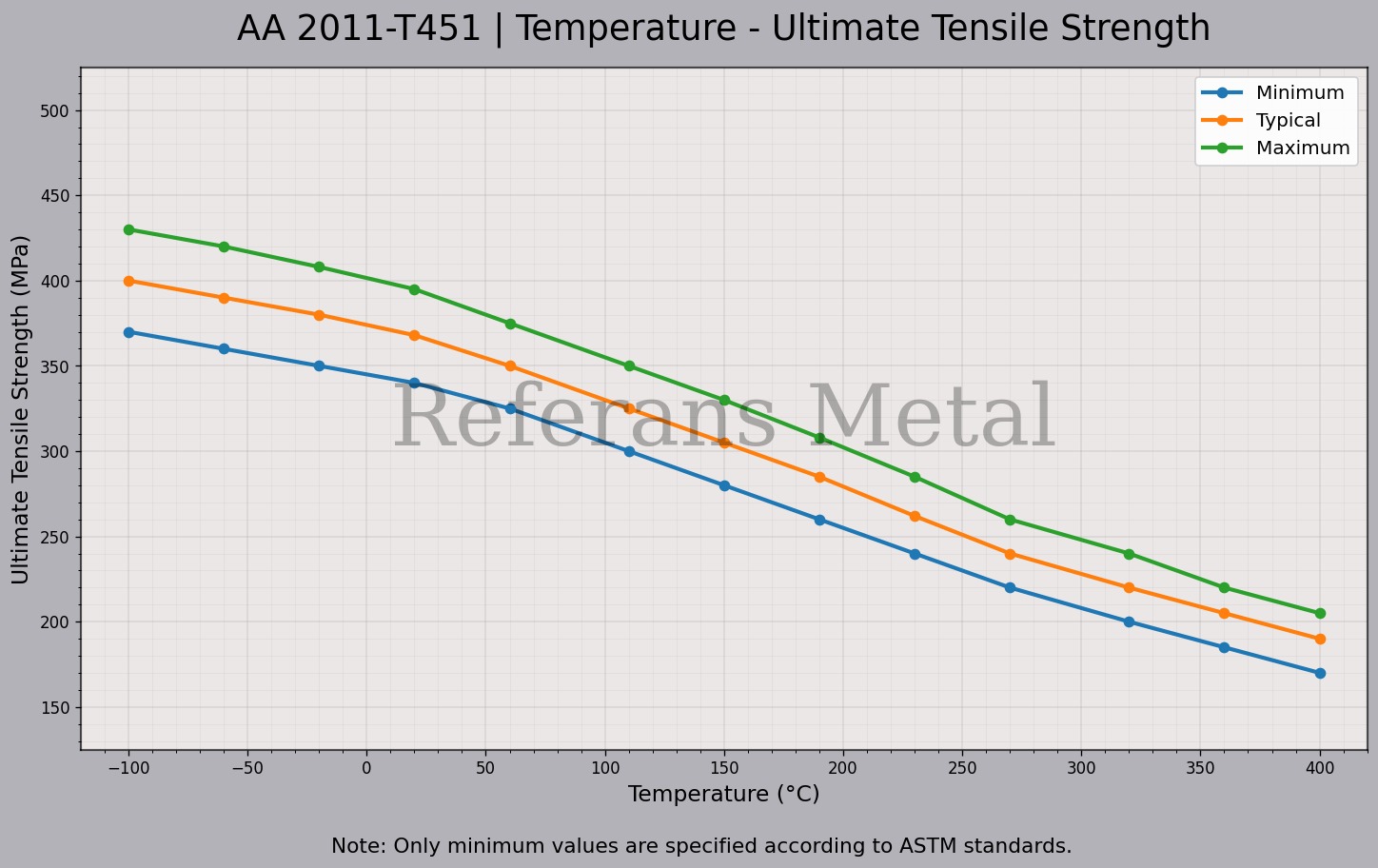
| 2011 T451 Temperature – Ultimate Tensile Strength Graph |
 |
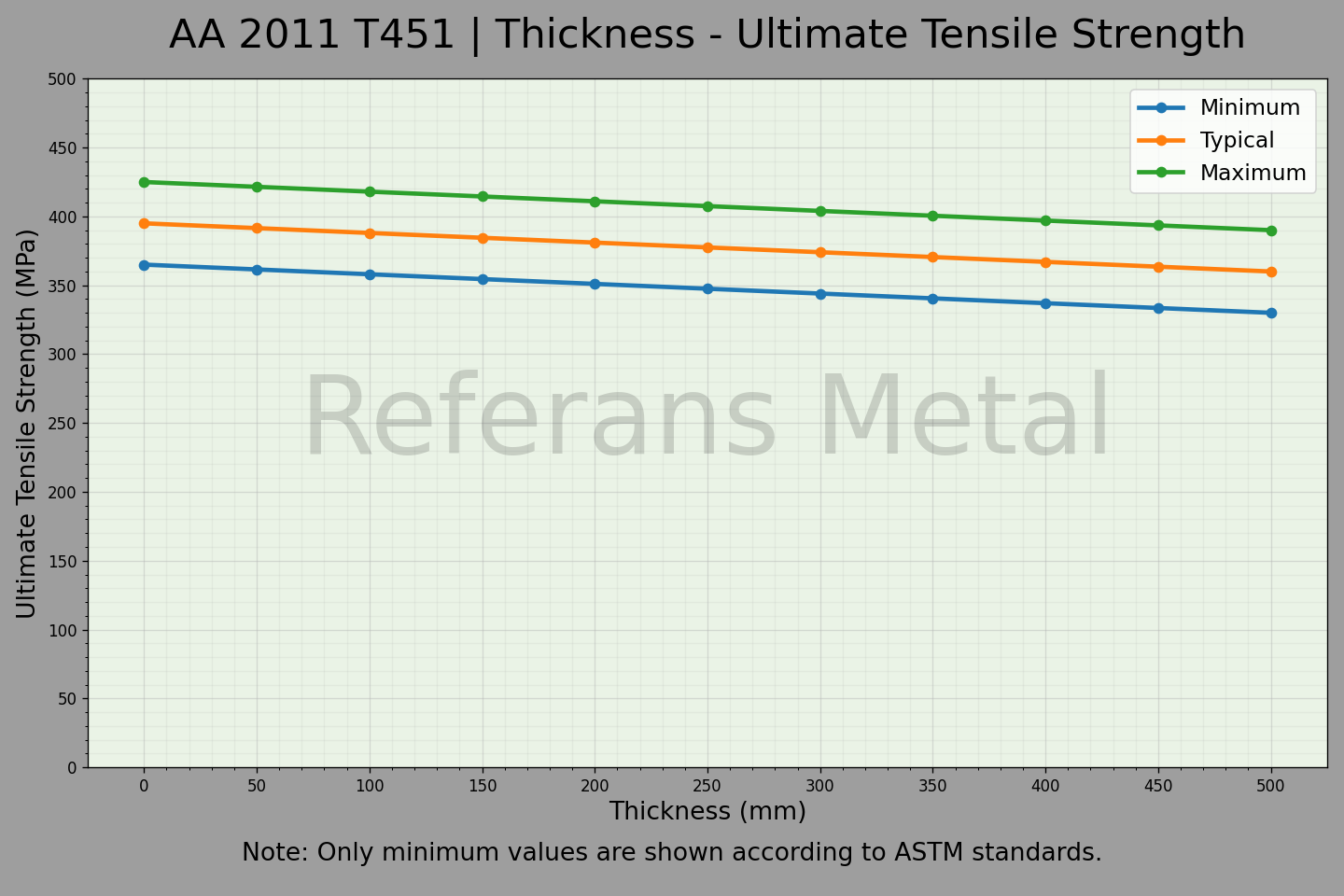
| 2011 T451 Thickness – Ultimate Tensile Strength Graph |
 |
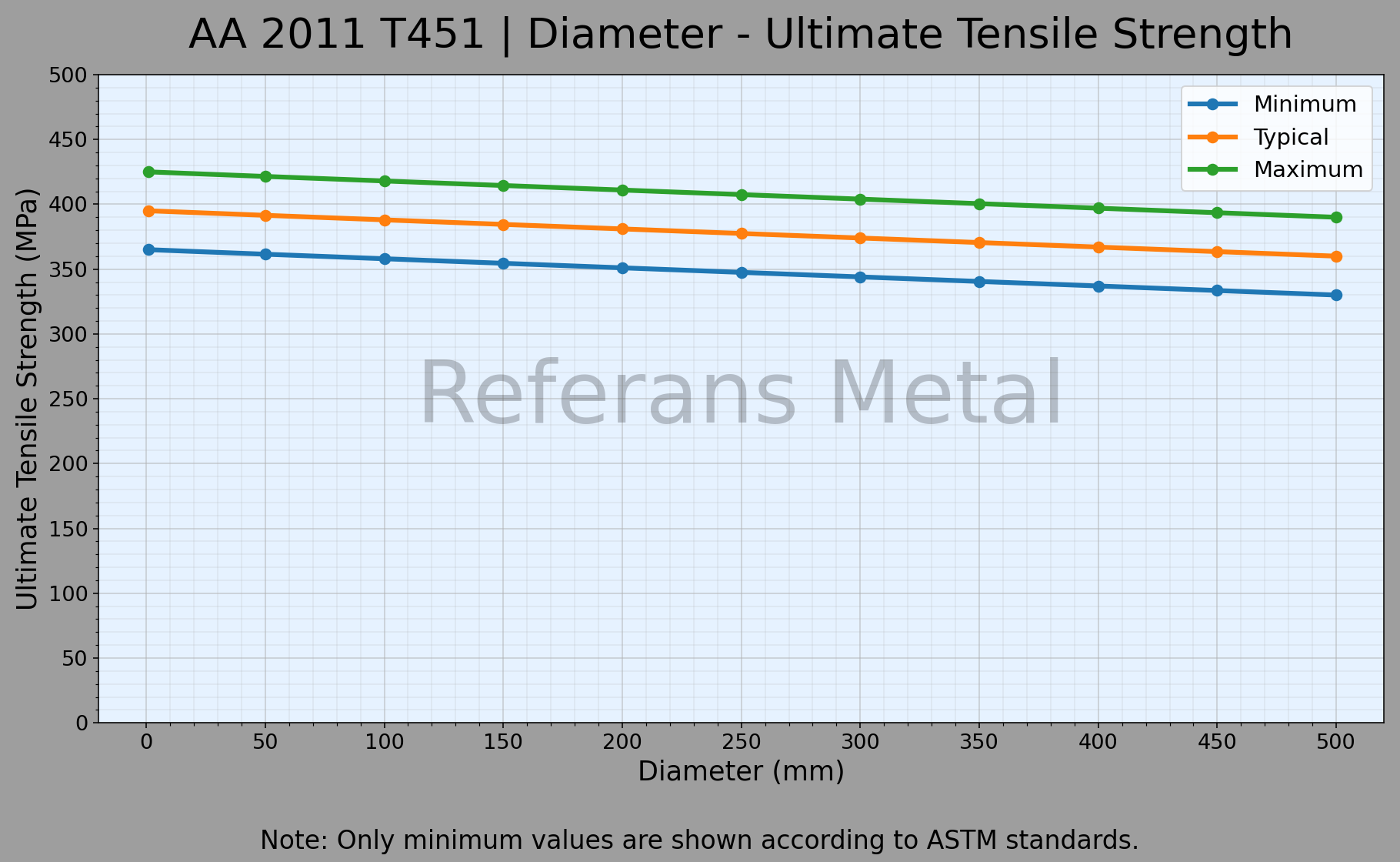
| 2011 T451 Diameter – Ultimate Tensile Strength Graph |
 |
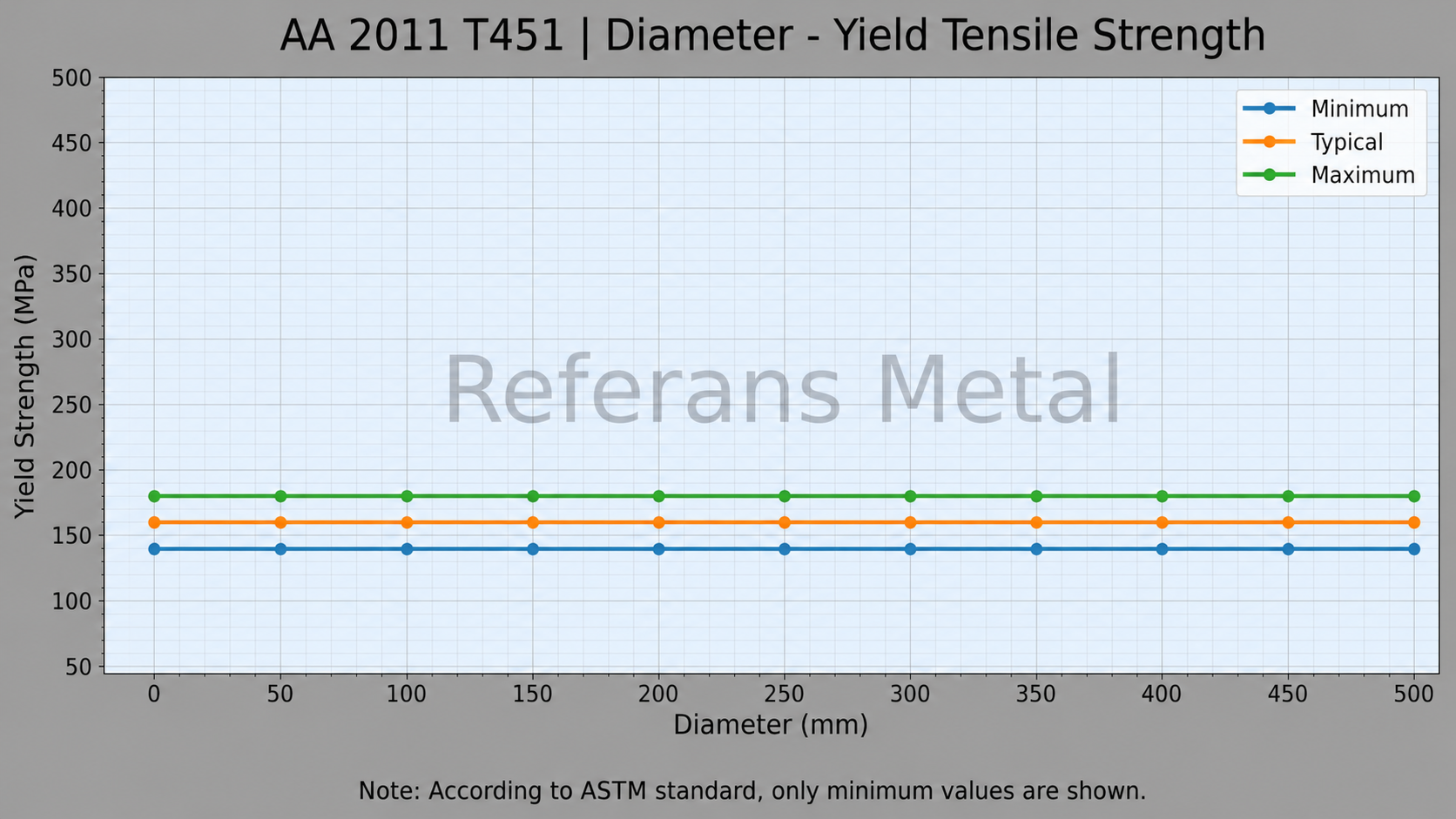
| 2011 T451 Diameter-Yield Tensile Strength |
 |
2011 T451 aluminum alloy is a free-machining alloy with a high copper content that is particularly known for its excellent machinability. This alloy is widely preferred in applications requiring extensive machining. Its strength is moderate, and it provides stable mechanical properties especially in the production of precision components. However, its corrosion resistance is lower compared with pure aluminum alloys, and it is often supported with surface coatings or protective treatments. When compared with alloys such as 2014 and 2024, its mechanical strength is lower, but its machinability is significantly higher.
The most distinctive characteristic of the 2011 T451 alloy is its outstanding machinability. Due to its structure containing lead and bismuth, chip breaking is very easy and stable production can be achieved even at high cutting speeds. For this reason, it is frequently used in sectors such as automotive manufacturing, machinery production, and precision mechanical parts. Compared with alloy 6061, alloy 2011 offers significantly better machinability, whereas 6061 provides advantages in weldability and corrosion resistance.
In terms of bending and forming properties, the 2011 T451 alloy has limited formability. Because of its high copper content and relatively high strength, cracking may occur especially during cold bending operations. Therefore, in applications requiring complex forming operations, more ductile alloys such as 5052 or 3003 are usually preferred. Nevertheless, alloy 2011 provides major advantages in the production of small and complex parts that require high machining precision.
Regarding coatability and surface treatments, the 2011 T451 alloy can generally be used with anodizing and various coating processes. However, due to its copper content, the anodized surface color may differ from that of other alloys. Its corrosion resistance is particularly limited in marine environments, therefore protective coatings are commonly used in many applications. In contrast, architectural alloys such as 6063 often provide better anodizing quality.
In terms of vibration response and weldability, the 2011 T451 alloy is generally not considered suitable for welding. Because of its copper content and free-machining elements, there is a high risk of cracking during welding. For structures requiring welding, alloys such as 6061 or 5083 are more commonly used. Nevertheless, alloy 2011 occupies an important place in the production of fasteners, precision machine components, automotive parts, electronic components, and high-precision machined products such as screws and nuts.
MATERIAL COMPOSITION STANDARDS
2011 T451 can be available in the following standards:
• 2011 T451 Extruded Round Bar; ASTM B221, UNS A92011, WNR 3.1655, ISO AlCu6BiPb, AFNOR A-U5PbBi, UNE L-3192, UNI 9002/5
• 2011 T451 Extruded Flat Bar; ASTM B221, UNS A92011, WNR 3.1655, ISO AlCu6BiPb, AFNOR A-U5PbBi, UNE L-3192, UNI 9002/5
• 2011 T451 Extruded Wire; ASTM B221, UNS A92011, WNR 3.1655, ISO AlCu6BiPb, AFNOR A-U5PbBi, UNE L-3192, UNI 9002/5
• 2011 T451 Extruded Tube; ASTM B221, UNS A92011, WNR 3.1655, ISO AlCu6BiPb, AFNOR A-U5PbBi, UNE L-3192, UNI 9002/5
KEY CHARACTERISTICS OF 2011 T451:
- Strength: Good
- Machinability: Very Good
- Weldability: Low
- Formability: Moderate
- Corrosion Resistance: Low
- Heat Treatable: Yes
SOME WELL-KNOWN APPLICATIONS OF 2011 T451:
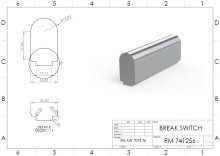
In speedometer frames,
Decorative elements,
Also used in variable-stroke engines.
STOCK
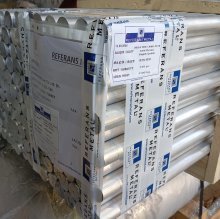
2011 T451 is produced and supplied in rod/flat bar and tube/profile forms.
- Rod / Flat Bar
- Tube / Profile
 Weight Calculator