
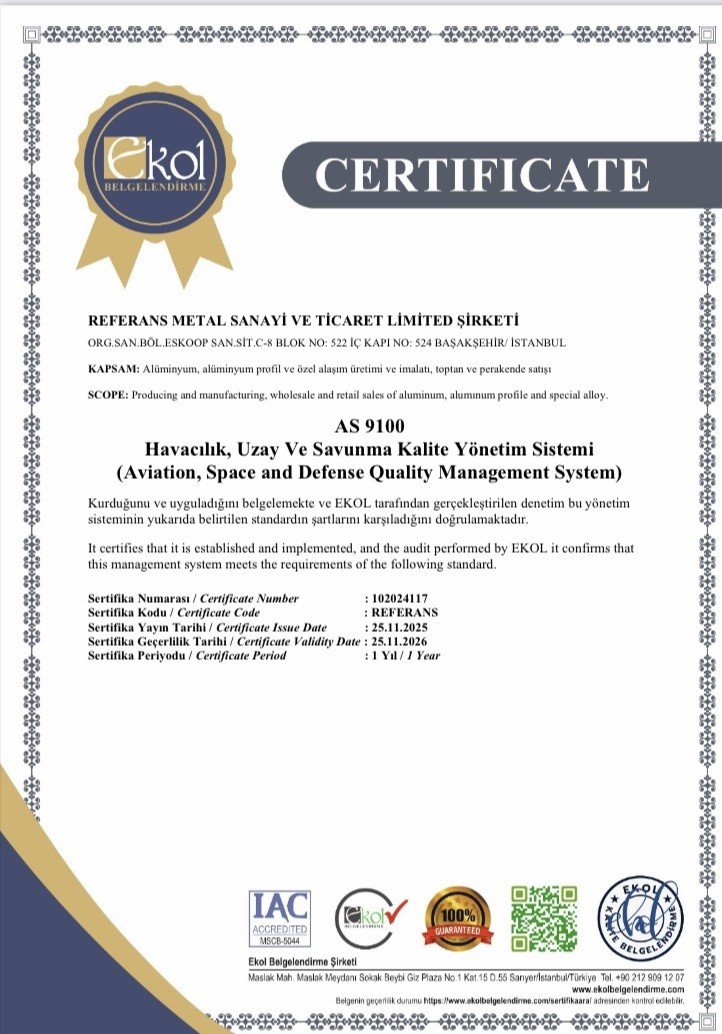
 AS 9100
 SPACE 2009
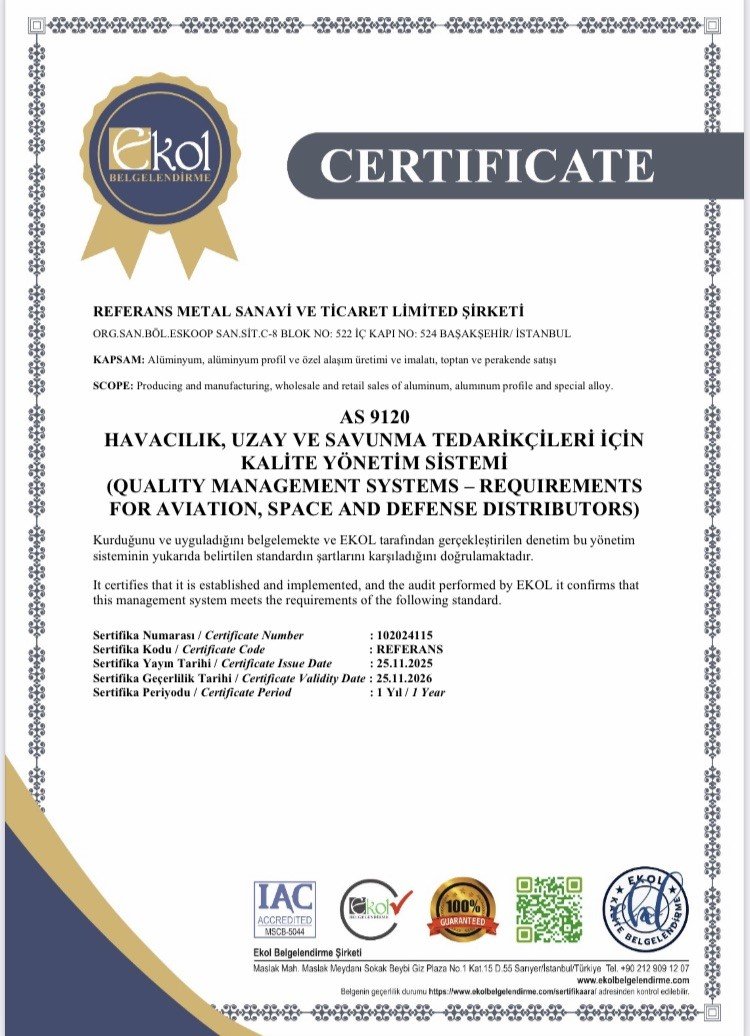 AS 9120




6013
ASTM B209 / AlMg1Si0.8CuMn / 6013 / T651
| Chemical Properties | % Value |
| Silicon (Si) | 0,60 - 1,00 |
| Chromium (Cr) | 0,00 - 0,10 |
| Manganese (Mn) | 0,20 - 0,80 |
| Magnesium (Mg) | 0,80 - 1,20 |
| Copper (Cu) | 0,60 - 1,10 |
| Titanium (Ti) | 0,00 - 0,10 |
| Iron (Fe) | 0,00 - 0,50 |
| Zinc (Zn) | 0,00 - 0,25 |
| Aluminium (Al) | Balance |
| Physical Properties | Value |
| Density | 2,71 g/cm³ |
| Melting Point | 579 °C |
| Thermal Expansion | 21.7 µm/m.°C |
| Modulus of Elasticity | 71 GPa |
| Thermal Conductivity | 164 W/m.K |
| Electrical Resistivity | %38 IACS |
| Mechanical Properties | Value |
| Yield Strength | 350 MPa |
| Ultimate Strength | 410 MPa |
| Shear Strength | 240 MPa |
| Elongation A50 mm | 4% |
| Hardness | 130 HB |
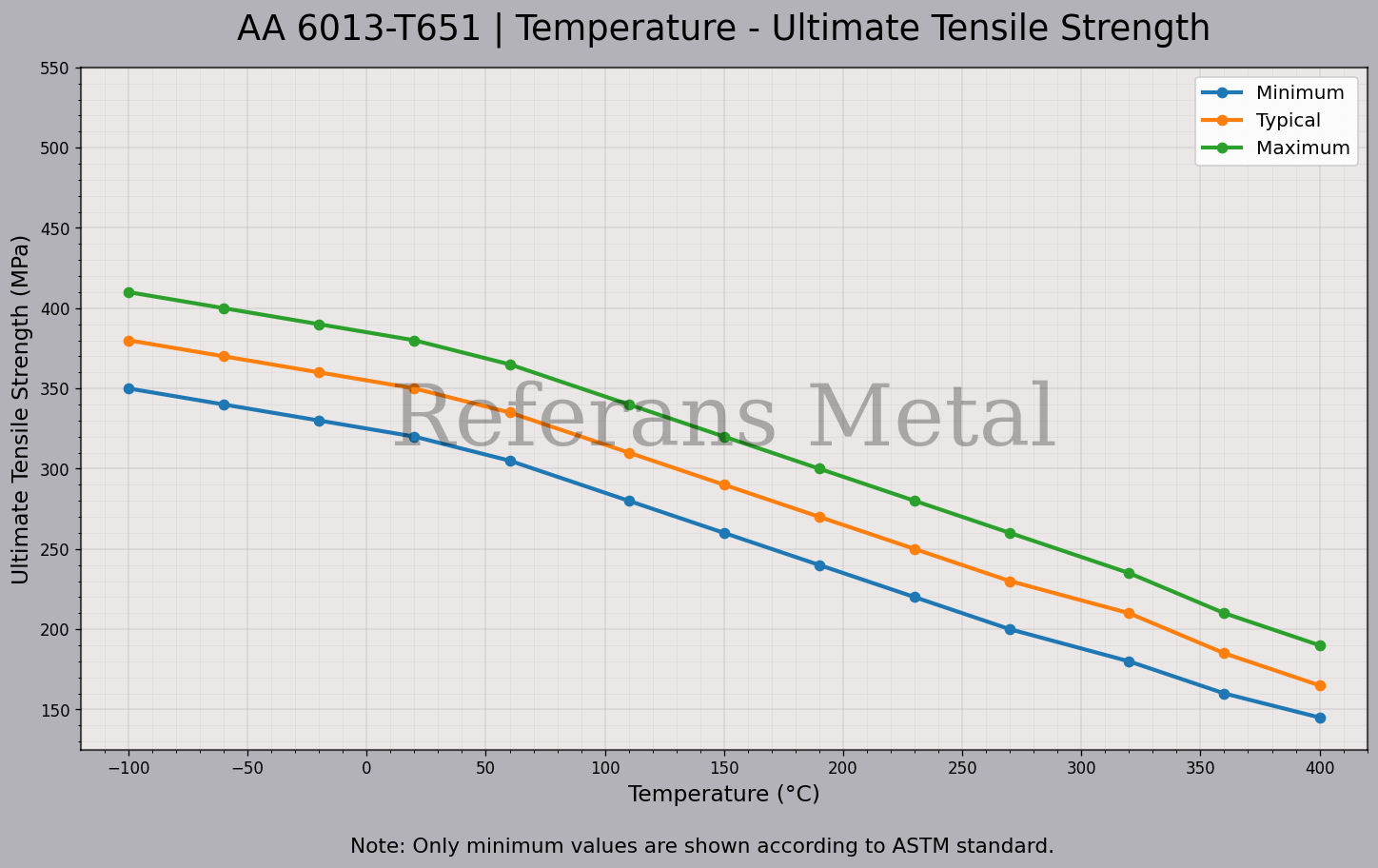
| 6013 T651 Temperature – Ultimate Tensile Strength Graph |
 |
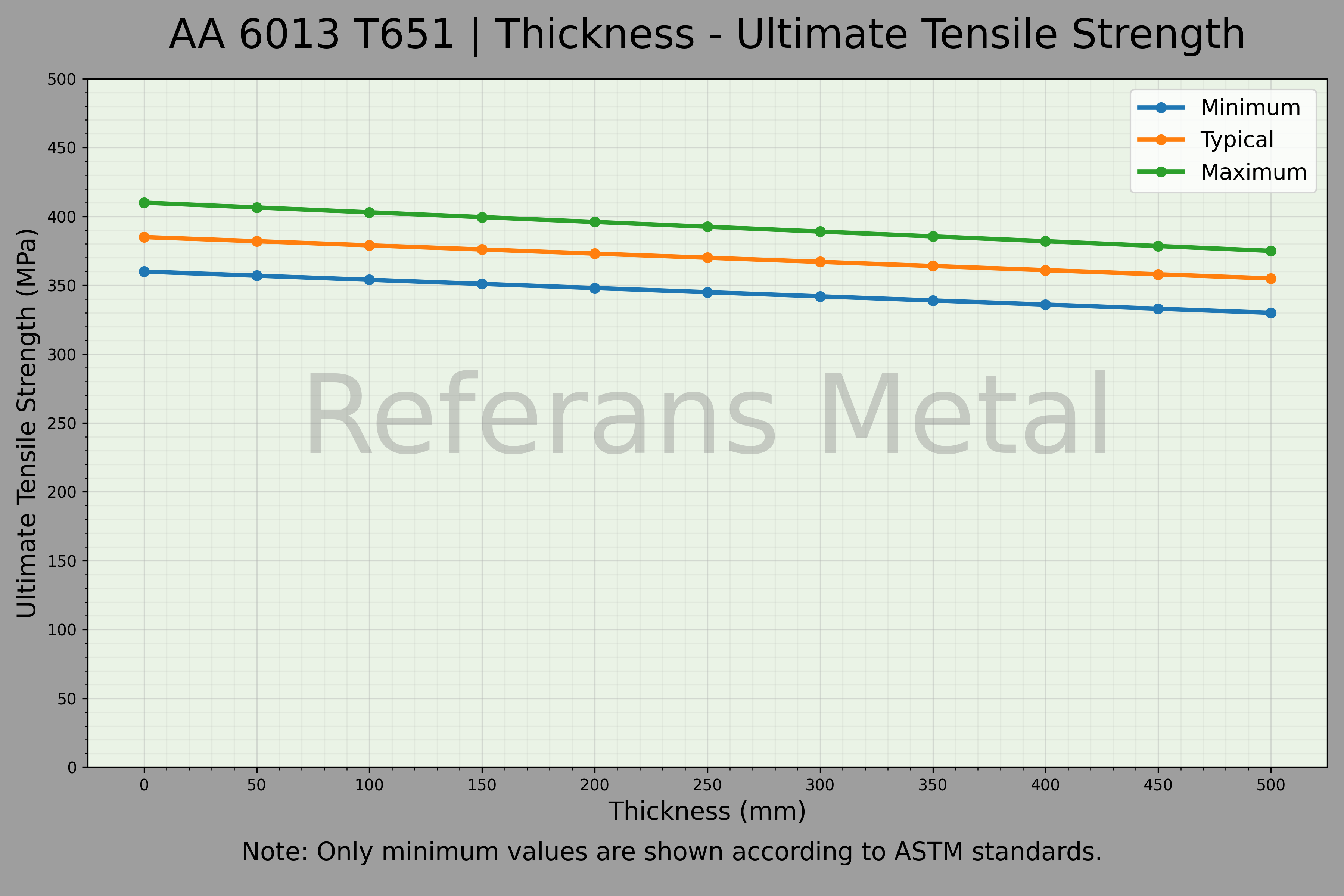
| 6013 T651 Thickness – Ultimate Tensile Strength Graph |
 |
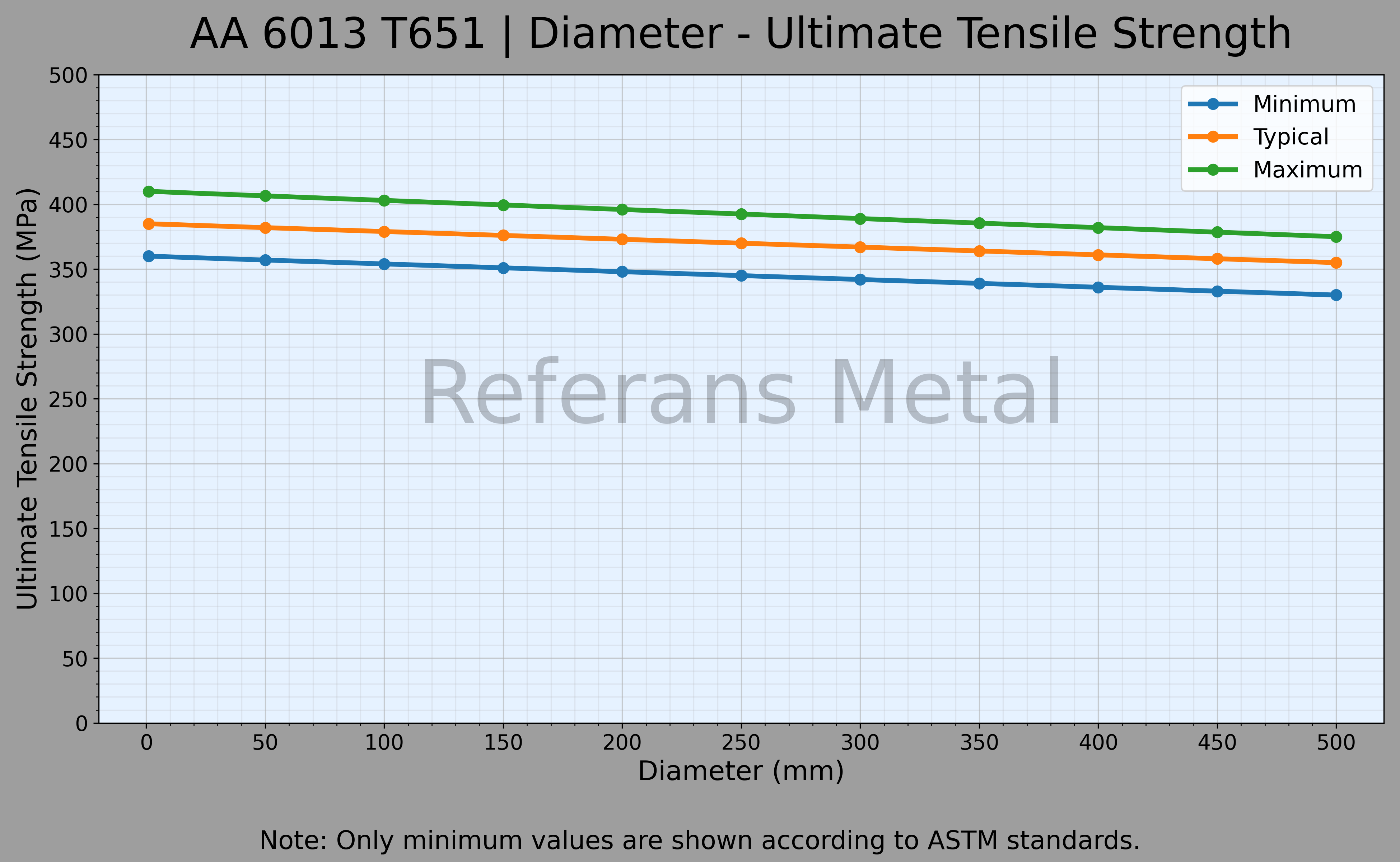
| 6013 T651 Diameter – Ultimate Tensile Strength Graph |
 |
The 6013 T651 aluminum alloy belongs to the Al-Mg-Si-Cu series and provides a balanced combination of high strength and good corrosion resistance. The T651 temper indicates that the material has been solution heat-treated, stress-relieved, and artificially aged to optimize dimensional stability and mechanical performance. This alloy is widely used in structural applications due to its medium-to-high strength and relatively low density. It offers good resistance to atmospheric corrosion, making it more advantageous than copper-rich alloys like 2024.
In terms of strength, 6013 T651 provides higher yield and tensile strength compared to 6061-T6, although it does not reach the strength levels of 7075-T6, but it(10).jpg) is also less brittle. This results in a more balanced mechanical performance. It also has good fatigue resistance and performs reliably under vibration loading, which is why it is commonly used in aerospace and automotive industries.
is also less brittle. This results in a more balanced mechanical performance. It also has good fatigue resistance and performs reliably under vibration loading, which is why it is commonly used in aerospace and automotive industries.
Regarding machinability and bending properties, 6013 offers better machinability than 2024 and provides stable results in machining operations. Due to the T651 temper, its bending capability is limited, but forming is still possible with proper processes. While 6061 has better bending capability, 6013 provides higher strength, offering engineers a valuable balance between strength and formability.
In terms of coating and surface treatments, 6013 responds well to anodizing and painting processes. Surface coatings can further enhance its corrosion resistance. While 7075 may show sensitivity to corrosion after coating, 6013 performs more reliably in this regard. Its surface quality also makes it suitable for decorative applications.
Regarding weldability and applications, 6013 offers better weldability compared to 2024 and 7075. It can be welded using MIG and TIG methods, although strength reduction should be considered. This alloy is widely used in aerospace structures, automotive components, rail systems, and high-performance machinery. Its vibration damping capability and balanced mechanical properties make it suitable for dynamically loaded systems.
Material Composition Standards
6013 T651 alloys are available according to the following standards:
• 6013 T651 Sheet; AMS 4347, UNS A96013, ASTM B209, ISO AlMg1Si0.8CuMn
• 6013 T651 Extruded Round Bar; UNS A96013, ASTM B221, ISO AlMg1Si0.8CuMn
• 6013 T651 Extruded Strip; UNS A96013, ASTM B221, ISO AlMg1Si0.8CuMn
• 6013 T651 Extruded Wire; UNS A96013, ASTM B221, ISO AlMg1Si0.8CuMn
• 6013 T651 Extruded Tube; UNS A96013, ASTM B221, ISO AlMg1Si0.8CuMn
Key Properties of 6013 T651 Alloys:
- Strength: High
- Machinability: Good
- Weldability: Medium
- Formability: Good
- Corrosion Resistance: Very Good
- Heat Treatment: Yes
Some Common Applications of 6013 T651 Alloys:
In valves and machinery parts,
In car body panels and bumpers,
In defense industries.
Stock
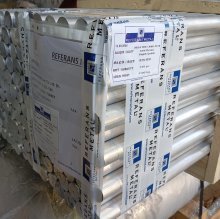
We produce and supply 6013 T651 alloys in sheets, bars/lamina, and tubes/profiles.
- Bars / Lamina
- Sheets / Plates
- Tubes / Profiles
 Weight Calculator