
 AS 9100
 SPACE 2009
 AS 9120




7075
ASTM B209 / AlZn5.5MgCu / 7075 / W
| Chemical Properties | % Value |
| Silicon (Si) | 0,00 - 0,40 |
| Chromium (Cr) | 0,18 - 0,28 |
| Manganese (Mn) | 0,00 - 0,30 |
| Magnesium (Mg) | 2,10 - 2,90 |
| Copper (Cu) | 1,20 - 2,00 |
| Titanium (Ti) | 0,00 - 0,20 |
| Iron (Fe) | 0,00 - 0,50 |
| Zinc (Zn) | 5,10 - 6,10 |
| Aluminium (Al) | Balance |
| Physical Properties | Value |
| Density | 2.81 g/cm³ |
| Melting Point | 477°C |
| Thermal Expansion | 24 µm/m.°C |
| Modulus of Elasticity | 71 GPa |
| Thermal Conductivity | 130 W/m.K |
| Electrical Resistivity | %33 IACS |
| Mechanical Properties | Value |
| Yield Strength | 138 Mpa |
| Ultimate Strength | 331 Mpa |
| Shear Strength | 130 MPa |
| Elongation A50 mm | %12 |
| Hardness | 150 HB |
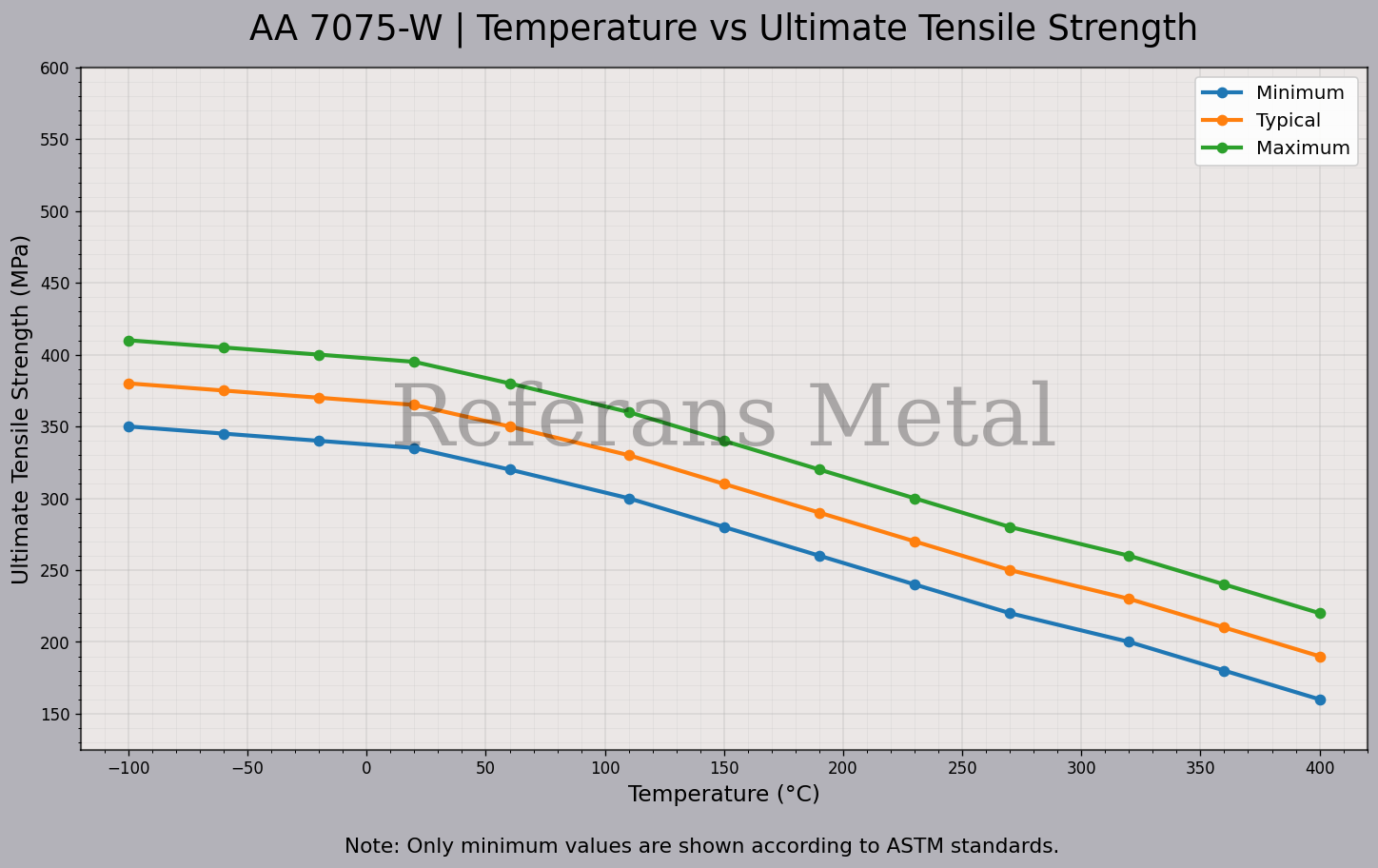
| 7075 W Temperature – Ultimate Tensile Strength Graph |
 |
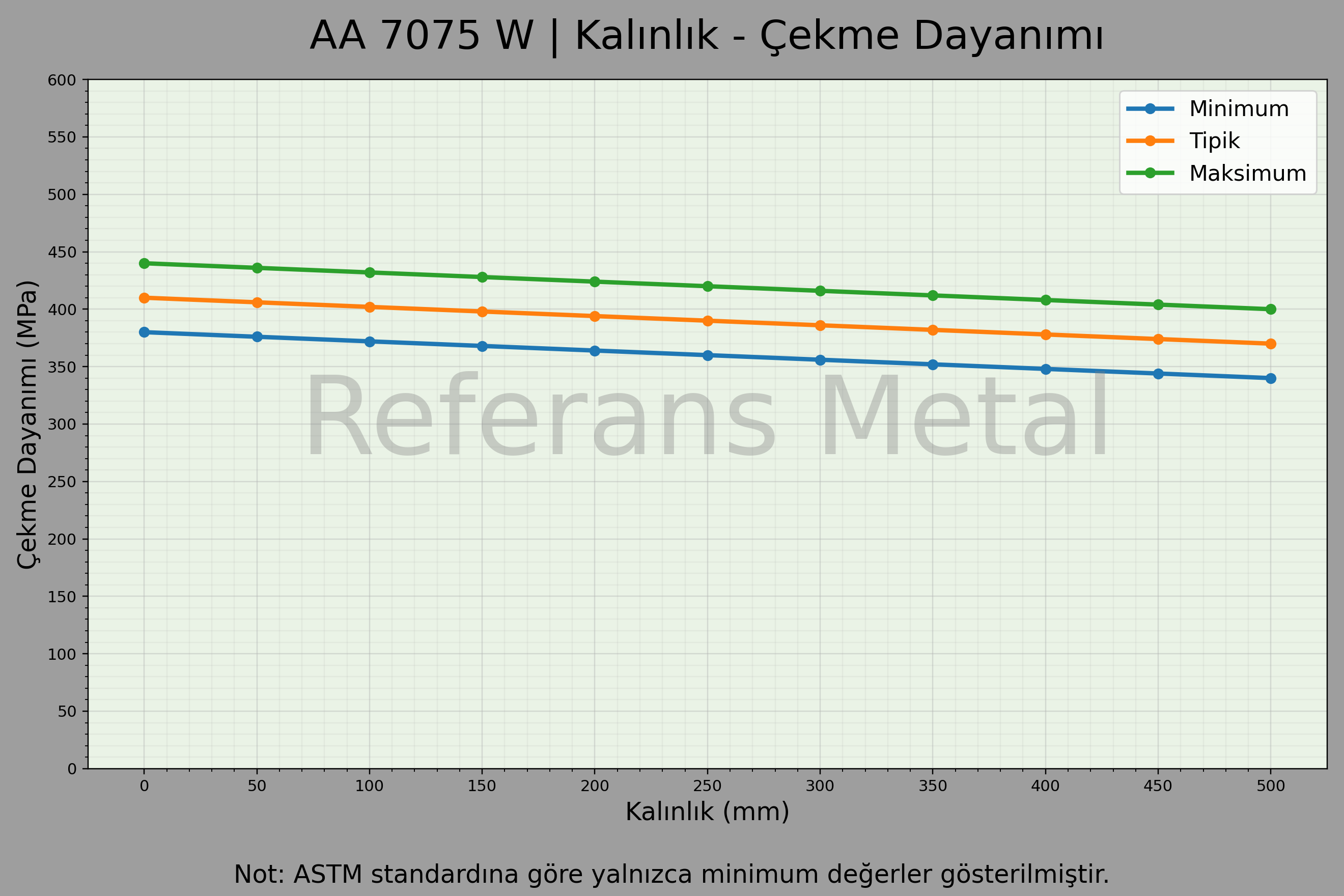
| 7075 W Kalınlık – Çekme Dayanımı Grafiği |
 |
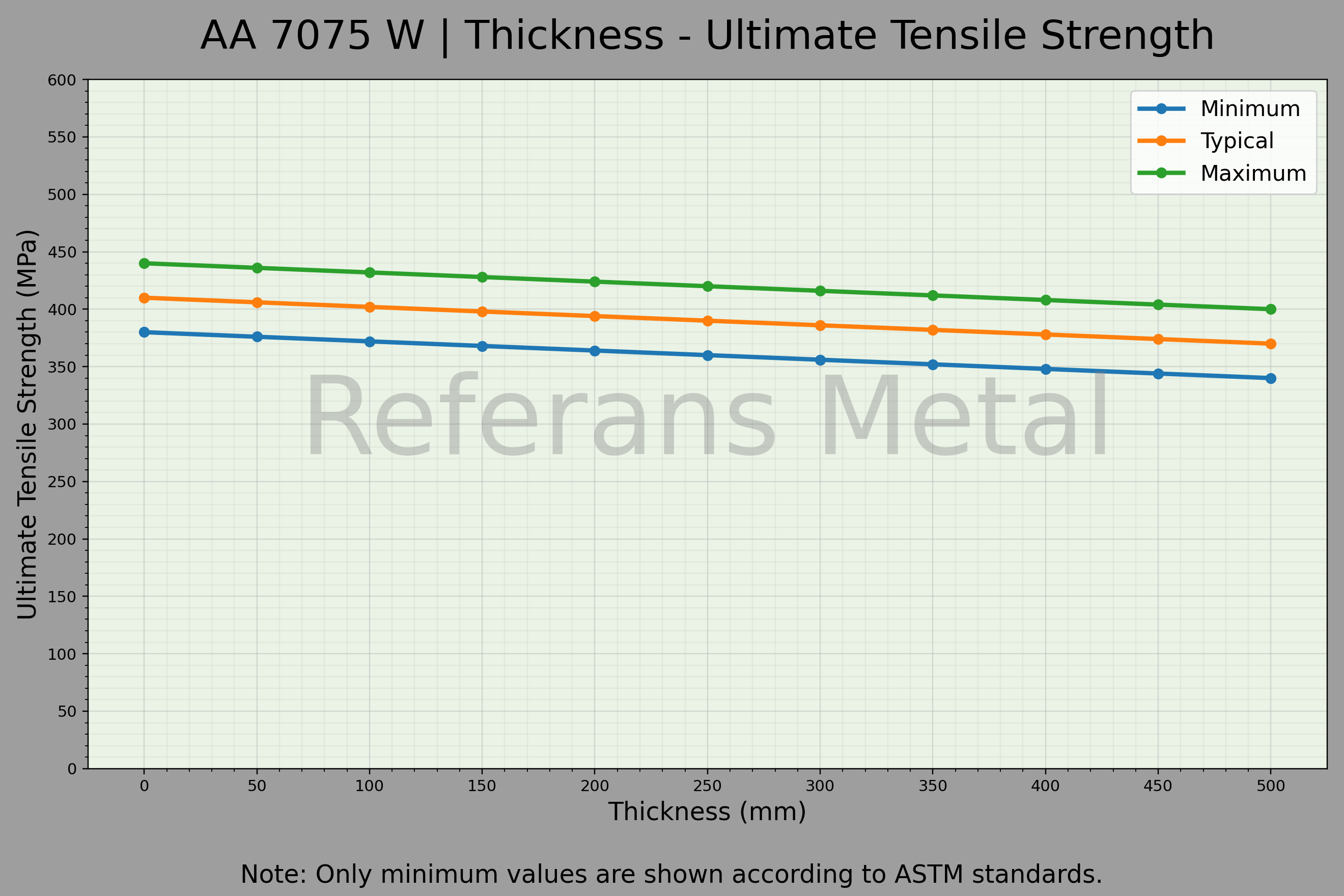
| 7075 W Thickness – Ultimate Tensile Strength Graph |
 |
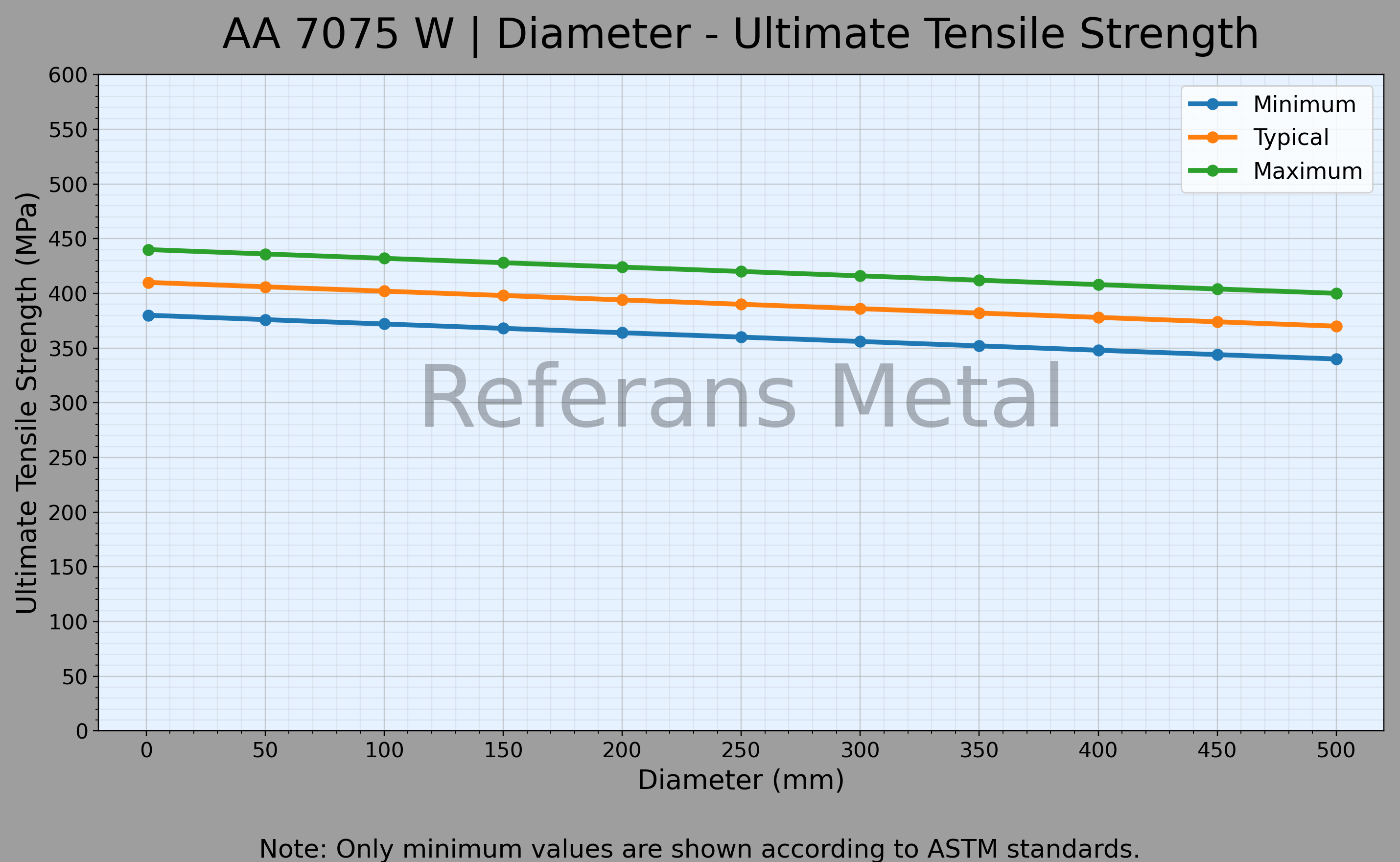
| 7075 W Diameter – Ultimate Tensile Strength Graph |
 |
7075-W aluminum alloy refers to the condition immediately after solution heat treatment, where no aging process has yet been applied, meaning it is a naturally unstable and temporary temper condition. The “W temper” represents one of the softest and lowest strength states of the alloy, and its mechanical properties begin to change over time due to natural aging at room temperature. Therefore, the W condition is generally not a final product delivered to the end user but rather a transient stage in the production process.
In terms of corrosion resistance, 7075-W alloy exhibits the general characteristics of the 7075 series and has moderate corrosion resistance. However, due to lower internal stresses in this condition, it is less susceptible to stress corrosion cracking compared to high-strength tempers such as T6. Nevertheless, for long-term use, surface protection methods such as anodizing or coating are typically recommended. Alloys like 5083 offer naturally higher corrosion resistance, while 2024, similar to 7075, often requires protective coatings.
Regarding strength and mechanical properties, 7075-W alloy has very low yield and tensile strength because precipitation hardening has not yet occurred. However, over time, natural aging increases the strength, and the material gradually moves toward properties similar to T4 or T6 conditions. Similar to 6061-W, it is a low-strength transitional state, but the maximum potential strength of 7075 is significantly higher. Therefore, the W temper is not typically used for final applications but rather as an intermediate stage after heat treatment.
In terms of machinability, bending, and formability, 7075-W is highly advantageous. Its soft structure provides excellent formability, allowing complex geometries to be produced easily. In this respect, it behaves similarly to 7075-O; however, since it will harden over time, processing time must be carefully planned. Weldability remains poor, as 7075 is generally not suitable for welding, and in this regard, 6061 performs much better.
Regarding vibration behavior and applications, 7075-W is not typically used directly in service but exists temporarily during manufacturing processes. It is especially utilized in aerospace and defense industries where rapid forming is required immediately after solution heat treatment. Subsequently, controlled aging is applied to achieve the desired strength. Alloys such as 2024 and 6061 also pass through the W condition during heat treatment processes, but 7075 has one of the highest strength potentials among them.
MATERIAL COMPOSITION STANDARDS
7075 W is available in the following standards:
• 7075 W Sheet; AMS QQ-A-250/12, ASTM B209
7075 W Characteristic Properties:
- Strength: Variable
- Machinability: Variable
- Weldability: Poor
- Formability: Excellent
- Corrosion Resistance: Variable
- Heat Treatment: No
Some Well-Known Applications of 7075 T7651:
In special projects requiring Hi-Form precision
STOCK
Available in 7075 W Sheet form.
- Sheet
| Mechanical Properties | |||
| Thickness (mm) | Yield Strength (Min.) | Ultimate Strength (Min.) | Elongation A50 mm % |
| Over 6.3 up to & incl. 12.6 | 462 MPa | 538 MPa | %9 |
| Over 12,7 up to & incl. 25,4 | 469 MPa | 538 MPa | %7 |
| Over 25,4 up to & incl. 50,8 | 462 MPa | 531 MPa | %6 |
| Over 50,8 up to & incl. 63,5 | 441 MPa | 524 MPa | %6 |
| Over 63,5 up to & incl. 76,2 | 421 MPa | 496 MPa | %5 |
| Over 76,2 up to & incl. 88,9 | 400 MPa | 490 MPa | %5 |
| Over 88,9 up to & incl. 101,6 | 372 MPa | 462 MPa | %3 |
 Weight Calculator