
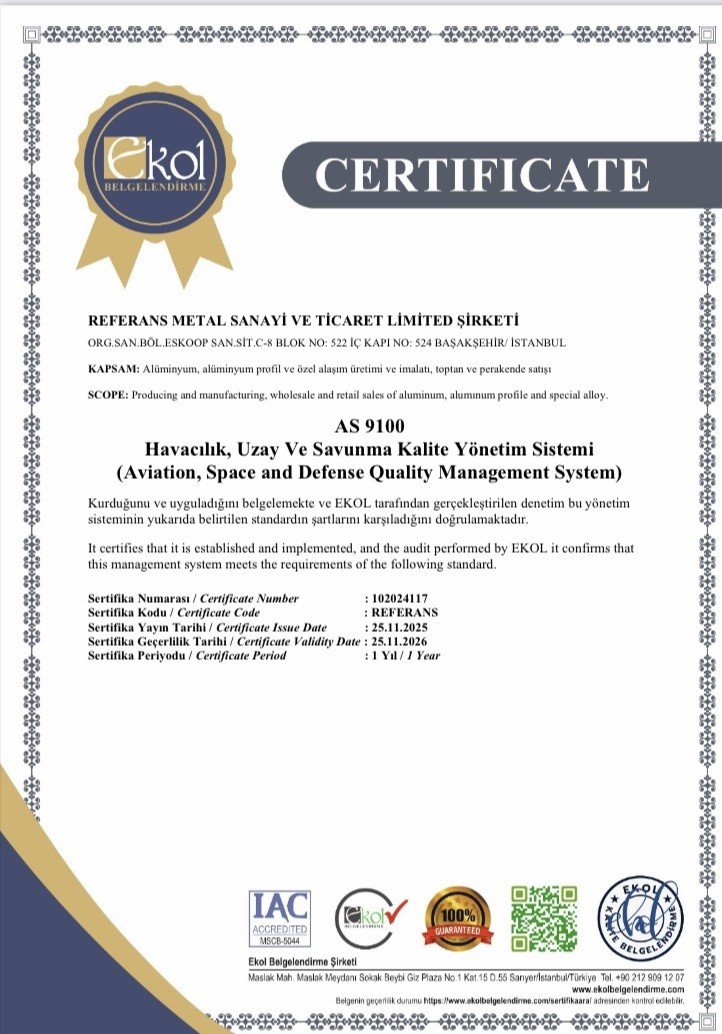
 AS 9100
 SPACE 2009
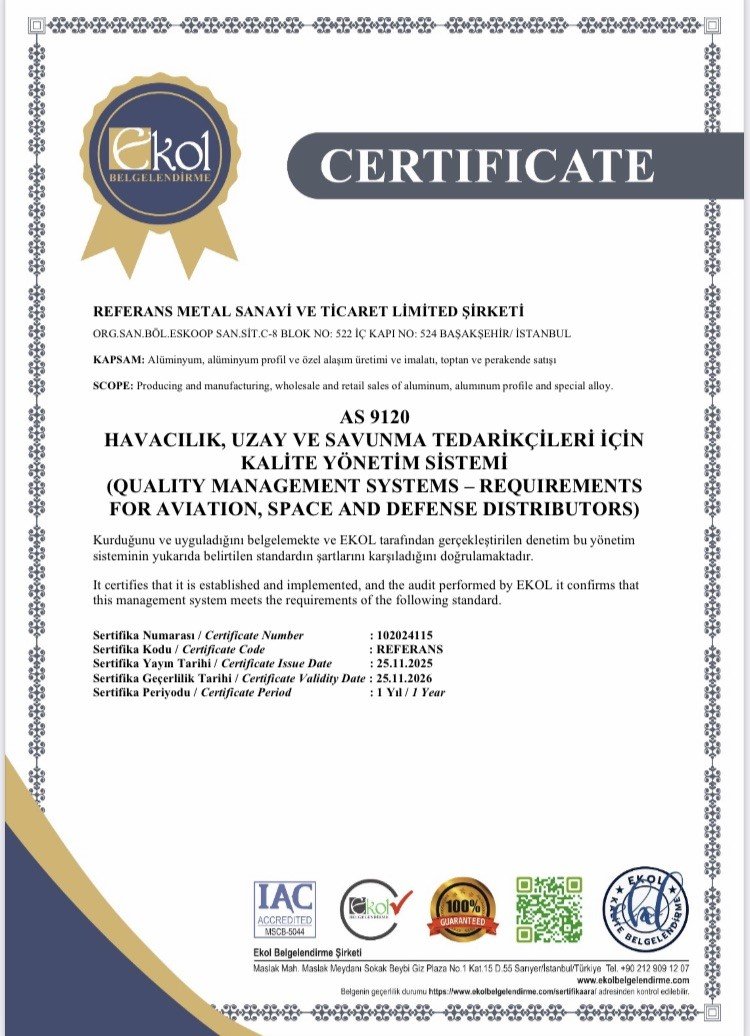 AS 9120


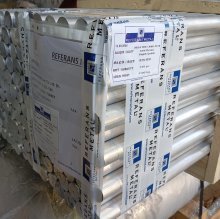


2030
AU4Pb / AlCu4PbMg / 2030 / T351
| Chemical Properties | % Value |
| Silicon (Si) | 0,00 - 0,80 |
| Chromium (Cr) | 0,00 - 0,10 |
| Manganese (Mn) | 0,20 - 1,00 |
| Magnesium (Mg) | 0,50 - 1,00 |
| Copper (Cu) | 3,50 - 4,50 |
| Titanium (Ti) | 0,00 - 0,20 |
| Iron (Fe) | 0,00 - 0,70 |
| Zinc (Zn) | 0,00 - 0,50 |
| Lead (Pb) | 0,80 - 1,00 |
| Aluminium (Al) | Balance |
| Physical Properties | Value |
| Density | 2.82 g/cm³ |
| Melting Point | 520 °C |
| Thermal Expansion | 23 µm/m°C |
| Modulus of Elasticity | 73.6 GPa |
| Thermal Conductivity | 120 W/m.K |
| Electrical Resistivity | %40 IACS |
| Mechanical Properties | Value |
| Yield Strength | 270 MPa |
| Ultimate Strength | 410 MPa |
| Shear Strength | 240 MPa |
| Elongation A50 mm | 7% |
| Hardness | 95 HB |
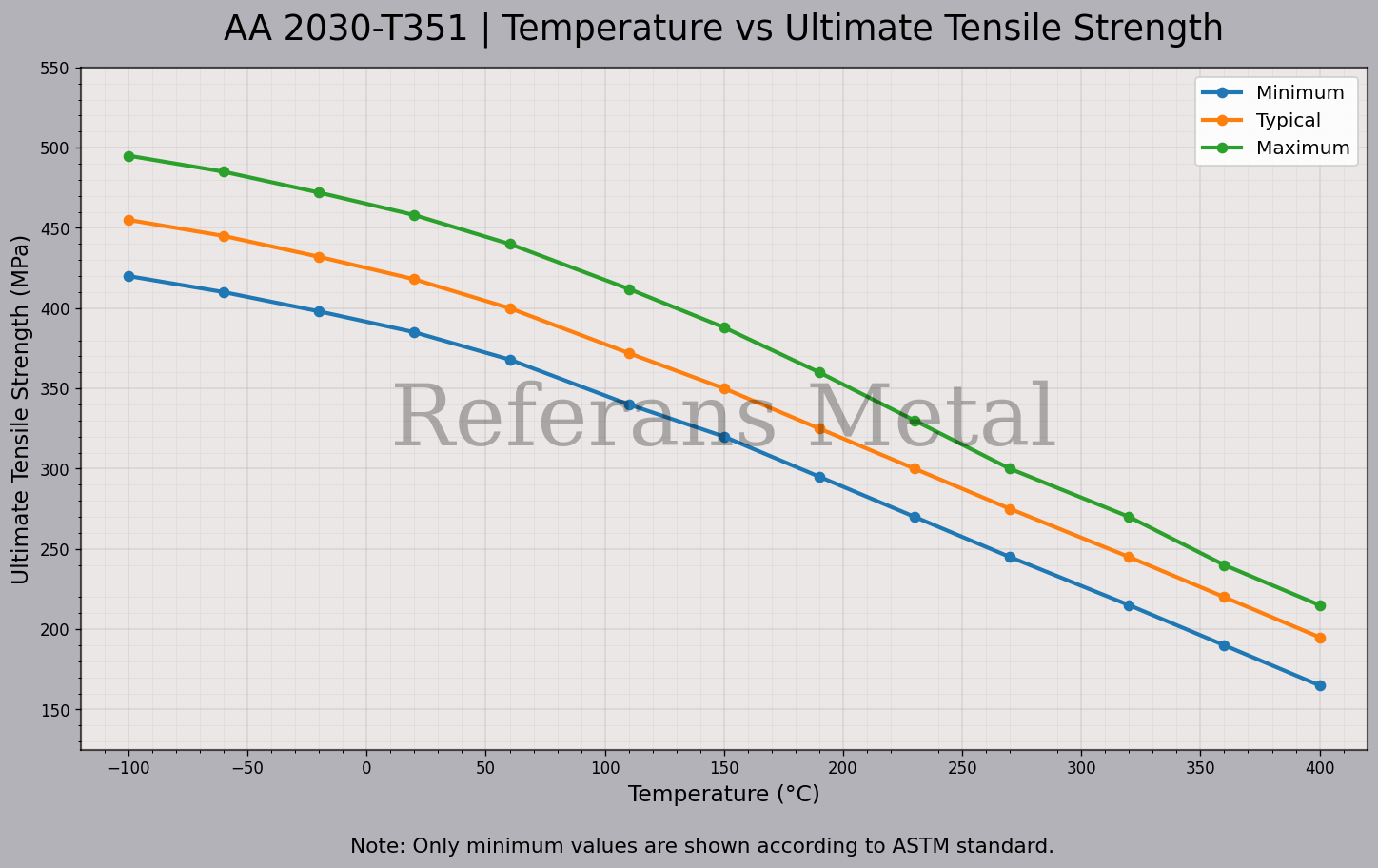
| 2030 T351 Temperature – Ultimate Tensile Strength Graph |
 |
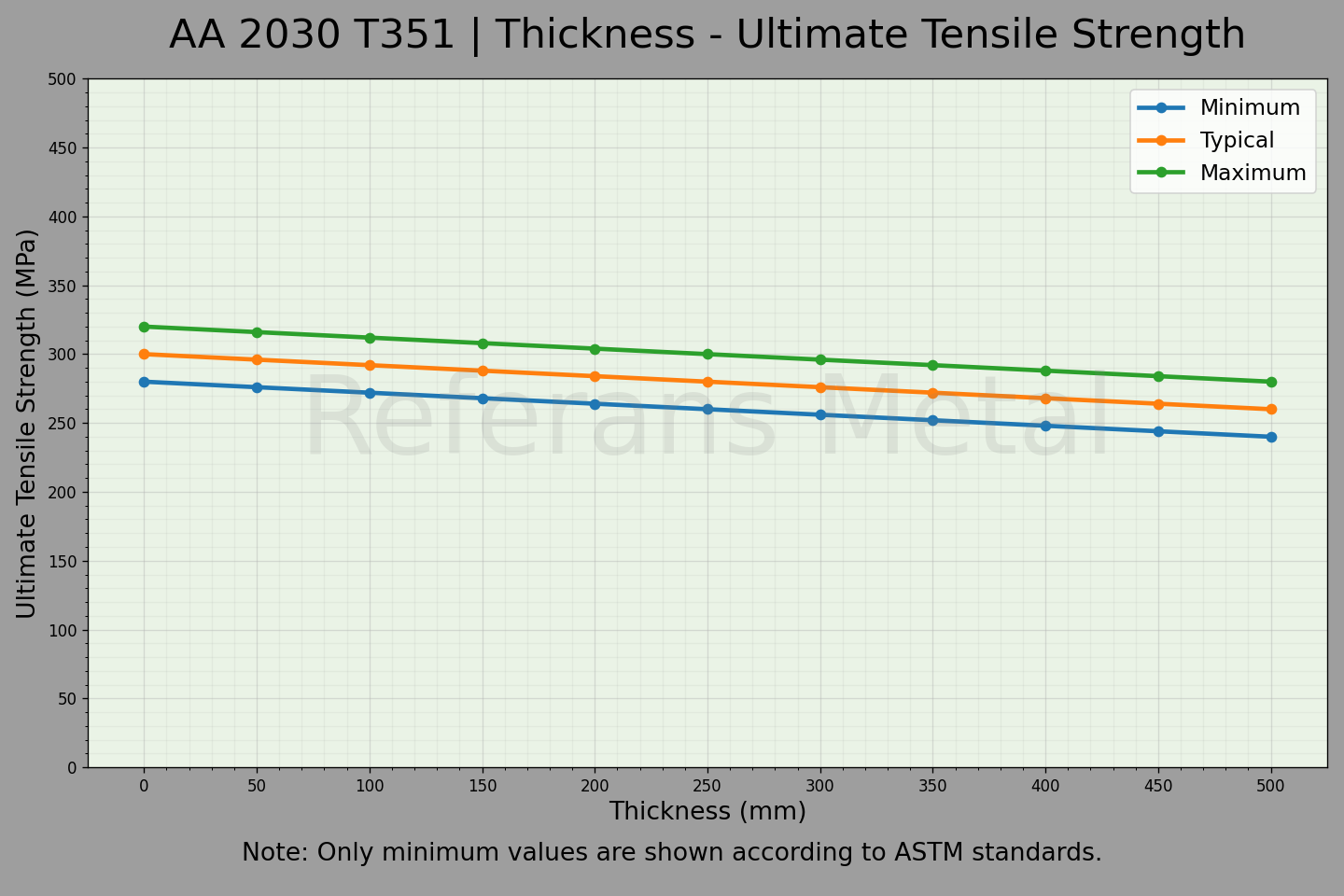
| 2030 T351 Thickness – Ultimate Tensile Strength Graph |
 |
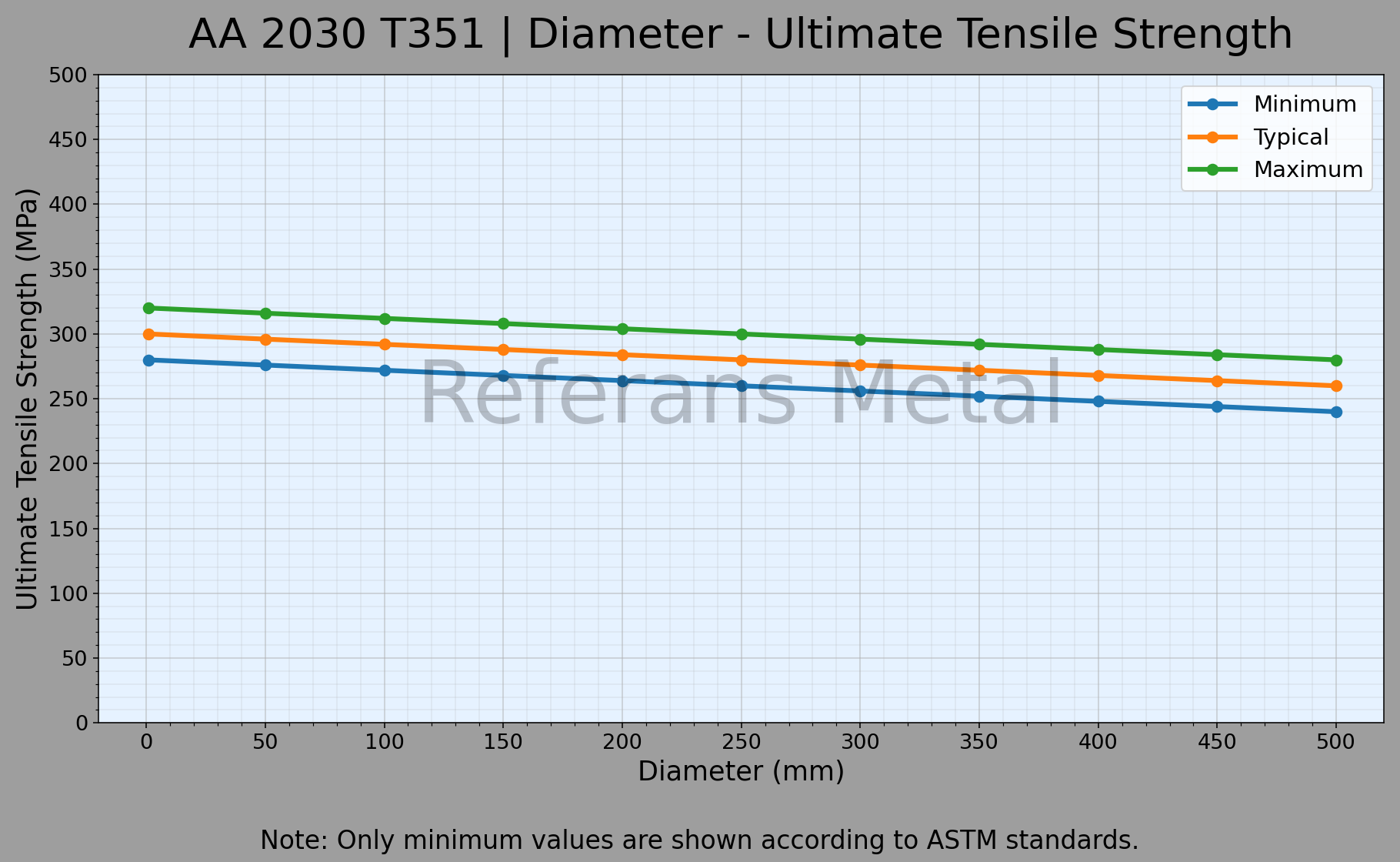
| 2030 T351 Diameter – Ultimate Tensile Strength Graph |
 |
The 2030 T351 aluminum alloy is a copper-based (Al-Cu) alloy developed for applications requiring high strength. The T351 temper includes solution heat treatment, stress relief, and natural aging. This provides a balanced mechanical performance, making it especially suitable for aerospace and defense industries. Its high strength-to-weight ratio offers significant advantages in structural applications.
This alloy has high strength, significantly superior to alloys like 6061-T6 in terms of tensile and yield strength. However, its strength is slightly lower than ultra-high-strength alloys such as 7075-T6. Its corrosion resistance is moderate and is usually enhanced by surface treatments like anodizing. In this respect, it is inferior to highly corrosion-resistant alloys such as 5052.
Machinability of 2030 T351 is quite good, allowing clean surfaces in machining processes. However, due to its high strength, tool wear is higher compared to lower-strength alloys. Formability and bending capability are limited, so alloys like 2024 or 6061 may be more suitable for complex forming. The T351 temper reduces internal stresses and minimizes deformation risks.
It is suitable for coating and surface treatments, and its performance can be enhanced through anodizing and painting. Its vibration and fatigue behavior are quite good, making it ideal for dynamic load applications. However, its weldability is poor, and mechanical fastening methods are generally preferred.
The 2030 T351 alloy is widely used in aerospace, defense, automotive, and high-performance engineering applications. It is common in aircraft structural parts, fasteners, and components. While it shares similar applications with 2024, 7075 is preferred where higher strength is needed, and 6061 stands out in applications requiring better weldability.
MATERIAL COMPOSITION STANDARDS
2030 T351 is available according to the following standards:
• 2030 T351 Cold Drawn Round Bar; ISO AlCu4PbMg, DIN AlCuMgPb, UNS A92030, ASTM B211, AFNOR AU4Pb
• 2030 T351 Cold Drawn Sheet; ISO AlCu4PbMg, DIN AlCuMgPb, UNS A92030, ASTM B211, AFNOR AU4Pb
• 2030 T351 Cold Drawn Tube; ISO AlCu4PbMg, DIN AlCuMgPb, UNS A92030, ASTM B211, AFNOR AU4Pb
Characteristic Properties of 2030 T351:
- Strength: Very Good
- Machinability: Excellent
- Weldability: Average
- Formability: Moderate
- Corrosion Resistance: Low
- Heat Treatable: Yes
Some Well-Known Applications of 2030 T351:
Used in nut and threaded rods,
Hydraulic cylinders
Commonly used in the automotive industry.
STOCK
2030 T351 is supplied in rod/sheet, tube/profile forms.
- Rod/Sheet
- Tube/Profile
 Weight Calculator