
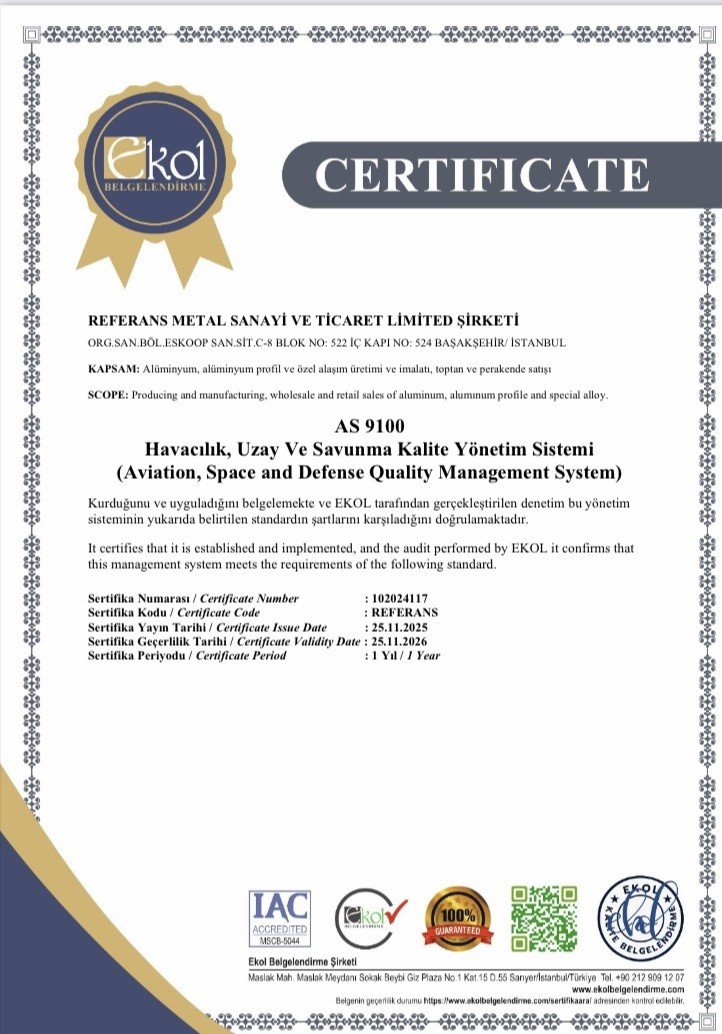
 AS 9100
 SPACE 2009
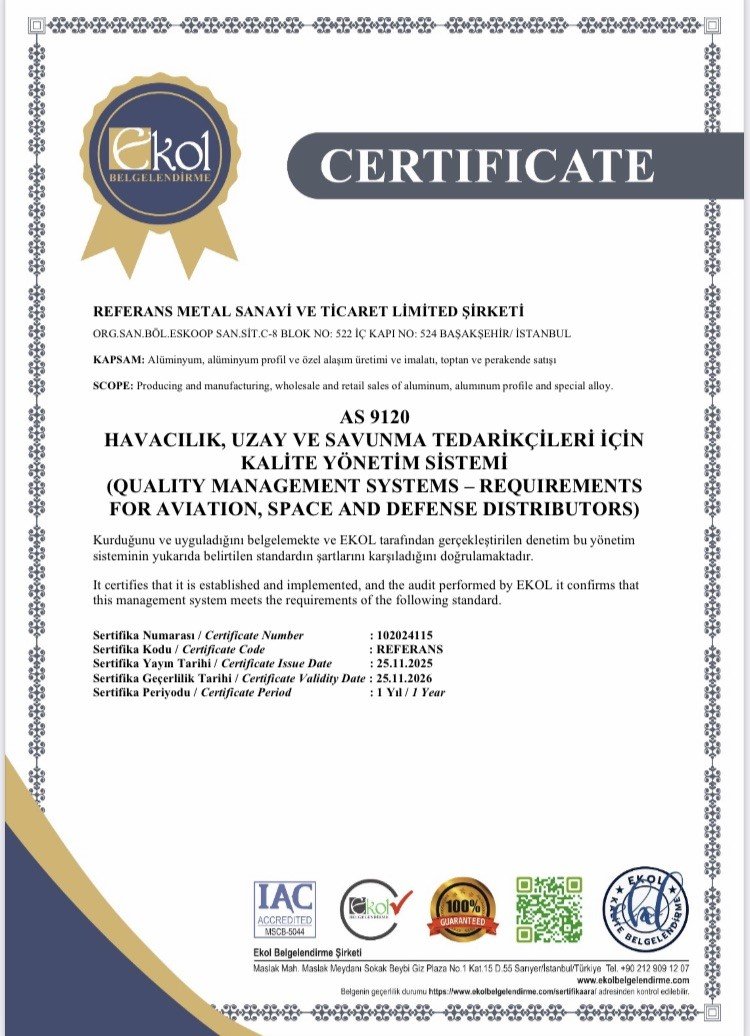 AS 9120




Plates
Sheets
Rod/Round Bar/Flat Bar
Tube/Extrusions/Profile
7150
AMS 4252 / AlZn6CuMgZr(A) / 7150 / T7751
| Chemical Properties | % Value |
| Silicon (Si) | 0,00 - 0,15 |
| Chromium (Cr) | 0,10 - 0,22 |
| Manganese (Mn) | 0,00 - 0,20 |
| Magnesium (Mg) | 2,00 - 2,90 |
| Copper (Cu) | 1,20 - 1,90 |
| Titanium (Ti) | 0,00 - 0,10 |
| Iron (Fe) | 0,00 - 0,20 |
| Zinc (Zn) | 7,20 - 8,20 |
| Aluminium (Al) | Balance |
| Titanium + Zirconium (Ti+Zr) | 0,08 - 0,15 |
| Physical Properties | Value |
| Density | 2,86 g/cm³ |
| Mechanical Properties | Value |
| Yield Strength | 572 MPa |
| Ultimate Strength | 607 MPa |
| Shear Strength | 455 MPa |
| Elongation A50 mm | %11 |
| Hardness | 150 HB |
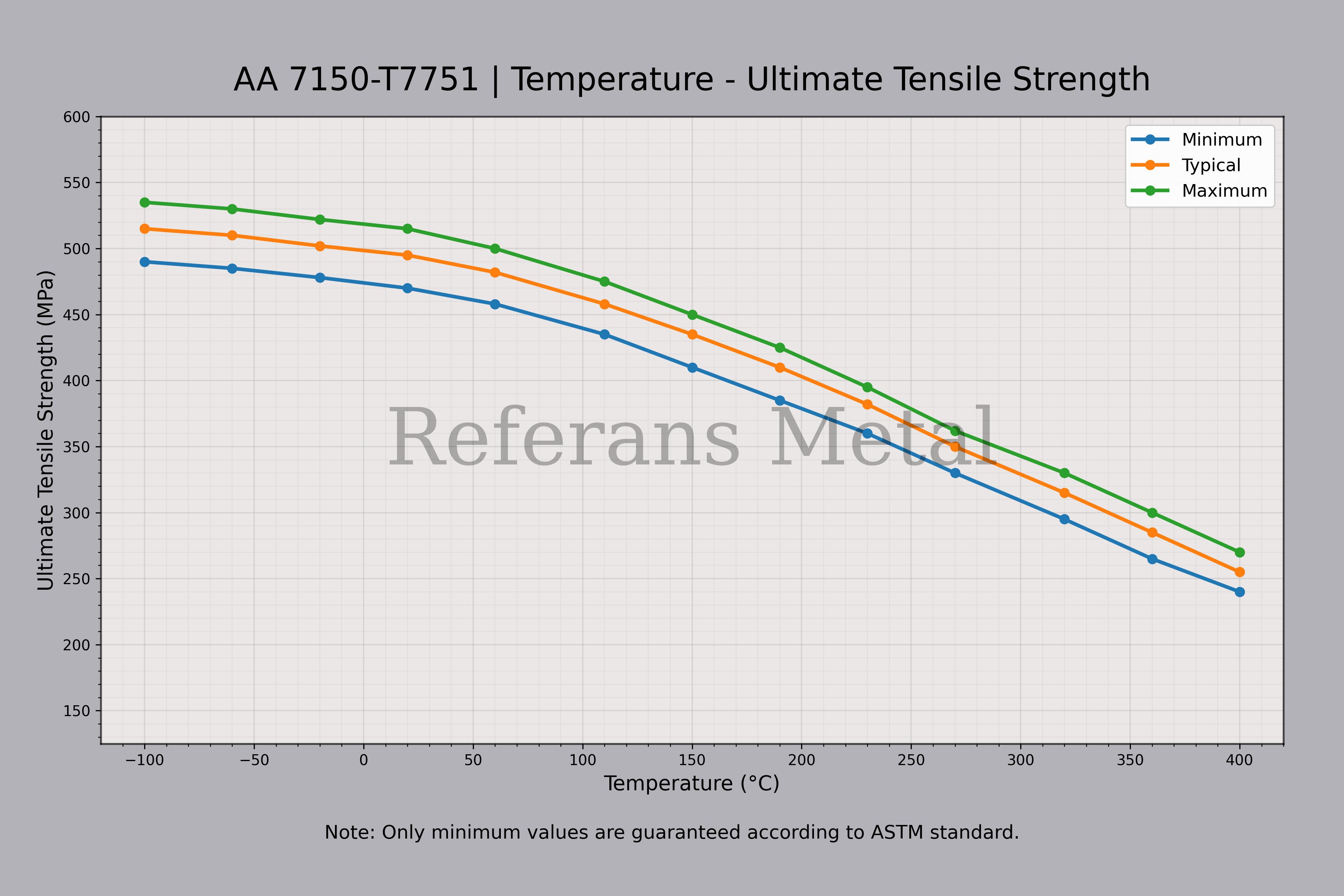
| 7150 T7751 Temperature – Ultimate Tensile Strength Graph |
 |
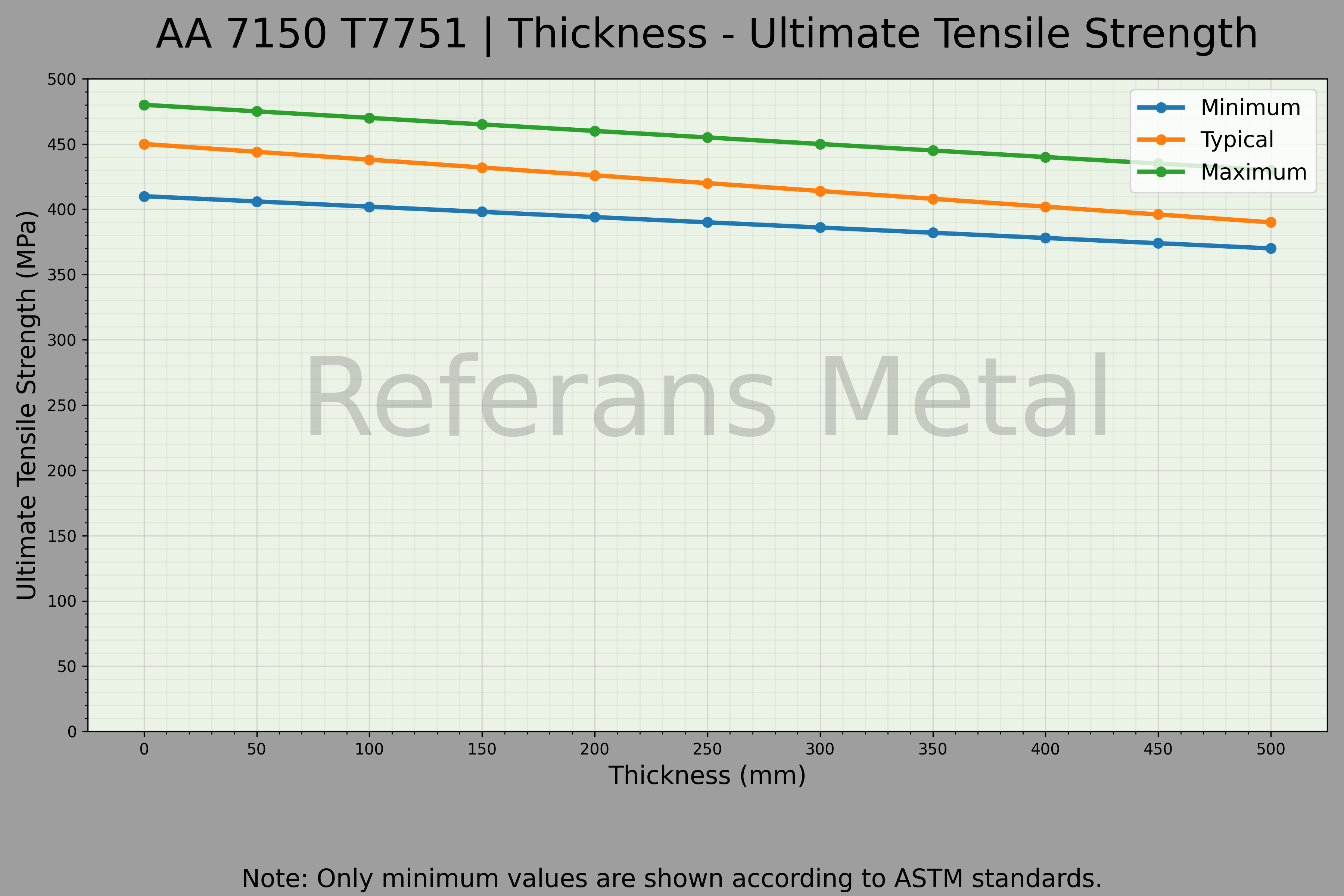
| 7150 T7751 Thickness – Ultimate Tensile Strength Graph |
 |
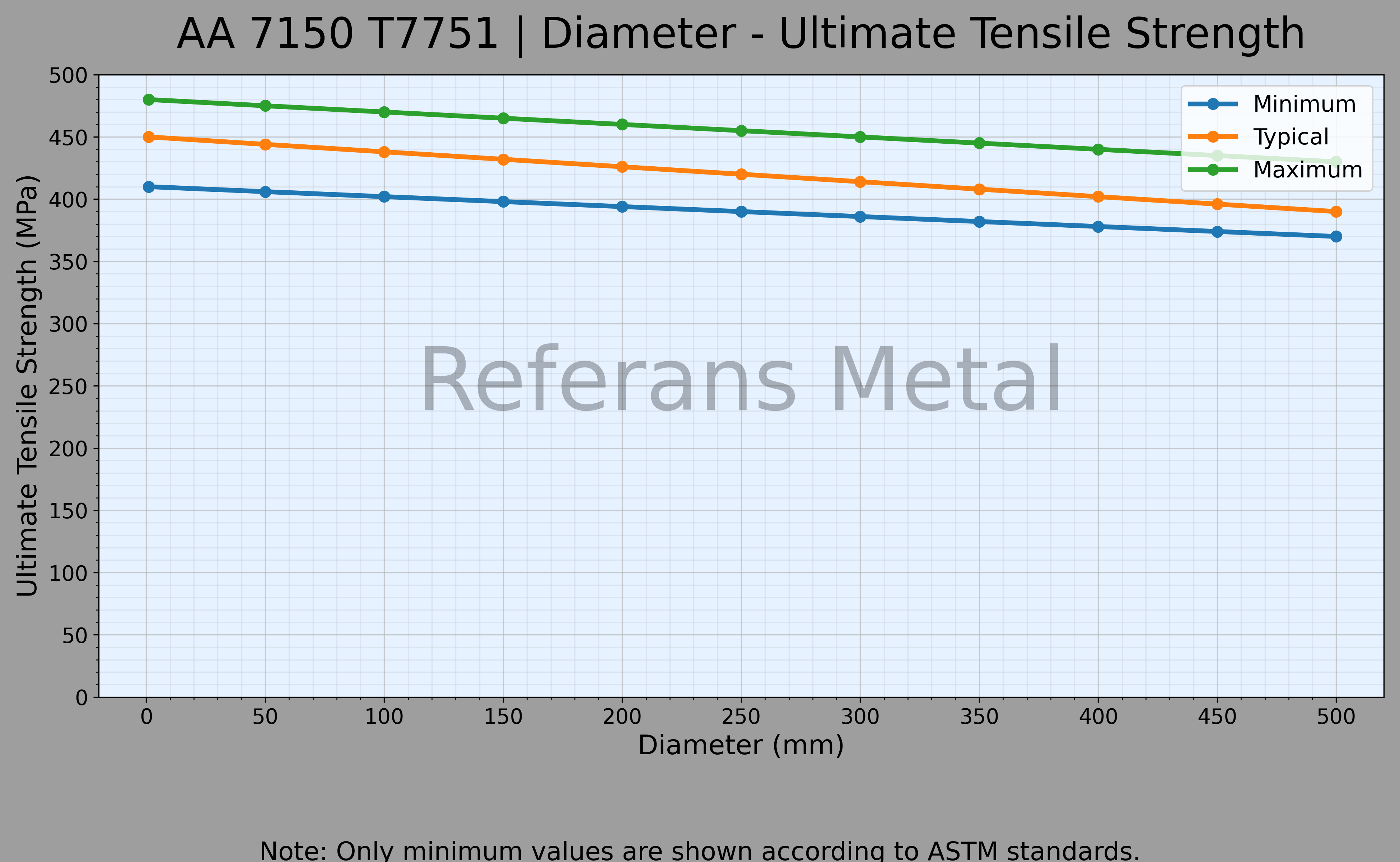
| 7150 T7751 Diameter – Ultimate Tensile Strength Graph |
 |
7150-T7751 aluminum alloy belongs to the 7xxx series of high-strength aluminum alloys and is specifically developed for aerospace applications. This alloy is strengthened with zinc (Zn), magnesium (Mg), and copper (Cu), and the T7751 temper provides an optimized balance between strength and corrosion resistance. The T7751 temper includes overaging and stress-relief processes, enabling more stable performance, particularly in thick sections.
In terms of corrosion resistance, 7150-T7751 exhibits significantly better resistance to stress corrosion cracking compared to conventional 7075-T6 alloy. This makes it especially suitable for aircraft structural components. Compared to 7050 alloy, it offers similar corrosion performance, while providing much better overall corrosion resistance than 2024 alloy. Surface treatments such as anodizing or coating can further enhance its performance.
Regarding strength and machinability, 7150-T7751 offers very high tensile and yield strength and performs particularly well in thick plates. Compared to 7075-T6, it provides similar or even better strength values, with the added advantage of more uniform mechanical properties in thick sections. Its machinability is generally good for the 7xxx series, although tool wear must be considered due to its high hardness.
In terms of bending properties, weldability, and coatability, 7150-T7751 has limited ductility, making bending operations more restricted and requiring careful process control. Its weldability is poor, and in this respect, 6061 alloy performs significantly better. However, it offers good coatability, and corrosion resistance can be enhanced through alclad or anodized surfaces. Thanks to the T7751 temper, residual stresses are minimized, resulting in reduced distortion after machining.
Regarding vibration response and applications, 7150-T7751 is widely used in aerospace and defense industries due to its high specific strength and good fatigue performance. Typical applications include wing panels, fuselage structures, and thick plate components. While it shares similar application areas with 7050 and 7075 alloys, 7150 stands out with its superior performance in thick sections.
MATERIAL COMPOSITION STANDARDS
7150 T7751 can be supplied in accordance with the following standards.
• 7150 T7751 Sheet / Plate; AMS 4252, UNS A97150, ISO AlZn6CuMgZr, ASTM B209
Characteristic Properties of 7150 T7751:
- Strength: Very Good
- Machinability: Good
- Weldability: Average
- Formability: Low
- Corrosion Resistance: High
- Heat Treatable: Yes
Some Well-Known Applications of 7150 T7751:
In ship keel structures,
In aircraft fuselage and wing structures,
Also used in the nuclear industry.
STOCK
We manufacture and supply 7150 T7751 in sheet form.
- Sheet / Plate
| Mechanical Properties | |||
| Thickness (mm) | Yield Strength (Min.) | Ultimate Strength (Min.) | Elongation A50 mm % |
| 25,4 mm | 565 MPa | 607 MPa | %11 |
 Weight Calculator