
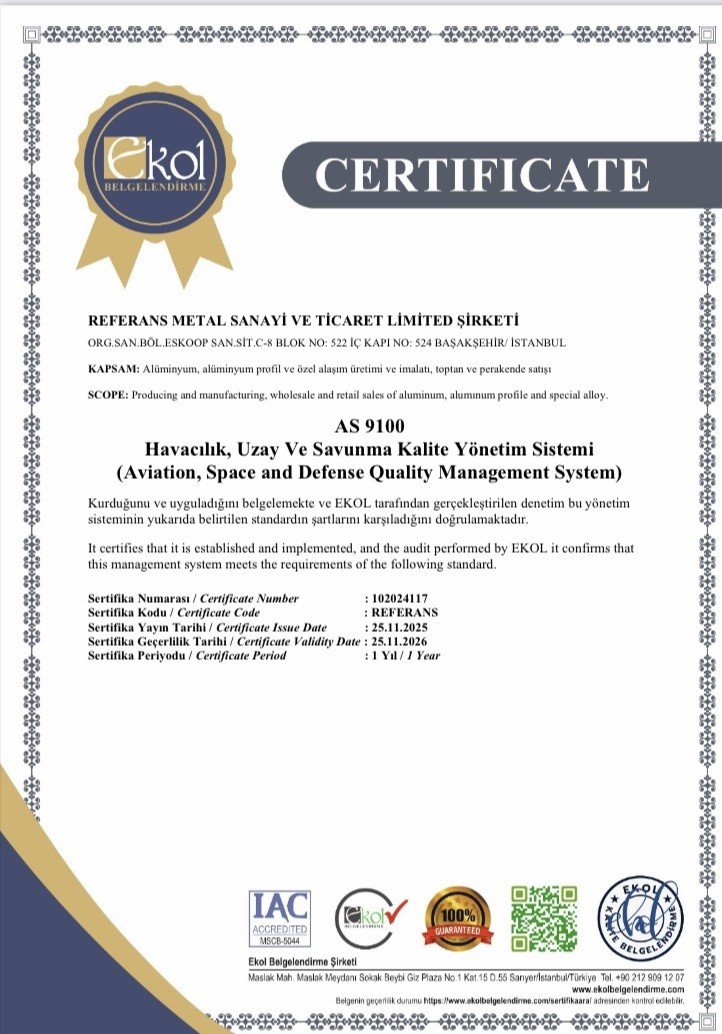
 AS 9100
 SPACE 2009
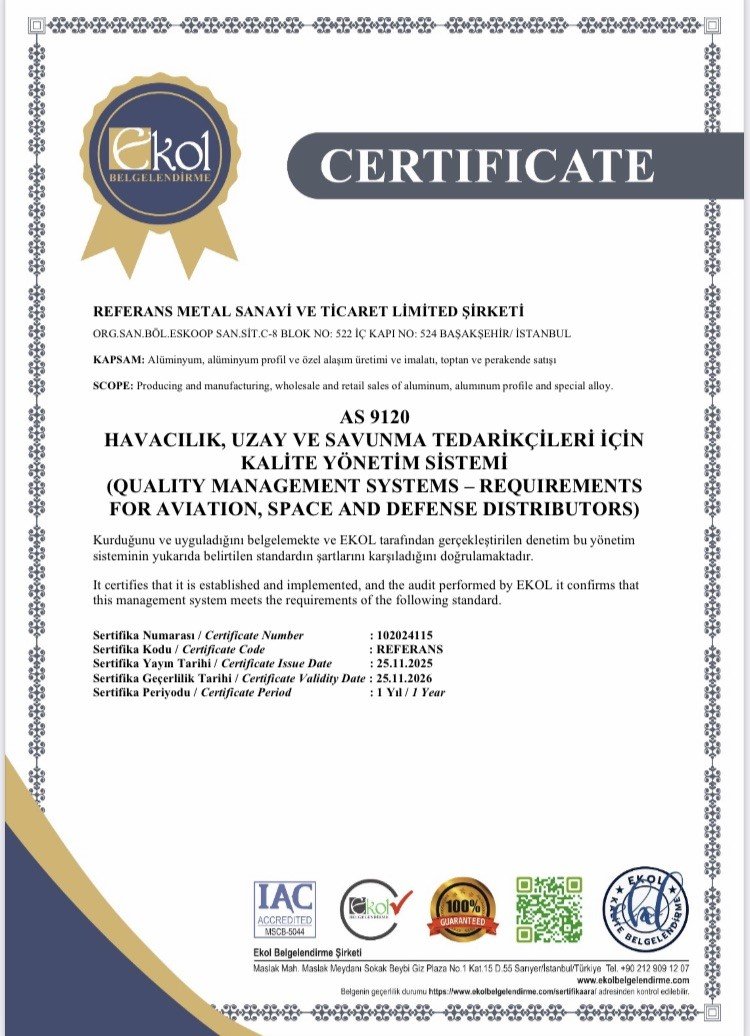 AS 9120




Plates
Sheets
Rod/Round Bar/Flat Bar
Tube/Extrusions/Profile
2024
AMS 4037 / AlCu4Mg1 / 2024 / T351
| Chemical Properties | % Value |
| Silicon (Si) | 0,00 - 0,50 |
| Chromium (Cr) | 0,00 - 0,10 |
| Manganese (Mn) | 0,30 - 0,90 |
| Magnesium (Mg) | 1,20 - 1,80 |
| Copper (Cu) | 3,80 - 4,90 |
| Titanium (Ti) | 0,00 - 0,20 |
| Iron (Fe) | 0,00 - 0,50 |
| Zinc (Zn) | 0,00 - 0,25 |
| Aluminium (Al) | Balance |
| Physical Properties | Value |
| Density | 2.78 g/cm³ |
| Melting Point | 502 °C |
| Thermal Expansion | 23 µm/m-K |
| Modulus of Elasticity | 73.1 GPa |
| Thermal Conductivity | 121 W/m.K |
| Electrical Resistivity | 30% IACS |
| Mechanical Properties | Value |
| Proof Strength | 330 MPa |
| Yield Strength | 460 MPa |
| Shear Strength | 290 MPa |
| Elongation A50 mm | 13% |
| Hardness | 120 HB |
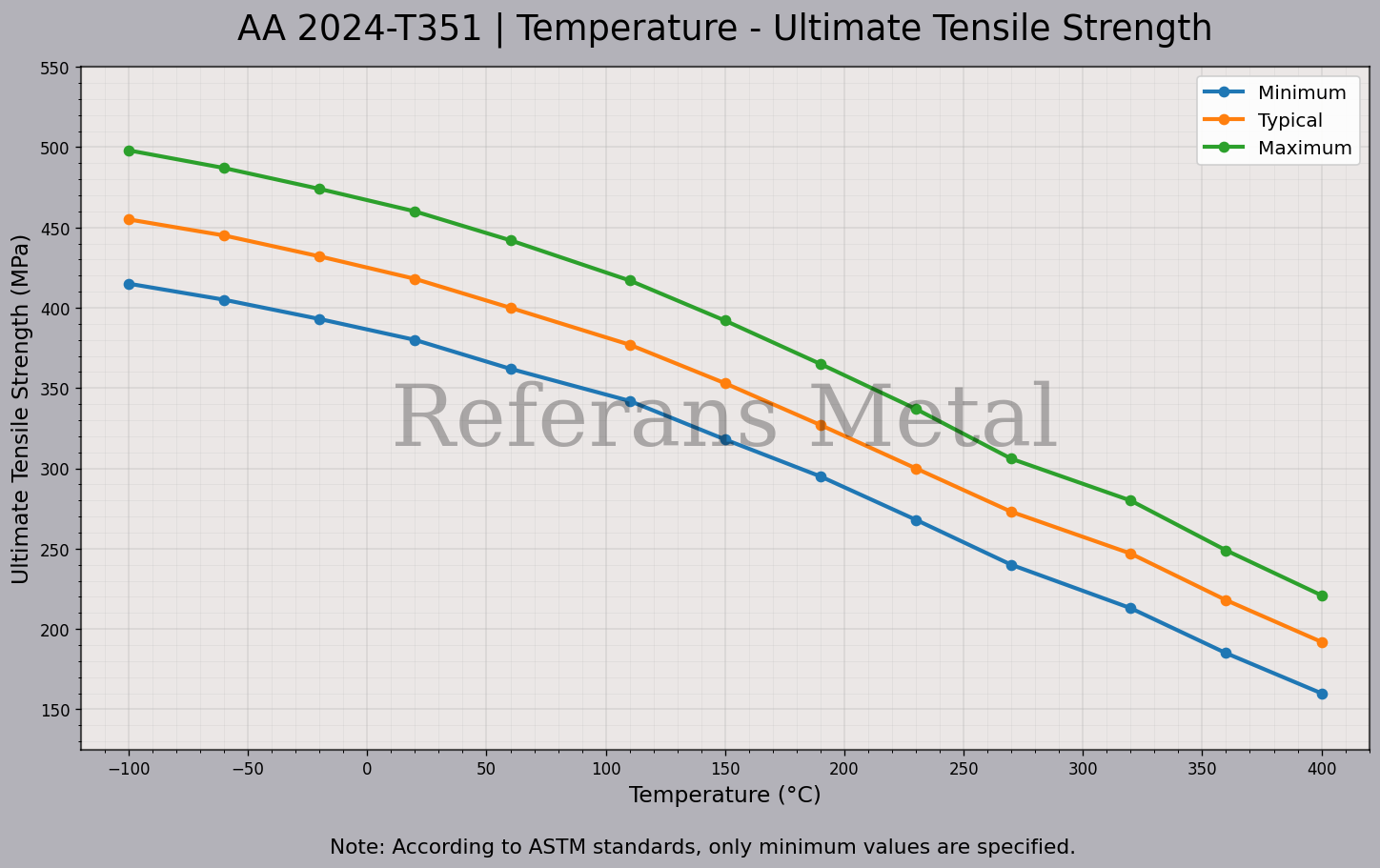
| 2024 T351 Temperature – Ultimate Tensile Strength Graph |
 |
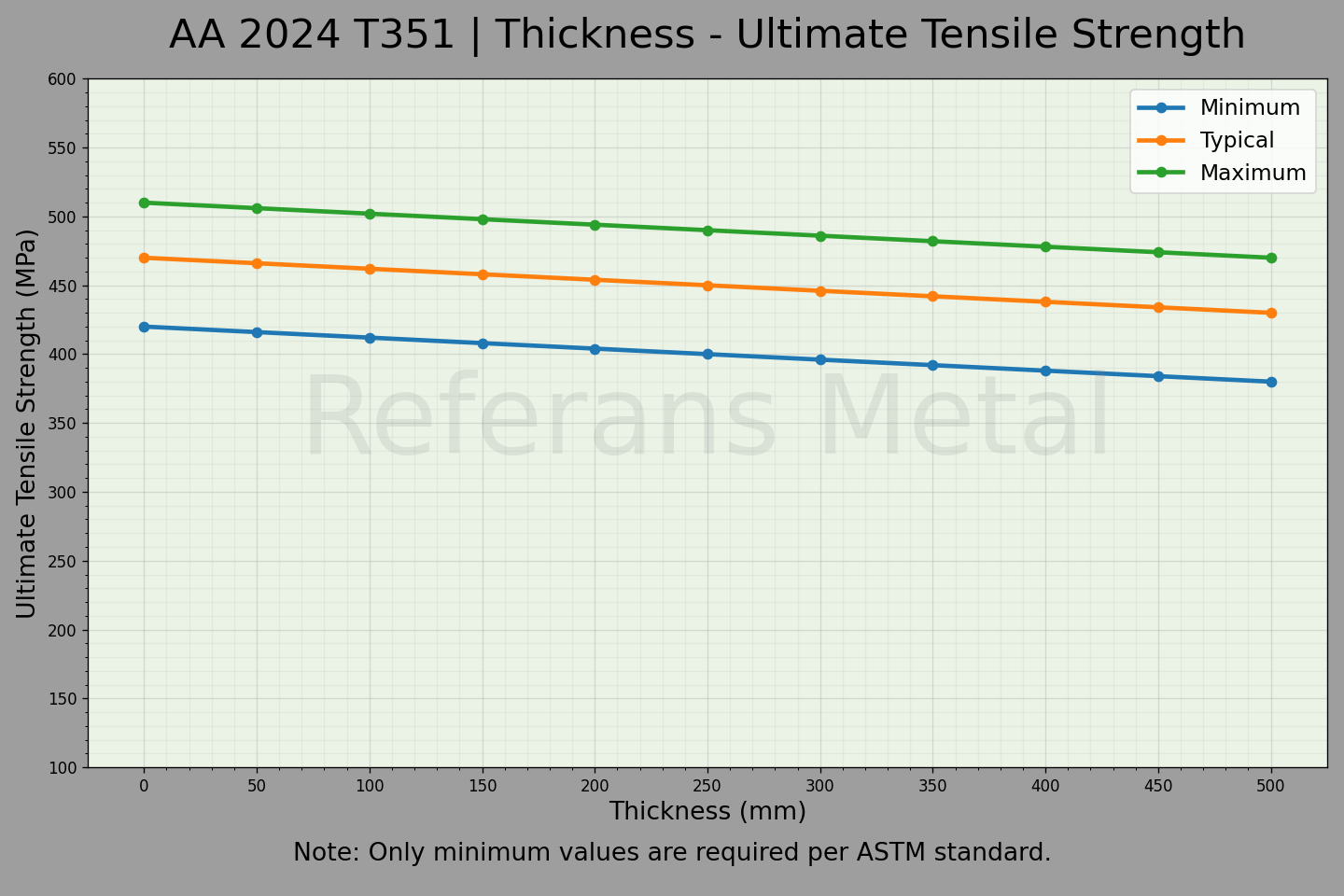
| 2024 T351 Thickness – Ultimate Tensile Strength Graph |
 |
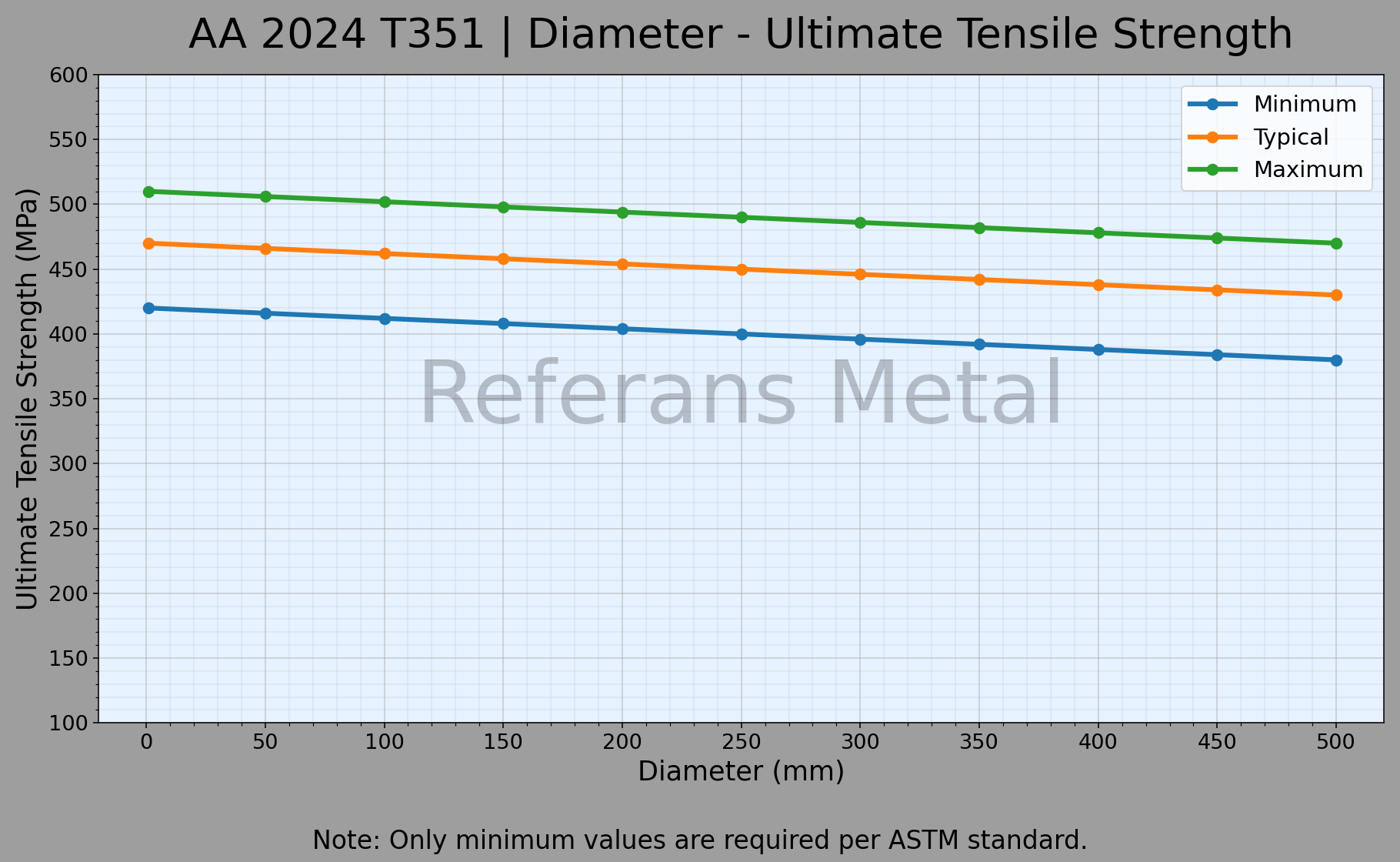
| 2024 T351 Diameter – Ultimate Tensile Strength Graph |
 |
The 2024 T351 aluminum alloy is a high-strength Al-Cu (aluminum-copper) alloy widely used especially in aerospace and high-performance engineering applications. The T351 temper includes solution heat treatment, stress relief, and natural aging processes. This alloy is known for its high tensile and yield strength, and is particularly preferred for structural components. Compared to 7075 alloy, it offers slightly lower strength but provides better damage tolerance and fatigue resistance.
In terms of corrosion resistance, the 2024 T351 alloy performs lower than pure aluminum and is therefore usually protected with surface treatments such as cladding.png) or anodizing. Compared to 6061 alloy, 6061 has better natural corrosion resistance. However, 2024 is preferred in environments requiring high strength despite this disadvantage. It is especially widely used in aircraft fuselage panels and wing structures.
or anodizing. Compared to 6061 alloy, 6061 has better natural corrosion resistance. However, 2024 is preferred in environments requiring high strength despite this disadvantage. It is especially widely used in aircraft fuselage panels and wing structures.
In terms of machinability, 2024 T351 performs quite well and is suitable for machining. This provides advantages in the production of precision parts. Compared to 2011 alloy, its machinability is slightly lower, but it is highly successful in terms of strength-machinability balance. It also exhibits good fatigue performance in vibrating environments, making it suitable for components operating under dynamic loads.
Its bending and formability properties are limited in the T351 temper. This alloy has lower formability compared to highly ductile alloys such as 5052. Therefore, forming operations are usually performed in T3 or T4 temper and then brought to T351 condition. Its weldability is low; welding can cause serious losses in mechanical properties, so riveting or mechanical fastening methods are generally preferred.
Coatability and suitability for surface treatments are among the important advantages of 2024 alloy. Corrosion resistance can be improved with Alclad coating. This alloy is widely used in sectors such as aerospace, defense, automotive, and high-performance machinery parts. Compared to 7075, it offers better machinability and fatigue resistance, while providing much higher strength than 6061. This combination of properties makes it indispensable for critical engineering applications.
MATERIAL COMPOSITION STANDARDS
2024 T351 is available under the following standards and specifications:
• 2024 T351 Sheet; AMS QQ-A-250/4, AMS 4037, EN 2419, WS 3.1394, AIR 9048-120, ASTM B20
• 2024 T351 Plate; AMS QQ-A-250/4, AMS 4037, EN 2419, WS 3.1394, AIR 9048-120, ASTM B20
• 2024 T351 Cold Drawn Rod; AMS 4120, AMS QQ-A-225/6, ASTM B211
• 2024 T351 Extrusion Rod; AMS QQ-A-200/3, ASTM B221
• 2024 T351 Sheet; AMS QQ-A-250/4, AMS 4037, EN 2419, WS 3.1394, AIR 9048-120, ASTM B209
• 2024 T351 Plate; AMS QQ-A-250/4, AMS 4037, EN 2419, WS 3.1394, AIR 9048-120, ASTM B209
• 2024 T351 Alclad Sheet; AMS QQ-A-250/5, AMS 4041, AIR 9048-140, EN 4001, ASTM B209
• 2024 T351 Alclad Plate; AMS QQ-A-250/5, AMS 4041, AIR 9048-140, EN 4001, ASTM B209
• 2024 T351 Cold Drawn Strip; ASTM B211
- Strength: High
- Machinability: Good
- Weldability: Average (Spot welding is preferred)
- Formability: Low
- Corrosion Resistance: Moderate
- Heat Treatment: Yes
Some Well-Known Applications for 2024 T351:
Hydraulic manifolds in aircraft,
Horizontal tail connection parts,
Used in vertical tail spars and beams.
STOCK
2024 T351 aluminum is supplied in sheet/plate, coil, rod, strip, tube, and profile forms.
- Sheet / Plate
- Coil
- Rod / Strip
- Tube / Profile
| Mechanical Properties | |||
| Thickness (mm) | Proof Strength (Min.) | Yield Strength (Min.) | Elongation A50 mm % |
| Up to & incl. 6.25mm | 290 MPa | 393 MPa | %12 |
| Over 6.3mm up to & incl. 19mm | 303 MPa | 414 MPa | %12 |
| Over 19mm up to & incl. 38mm | 317 MPa | 448 MPa | %10 |
| Over 38mm | 358 MPa | 483 MPa | %10 |
 Weight Calculator