
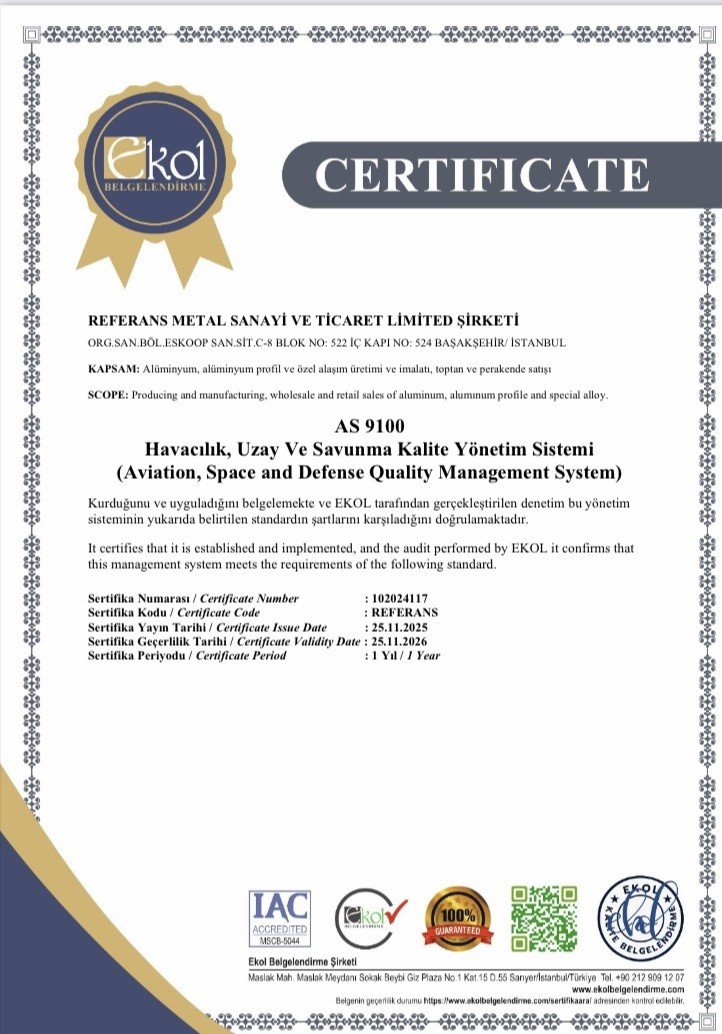
 AS 9100
 SPACE 2009
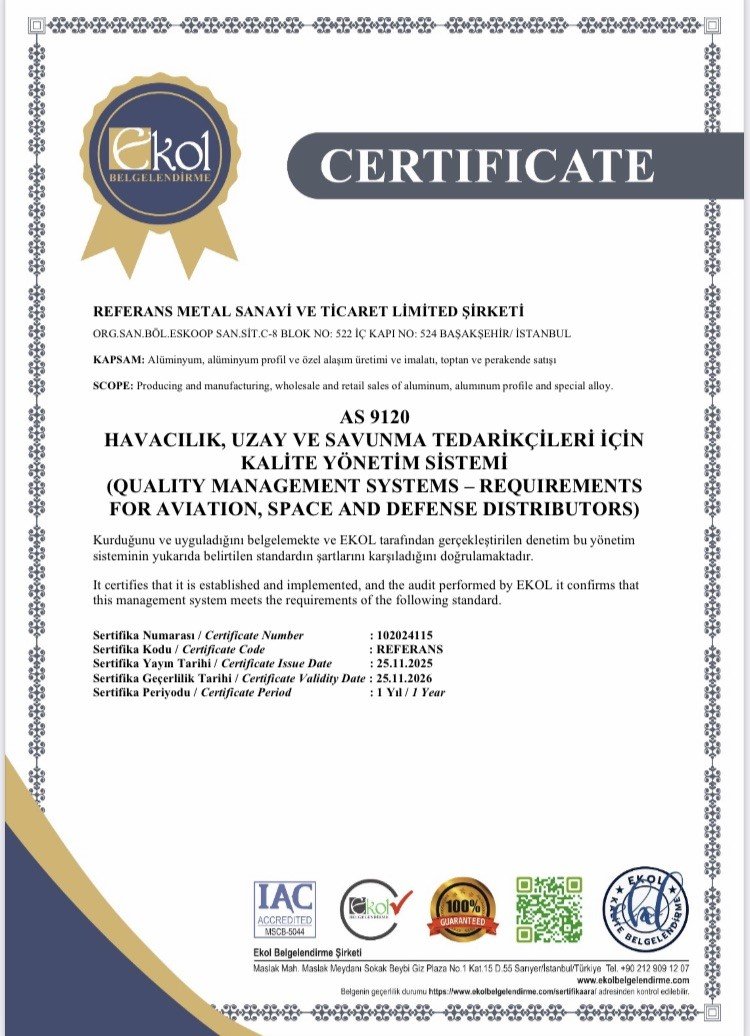 AS 9120


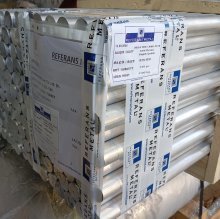


Plates
Sheets
Rod/Round Bar/Flat Bar
Tube/Extrusions/Profile
7475 alclad
AMS 4100 / AlZn5.5MgCu / 7475 alclad / T761
| Chemical Properties | % Value |
| Silicon (Si) | 0,00 - 0,10 |
| Chromium (Cr) | 0,18 - 0,25 |
| Manganese (Mn) | 0,00 - 0,06 |
| Magnesium (Mg) | 1,90 - 2,60 |
| Copper (Cu) | 1,20 - 1,90 |
| Titanium (Ti) | 0,00 - 0,06 |
| Iron (Fe) | 0,00 - 0,12 |
| Zinc (Zn) | 5,20 - 6,20 |
| Aluminium (Al) | Balance |
| Physical Properties | Value |
| Density | 2,81 g/cm³ |
| Melting Point | 477 °C |
| Thermal Expansion | 23.2 µm/m.°C |
| Modulus of Elasticity | 71.7 GPa |
| Thermal Conductivity | 163 W/m.K |
| Electrical Resistivity | % 33 IACS |
| Mechanical Properties | Value |
| Proof Strength | 421 MPa |
| Yield Strength | 490 MPa |
| Shear Strength | 290 MPa |
| Elongation A50 mm | %12 |
| Hardness | 84 HB |
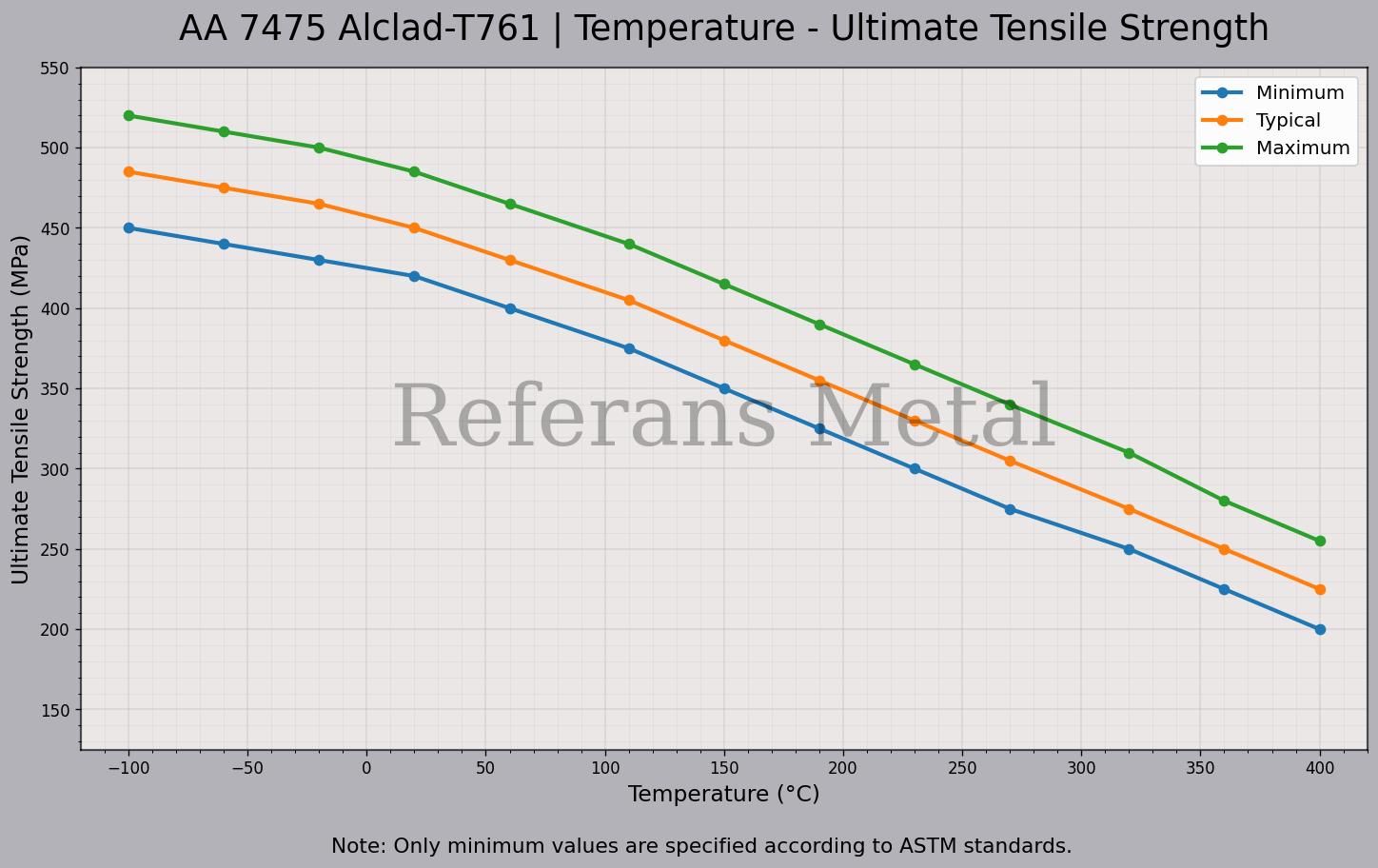
| 7475 Alclad T761 Temperature – Ultimate Tensile Strength Graph |
 |
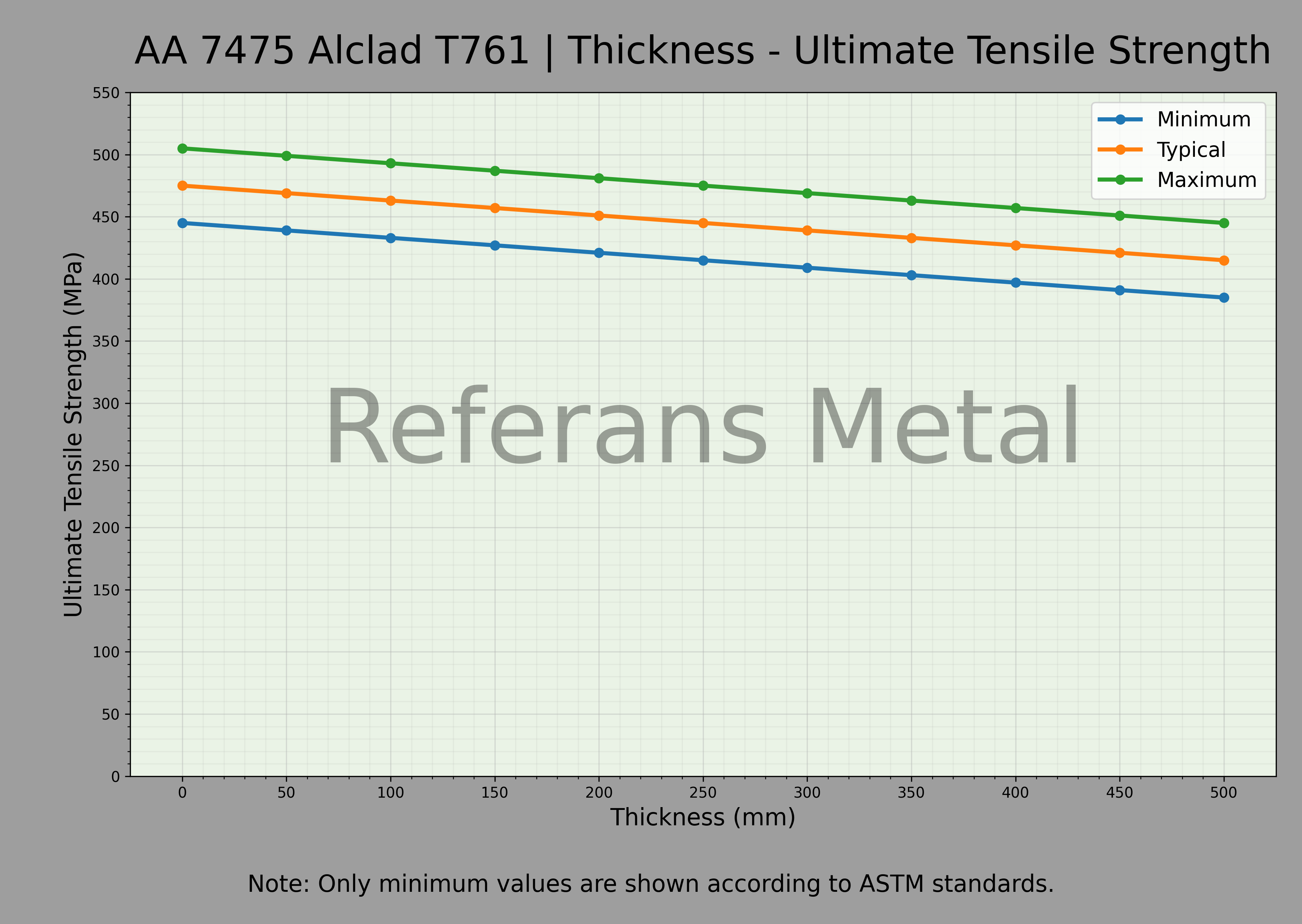
| 7475 Alclad T761 Thickness – Ultimate Tensile Strength Graph |
 |
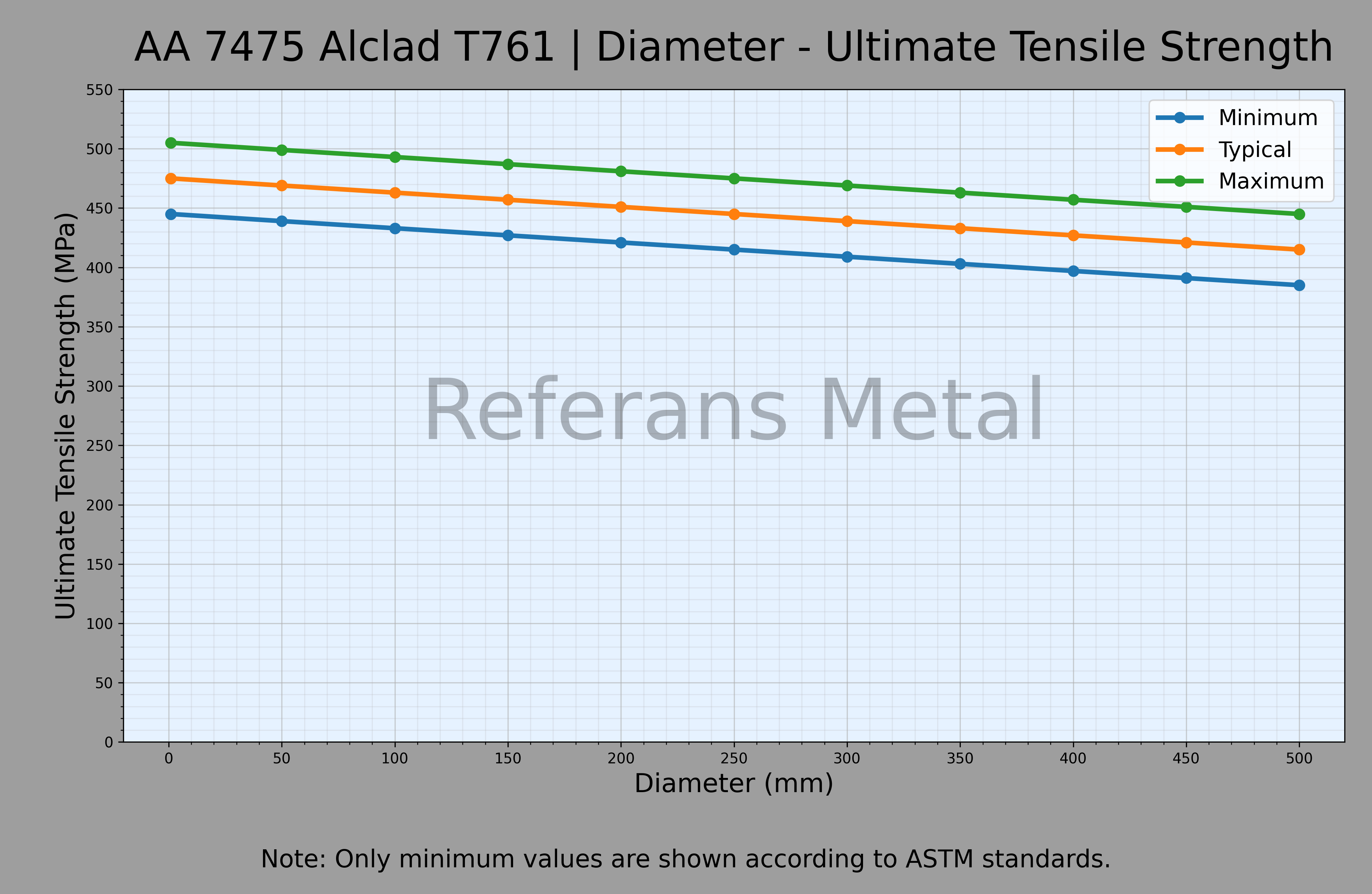
| 7475 Alclad T761 Diameter – Ultimate Tensile Strength Graph |
 |
7475 Alclad T761 aluminum alloy is a member of the 7xxx aluminum alloy series specifically developed for aerospace applications, offering a combination of high strength, excellent fracture toughness, and improved corrosion resistance. The “Alclad” cladding consists of a thin layer of pure aluminum on the surface, providing additional protection against corrosion. This feature is particularly advantageous for aircraft structural components exposed to humid, saline, or aggressive atmospheric environments. Thanks to its high zinc and magnesium content, the alloy achieves high mechanical strength, while the optimized T761 heat treatment improves resistance to stress corrosion cracking.
In terms of strength, 7475 Alclad T761 demonstrates superior performance compared to many high-strength aluminum alloys. Compared with 7075-T6, it provides a similar level of tensile strength but offers higher fracture toughness, making it safer for critical aerospace structures. In comparison with 2024-T3, it provides higher static strength and generally improved fatigue resistance. When compared to 7050-T7451, it can offer advantages in certain cases such as better machinability and slightly lower density depending on the application.
Regarding machinability and formability, 7475 alloy shows good machinability among high-strength aluminum alloys. It produces consistent chips during machining and provides good surface finish quality in machining operations. However, due to its high strength level, its cold bending capability is somewhat limited, and forming operations are usually carried out under controlled temperatures or with suitable pre-treatment. The T761 temper reduces internal stresses, improving machining stability and dimensional accuracy.
Corrosion resistance and surface coating capability are among the important advantages of this alloy. The Alclad layer significantly improves resistance to galvanic corrosion and atmospheric oxidation. This characteristic makes the alloy particularly suitable for aircraft fuselage panels, wing skins, and structural plates that require long service life. In addition, it shows good compatibility with painting, anodizing, and other surface treatments, allowing both protective and aesthetic coatings.
In terms of vibration behavior and weldability, the alloy performs well under vibration thanks to its high elastic modulus and strength, providing good resistance to fatigue crack propagation. However, like most 7xxx series aluminum alloys, it has limited weldability, and mechanical fastening, riveting, or adhesive bonding are generally preferred instead of welding. Due to these characteristics, 7475 Alclad T761 aluminum alloy is widely used in aerospace, defense, high-performance engineering structures, and certain space applications.
MATERIAL COMPOSITION STANDARDS
7475 T761 can be produced according to the following standards.
• 7475 T761 Alclad Sheet; AMS 4100, EN 2803, 3.4377
• 7475 T761 Bare Sheet; AMS 4085, AIR 9048-290 Alloy 7475, UNS A97475 AlZn5.5MgCu
MINIMUM BASIC MECHANICAL VALUES FOR 7475 T761
Bare Alclad
Thickness: inch 0.040-0.249 0.063-0.187
(mm) (1.016-6.325) (1.60-4.75)
Tensile Strength, ksi (MPa) 523 / 490
Yield Strength, ksi (MPa) 456 / 421
Elongation, % 12 / 12
MINIMUM FRACTURE TOUGHNESS VALUES FOR 7475 T761
(Fracture Toughness)
KIc: ksi√in.(MPa√m)*
Temper Thickness T-L
T761 0.040-0.125 in. 88.0 (96.6)
Bare (1.02-3.18 mm)
0.126-0.249 in. 81.0 (88.9)
(3.20-6.32 mm)
T761 Alclad 0.040-0.125 in. 88.0 (96.6)
(1.02-3.18 mm)
0.126-0.249 in. 81.0 (88.9)
(3.20-6.32 mm)
CHARACTERISTIC PROPERTIES OF 7475 T761:
- Strength: Excellent
- Machinability: Moderate
- Weldability: Poor
- Formability: Moderate
- Corrosion Resistance: Good
- Heat Treatment: Yes
SOME KNOWN APPLICATIONS OF 7475 T761:
Manufacturing of military aircraft and spacecraft.
Production of components operating under high speed and high torque.
Shipbuilding and the manufacture of large chassis and central systems in various industries.
STOCK
7475 T761 is supplied in sheet form.
- Alclad Sheet
- Bare Sheet
| Mechanical Properties | |||
| Thickness (mm) | Proof Strength (Min.) | Yield Strength (Min.) | Elongation A50 mm % |
| over 0.5 up to & incl. 0.6 | 435 MPa | 510 MPa | 12 |
| over 1.60 up to & incl. 4.75 | 386 MPa | 465 MPa | 9 |
 Weight Calculator