
 AS 9100
 SPACE 2009
 AS 9120


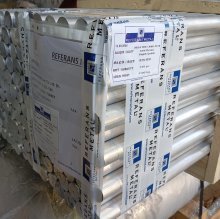


Cold Drawn Round Bar
Cold Drawn Tube
2124
Cold Drawn/Finished (CF) / AlCu4Mg1 (Soğuk Çekim) / 2124 / T6
| Chemical Properties | % Value |
| Silicon (Si) | 0,00 - 0,20 |
| Chromium (Cr) | 0,00 - 0,10 |
| Manganese (Mn) | 0,30 - 0,90 |
| Magnesium (Mg) | 1,20 - 1,80 |
| Copper (Cu) | 3,80 - 4,90 |
| Titanium (Ti) | 0,00 - 0,15 |
| Iron (Fe) | 0,00 - 0,30 |
| Zinc (Zn) | 0,00 - 0,25 |
| Aluminium (Al) | Balance |
| Physical Properties | Value |
| Density | 2.78 g/cm³ |
| Melting Point | 502 °C |
| Thermal Expansion | 21.9 µm/m.°C |
| Modulus of Elasticity | 71 GPa |
| Thermal Conductivity | 145 W/m.K |
| Electrical Resistivity | 38 % IACS |
| Mechanical Properties | Value |
| Proof Strength | 430 MPa |
| Yield Strength | 490 MPa |
| Shear Strength | 280 MPa |
| Elongation A50 mm | 6 % |
| Hardness | 110 HB |
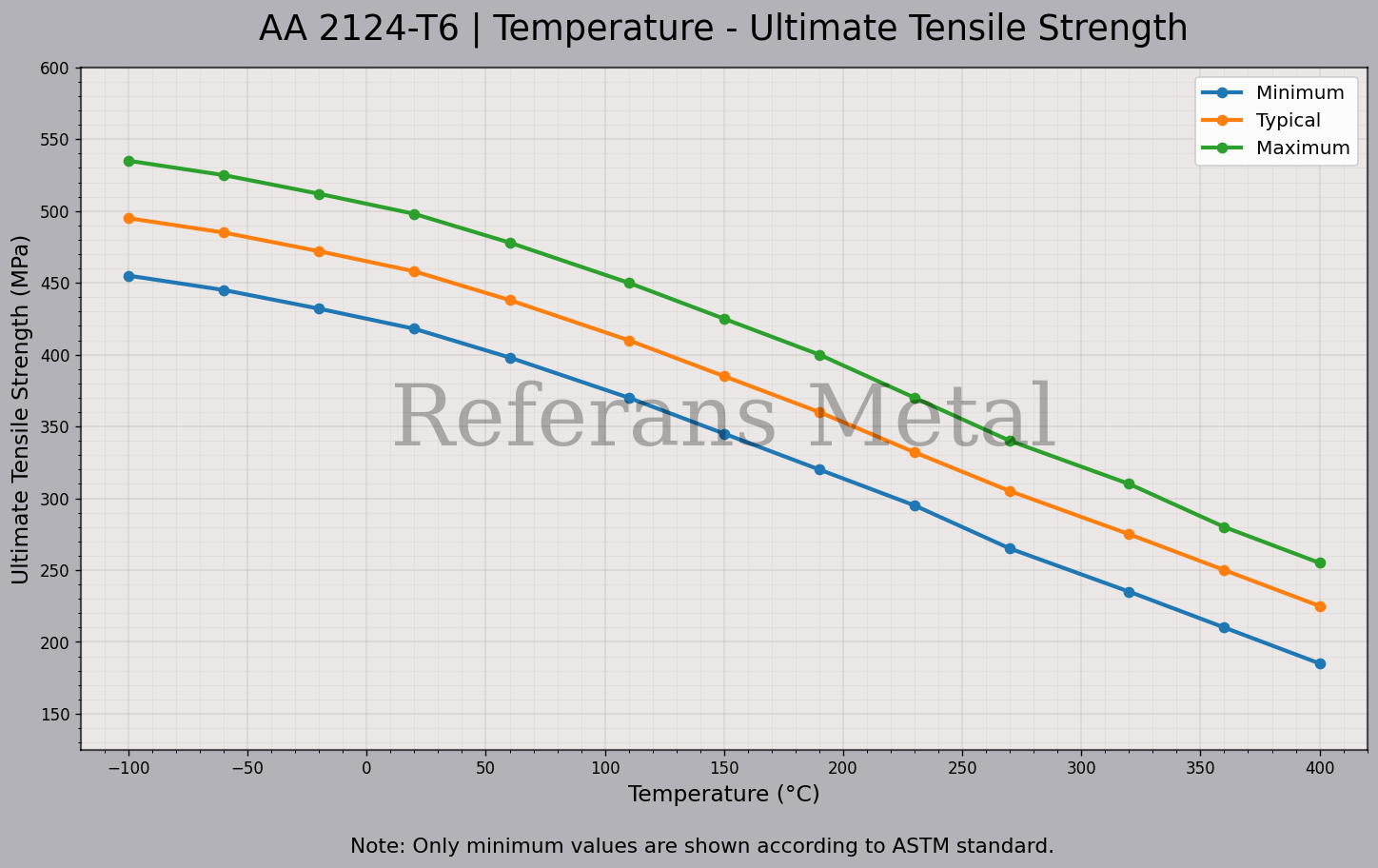
| 2124 T6 Temperature – Ultimate Tensile Strength Graph |
 |
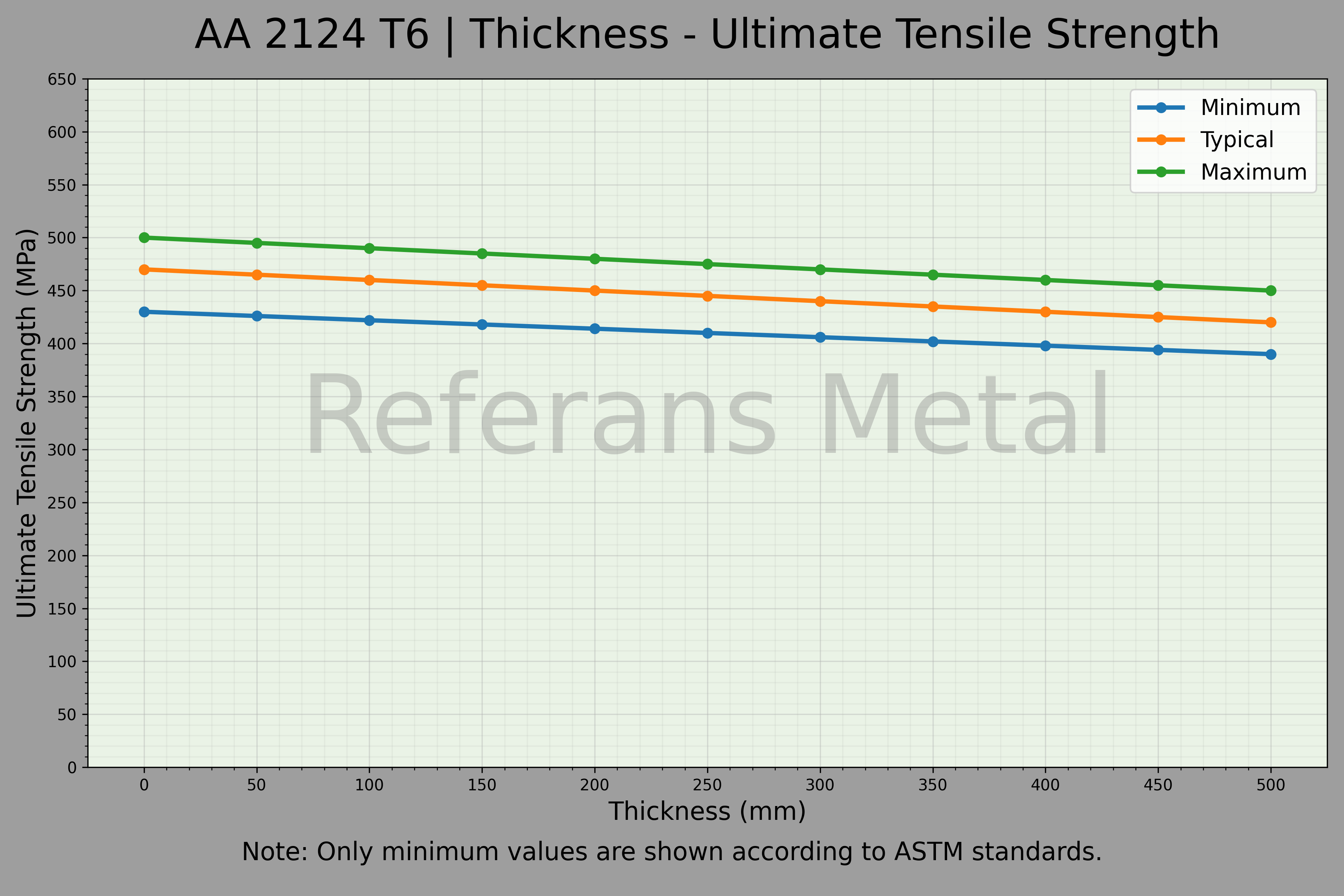
| 2124 T6 Thickness – Ultimate Tensile Strength Graph |
 |
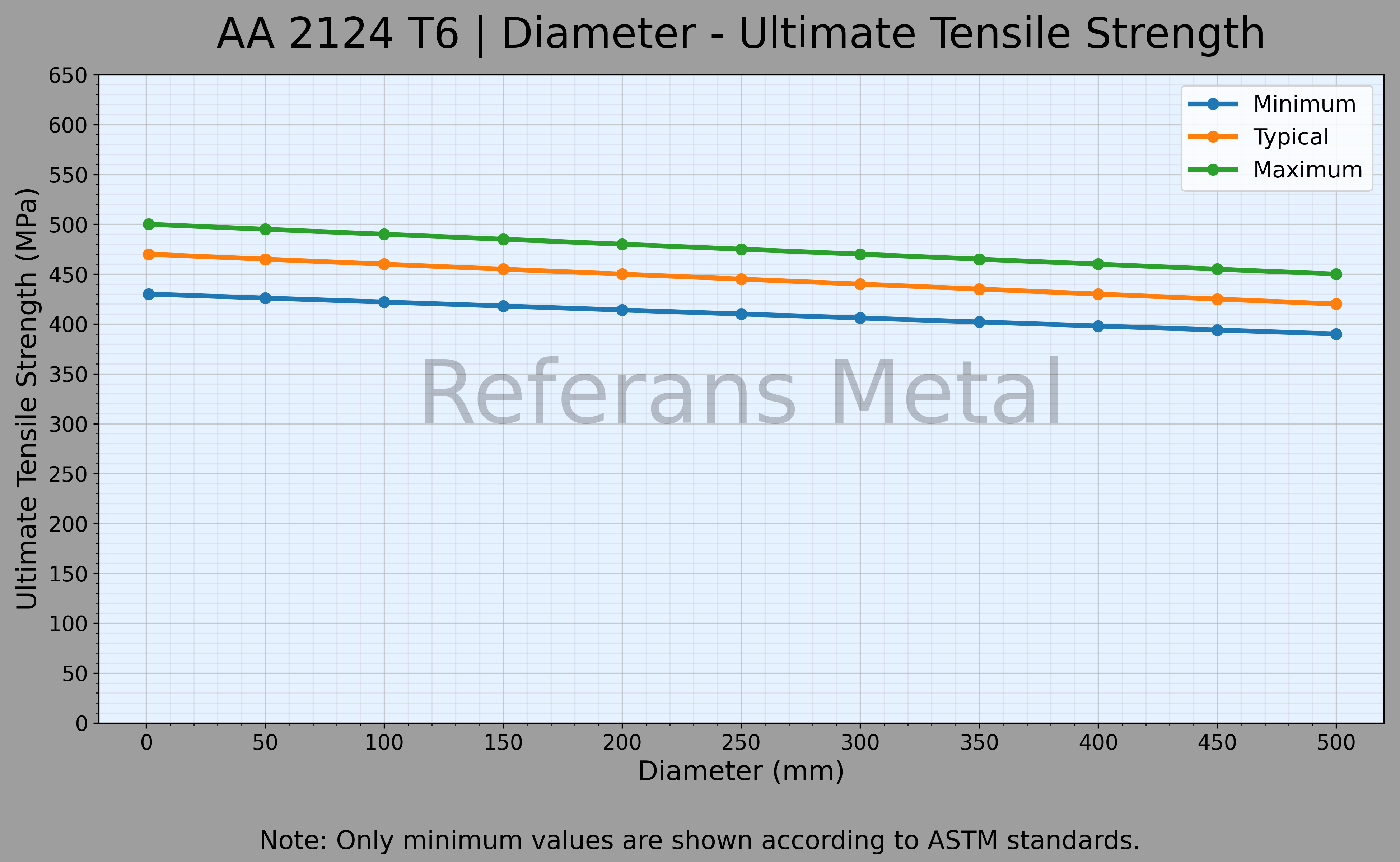
| 2124 T6 Diameter – Ultimate Tensile Strength Graph |
 |
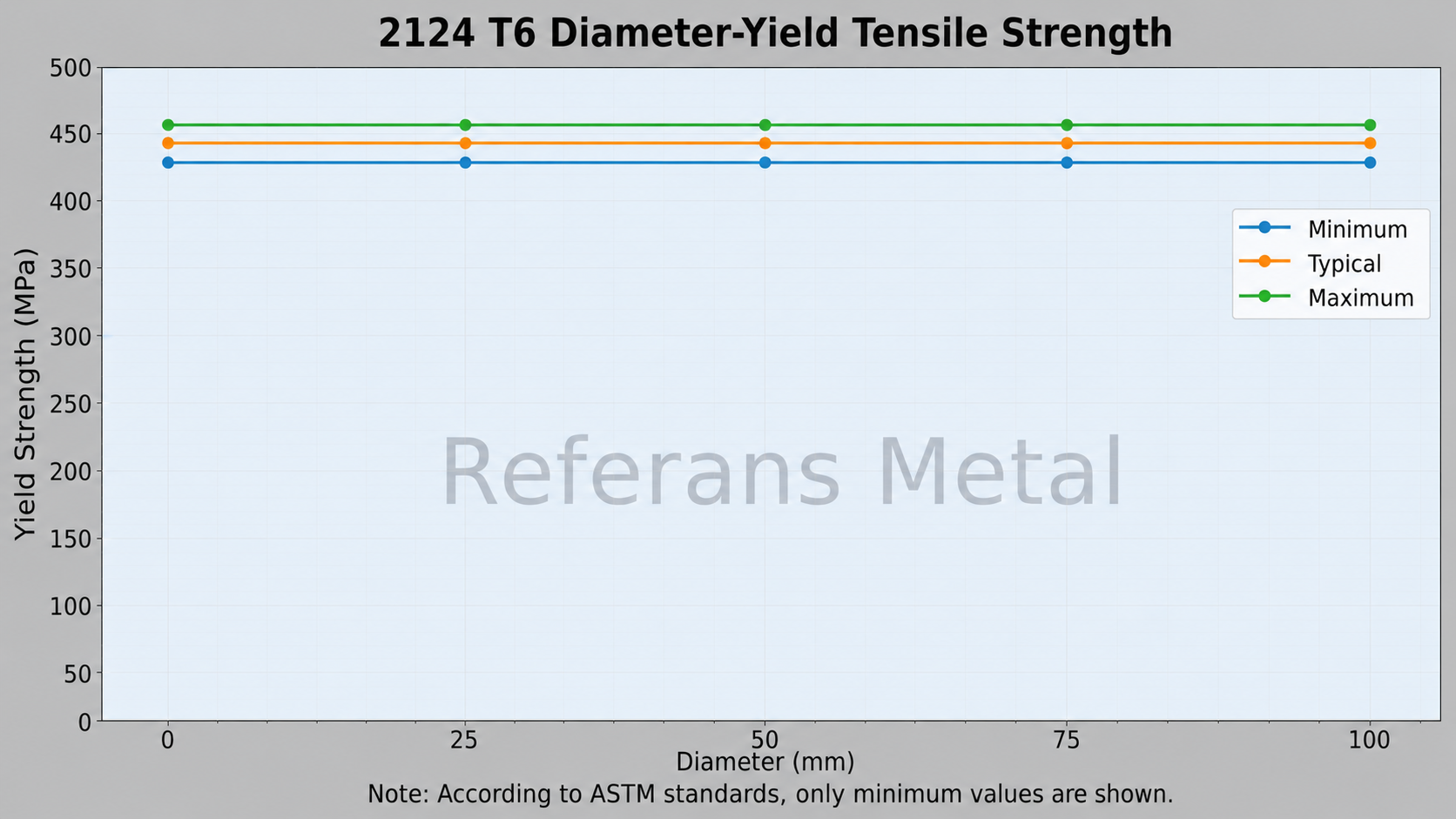
| 2124 T6 Diameter-Yield Tensile Strength |
 |
The 2124-T6 aluminum alloy is an Al-Cu-Mg series alloy specifically developed for applications requiring high strength and improved damage tolerance. It is widely preferred in the aerospace industry, offering better fatigue resistance and crack propagation performance compared to conventional 2024 alloy due to its fine grain structure. In terms of strength, 2124-T6 provides high yield and tensile strength, making it significantly stronger than 6061-T6. However, while it offers slightly lower strength than 7075-T6, it provides better damage tolerance and machinability advantages.
In terms of corrosion resistance, 2124-T6 does not naturally have high corrosion resistance due to its copper content and is typically supported by protective coatings or anodizing. In this respect, it performs worse than 5xxx series alloys such as 5083. However, its coating capability is excellent, and when used with alclad coatings, its environmental resistance is significantly improved. This coating method is widely used in aerospace applications and greatly extends the service life of the material.
Regarding machinability, 2124-T6 demonstrates very good performance and provides stable results in machining processes. This makes it suitable for producing complex geometries. However, its bending and forming properties are limited due to the T6 temper, and forming is usually performed in softer tempers followed by aging. Compared to 2024-T3, this means lower formability.
In terms of weldability, 2124-T6 performs poorly and welding is generally not recommended. This is a significant disadvantage compared to 6061, which has excellent weldability. Additionally, its vibration and fatigue behavior is very good due to its fine grain structure, making it suitable for dynamically loaded components such as aircraft structures. Although 7075 offers higher strength, it is less resistant to fatigue crack propagation compared to 2124.
Applications primarily include aerospace and defense industries, covering high-performance engineering uses. It is commonly used in wing structures, fuselage panels, fasteners, and load-bearing structural components. Compared to 2024, 6061, and 7075 alloys, 2124-T6 stands out by offering a balanced performance, particularly in critical applications requiring damage tolerance and fatigue resistance.
MATERIAL COMPOSITION STANDARDS
2124 T6 can be produced according to the following standards:
• 2124 T6 Cold Drawn Round Bar; ASTM B211, AMS 4339, UNS A92124
• 2124 T6 Cold Drawn Tube; AMS 4087, WW-T-700/3, ASTM B211, UNS A92124
Characteristic Properties of 2124 T6:
- Strength: High
- Machinability: Above Average
- Weldability: Moderate (Spot welding is preferred)
- Formability: Low
- Corrosion Resistance: Poor
- Heat Treatable: Yes
Well-Known Applications of 2124 T6:
Military vehicles,
Project-based aerospace applications,
Applications requiring high transverse rupture strength.
STOCK
2124 T6 is supplied in rod/flat bar and tube/profile forms.
- Rod / Flat Bar
- Tube / Profile
| Mechanical Properties | |||
| Thickness (mm) | Proof Strength (Min.) | Yield Strength (Min.) | Elongation A50 mm % |
| Over 38.1 up to & incl. 50.8 | 393 MPa | 455 MPa | %5 |
| Over 50,8 up to & incl. 76,2 | 393 MPa | 448 MPa | %4 |
| Over 76,2 up to & incl. 101,6 | 386 MPa | 448 MPa | %4 |
| Over 101,6 up to & incl. 127 | 379 MPa | 441 MPa | %4 |
| Over 127 up to & incl. 152,4 | 372 MPa | 434 MPa | %4 |
 Weight Calculator